Chainflip Vault Hack Drains $12.6M in BTC, ETH, and Stablecoins Crypto news today centers on the Chainflip vault hack, which Chainflip Labs detailed in Part 1 of its incident report on 23 Nov
Chainflip Vault Hack Drains $12.6M in BTC, ETH, and Stablecoins
Crypto news today centers on the Chainflip vault hack, which Chainflip Labs detailed in Part 1 of its incident report on 23 November 2026. On 21 November, an attacker took about $12.6 million from the protocol's Bitcoin and Ethereum vaults.
The transactions carried valid vault signatures that the network never requested. Chainflip says this was effectively the entire balance of both vaults, and swaps, deposits, and withdrawals remain paused.
The protocol's incident report lists the stolen assets below. The dollar total uses prices from the morning of 21 November.
Vault
Asset
Amount taken
Bitcoin
BTC
133.34425053 (two transactions)
Ethereum
ETH
520.2243399
Ethereum
USDC
3,249,631.41
Ethereum
USDT
758,141.33
The Bitcoin vault was hit twice: 122.86137042 BTC at 06:41 UTC and 10.48288011 BTC at 11:24 UTC. The Ethereum vault was emptied in a single transaction at 07:10 UTC.
How a Minimum Stake Gave the Attacker Access to Validators
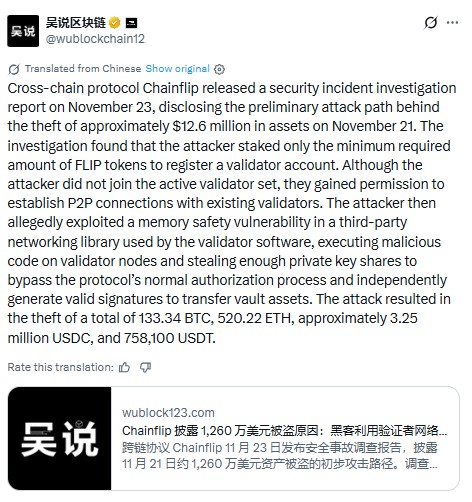
According to the report, the attacker registered a validator account with only the minimum stake, funded with 20,500 FLIP. The account never joined the active validator set. Registration alone was enough for existing validators to accept peer-to-peer (P2P) connections from it, since any new validator must be able to talk to current authorities before it can join.
The investigation indicates the attacker then exploited a memory-safety flaw, a coding error that lets outside input corrupt a program's memory, in a third-party networking library used by the validator software.
That allowed code to run on validator machines and extract stored key shares, the pieces of the vault key that validators hold. With enough shares, the attacker could sign vault transactions without the network. The team says the investigation is continuing and some steps are not yet fully confirmed.
WuBlockchain also summarized the report on X on 23 November.
Timeline: From Validator Signup to Network Safe Mode
The report shows a gap between the first theft and the first human response. An automated warning about the Bitcoin vault appeared at 06:49 UTC, but the report says that the monitor was still being tested and had produced false positives, so it did not trigger escalation.
A team member raised the alarm at 07:41 UTC. By our count, the first protocol responder came online about 71 minutes after the first Bitcoin transaction. Readers following the latest crypto updates can use this dated sequence (all times UTC):
Date and time
Event
20 Nov, 11:00
The attacker account registers as a validator.
21 Nov, 06:41
The first 122.86137042 BTC was taken.
21 Nov, 07:10
Ethereum vault drained
21 Nov, 08:21
First forced key rotation completes.
21 Nov, 08:31
Safe mode in place: swaps, deposits, and withdrawals paused.
21 Nov, 10:00
Governance multisig suspends the Ethereum vault contract.
21 Nov, 11:24
The remaining 10.48288011 BTC was taken.
21 Nov, 17:06
Patched release sent to validators
22 Nov, 11:24
The second key rotation completes.
23 Nov, 11:31
Every active validator runs the patched release.
On the Ethereum side, the report says the attacker swapped the USDC and USDT for ETH and deposited 2,909 ETH into Tornado Cash between 07:12 and 07:19 UTC. The report adds that the remaining Bitcoin was still reachable through the stolen key at the second transaction. Our earlier Ethereum vault drain story ran before any official statement.
Chainflip Vault Hack Recovery: Bounty, Tracing, and Status
In the Chainflip vault hack recovery effort, Chainflip Labs published a message to the attacker offering a 10% bounty. The attacker was asked to return 110.57523337 BTC and 2,618.1 ETH by 18:38 UTC on 23 November 2026.
In return, it said it would treat the return as a white-hat recovery and withdraw its reports and complaints to law enforcement. That deadline has passed, and the pages checked on 24 November did not report an outcome.
The report says that as of 17:18 CET on 23 November (16:18 UTC), the stolen Bitcoin had not moved from its two receiving addresses, which held 122.86136932 BTC and 10.48283731 BTC. The Ethereum-side funds went to Tornado Cash, and demixing efforts will continue if assets leave the mixer.
The team says it is working with law enforcement and has engaged ZeroShadow for tracing. It also found metadata the attacker left behind that could help identify them, and the addresses are flagged with analytics firms.
What Users and Liquidity Providers Should Watch Next
Swaps, deposits, and withdrawals stay paused. As a precaution, the team returned free liquidity provider (LP) balances on unaffected chains to refund addresses on Solana, Arbitrum, Tron, BNB Chain, and Polkadot Asset Hub. LPs can check their balances in the LP portfolio. Open lending, strategy, and range-order positions may still hold assets in the account.
A further update on the investigation, the recovery plan, and how affected users will be treated is still pending, along with a full count of losses. The project says it is confident it can return to service if active LPs are recapitalized through incentives and financing, noting that only a fraction of the old vault balances is needed for normal service.
Readers should rely on the official blog and status page for updates, as figures and recovery terms may change.
Disclaimer: This article is for educational and informational purposes only and should not be considered financial or investment advice. Always conduct your own research before making investment decisions.