Chainlink costs 10.42 dollars and has lost 11.47 percent within 24 hours. Bitcoin gave up 5.15 percent over the same period. The reason for that gap does not lie with Chainlink itself: an une
Chainlink costs 10.42 dollars and has lost 11.47 percent within 24 hours. Bitcoin gave up 5.15 percent over the same period. The reason for that gap does not lie with Chainlink itself: an unexplained movement of balances at the exchange Binance set off a wave of forced closures of leveraged positions on the evening of 29 October, and in waves like that mid-sized coins regularly fall twice as far as Bitcoin. For holders of Chainlink, that means the slide is part of a market move, while October's fundamental news points the other way.
Chainlink trades at 10.42 dollars, down 11.47 percent against the previous day. Over the week the decline stands at 10.96 percent. That puts LINK in 17th place among the largest cryptocurrencies by market value.
For comparison, the moves of the larger assets over the same window: Bitcoin lost 5.15 percent to 76,931 dollars, Ether 6.25 percent to 2,207.06 dollars. BNB, Binance's exchange token, fell 8.84 percent, XRP 8.03 percent, Solana 7.93 percent to 93.80 dollars. Cardano gave up 9.62 percent, and NEAR Protocol was the weakest in the field of the 25 largest coins at 15.52 percent. Only Hyperliquid at 12.26 percent, TRON at 7.98 percent and Monero at 3.26 percent moved higher.
Taken over the whole of October, Chainlink is down around 21 percent according to several market reports. The month has therefore run much weaker for LINK than for Bitcoin, and the drop of this night extends a move that has been under way for weeks.
Altcoins in a sell-down: beta and liquidity decide how far a coin falls
That a coin like Chainlink falls further than Bitcoin in a sell-down has two traceable causes, and neither has anything to do with the project.
The first is beta. The term describes how strongly an asset reacts to the movement of the overall market: a beta above one means the coin amplifies the market move, upwards as well as downwards. Most altcoins sit permanently above one, because in selling phases investors first shed the assets they regard as riskier, and in buying phases they look for the greater upside there.
The second cause is market depth. That means how many buy and sell orders sit close to the current price in the order book. For Bitcoin, the amounts there run into the billions; for a coin in 17th place, considerably less. A selling wave of the same size therefore pushes the price further down. Both effects work together, and in the night of 30 October a third was added: leverage.
The trigger: unexplained outflows at Binance
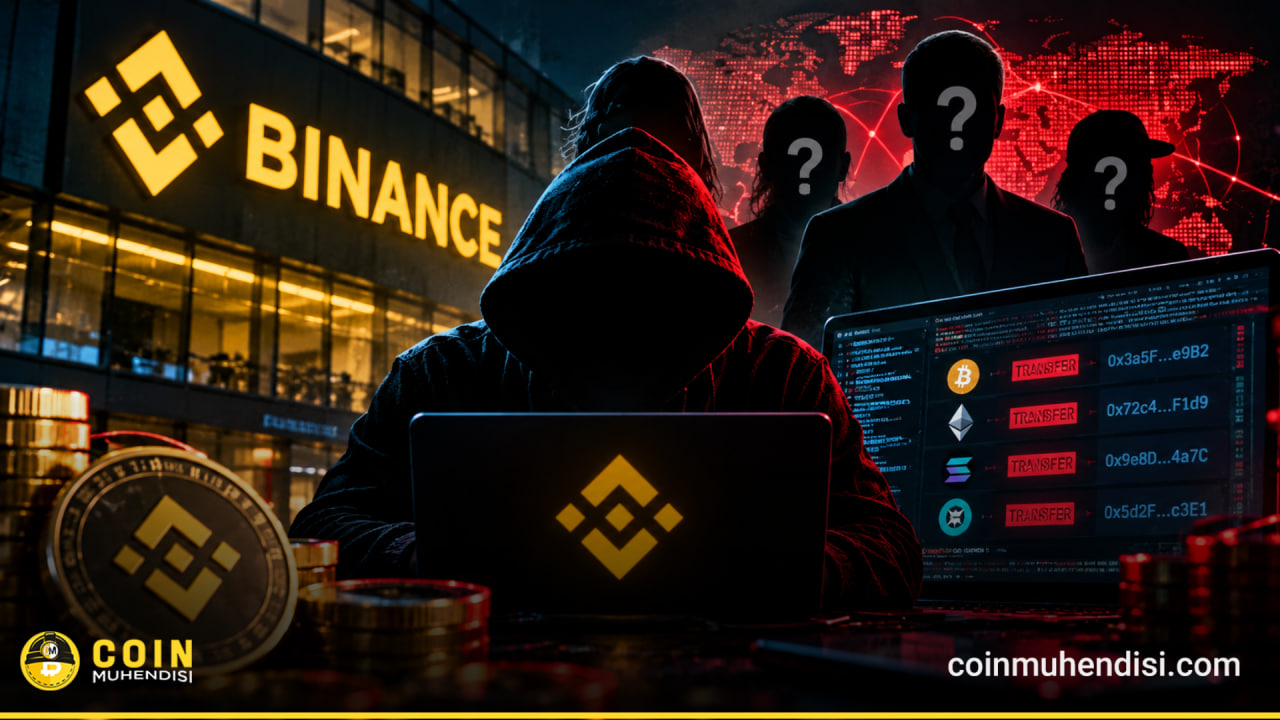
On the evening of 29 October, according to several market observers, balances running into the billions left a hot wallet attributed to Binance. A hot wallet is a wallet that is permanently connected to the internet and handles an exchange's day-to-day business, in contrast to a cold wallet, which is kept offline. Reports put the movement in the region of 2.8 billion dollars.
At this point precision matters more than speed: a loss of customer funds is not confirmed. Binance itself had said on 27 October that it had repelled several cyberattacks, without funds flowing out and without a breach succeeding. For the movements of 29 October, no conclusive account from the exchange is available so far, and a forensic analysis of the transactions is not publicly accessible. What moved the market, then, was uncertainty in the first instance, not an established loss. cryptoticker.io set out the chronology of the evening on 29 October in a timeline of its own.
A further factor in price formation was that Binance temporarily suspended withdrawals for individual networks. When balances on an exchange cannot be moved for a time, market participants sell where they can act, and that adds to the pressure on prices.

Once the price drops below the collateral threshold of a leveraged position, one forced closure sets off the next.
590 to 628 million dollars of liquidations in one hour
The actual push downwards came from forced closures. A liquidation is the automatic unwinding of a leveraged position by the exchange as soon as the collateral posted no longer covers the loss. That unwinding is itself a sale. If the price falls further, it reaches the threshold of the next position, and a chain reaction begins.
Figures for the size of this wave diverge. For the peak hour, market reports cite between 590 and 628 million dollars of positions unwound, mostly bets on rising prices. For the full day, the range of reported sums runs from 356 to 834 million dollars. These differences come down to the measurement: the data providers cover different exchanges and in some cases report only one position per unwinding event. Continuously updated totals are published by CoinGlass.
Anyone reading a figure like that should keep one thing in view: liquidations are an amplifier, not a cause. They explain why a price loses ten percent in an hour, and they do not explain why it falls for a month.
18 days of net outflows: what exchange balances say about LINK
Alongside the falling price, a movement is running at Chainlink that does not fit the picture at first sight. According to analyses of exchange flow data, LINK left the exchange Binance on a net basis for 18 trading days in a row, most recently on the order of around 280,200 tokens. Net means more was withdrawn than paid in. Individual analyses point out explicitly that this value is the latest reading and not the sum of all 18 days. Over the four days to 20 October, cryptoticker.io had reported an outflow of 246,800 LINK.
An outflow like that is usually read as a sign that holders are taking their coins into their own custody instead of leaving them ready to sell on the exchange. That reading has to be handled with care here, for a concrete reason: the withdrawal was preceded by a large inflow, which analysts put at about 8.7 million LINK. Part of the later outflows may therefore simply be the distribution of that deposit. Data from CryptoQuant shows balances across all exchanges back at around 124.2 million LINK, close to the level before the inflow. A figure showing outflows is no proof that new buyers have stepped in.
The movement did have one practical side effect on this night: anyone who pulled their tokens off the exchange over recent weeks was not affected by the temporary suspension of withdrawals.
Chainlink CustodySync and the reserve: the fundamentals in October
October was an active month for the project behind LINK, which explains the gap between the price and the news. On 26 October, Chainlink presented CustodySync, a service that lets licensed custodians give their institutional clients access to lending markets in decentralised finance without the assets leaving custody. Chainlink names Anchorage Digital Bank as the launch partner. The custody system remains authoritative for the holdings, the price data for the loan-to-value ratio comes from Chainlink, and a named collateral agent handles the unwinding in the event of a loss. Chainlink relates the announcement to around 700 billion dollars of digital assets under custody, by its own account less than 0.5 percent of the traditional custody market. cryptoticker.io wrote up what the service means for investors in detail on 28 October.
Added to that is the Chainlink Reserve, a holding into which the project transfers revenue from its services. Figures for it range between about 6.05 and 6.29 million LINK depending on the date of measurement. This is not a number that decides the current price: the reserve is small relative to the circulating supply.
This placement belongs to the picture: product announcements and institutional partnerships rarely move a price within days. They take effect when measurable demand for the token comes out of them, and for CustodySync that evidence is still outstanding.
Spot ETFs on LINK: eight sessions without a net inflow
A look at the funds completes the picture. According to market reports, the spot funds on Chainlink recorded neither net inflows nor net outflows for eight trading days in a row. For the price, that is the more awkward kind of standstill: a fund reporting inflows has to buy tokens in the market and thereby creates demand. If it stays flat, that buyer drops out.
For investors in Germany, one distinction matters here. The spot funds licensed in the United States are generally not tradable here. Anyone looking for regulated access via an exchange usually finds it in the form of an ETN, a debt security on the price, traded on Xetra for example. An ETN is legally not a fund unit but a claim against the issuer, and therefore carries that issuer's default risk. It is usually backed by coins deposited against it.

Anyone holding their coins in their own custody is untouched by an exchange suspending withdrawals.
Own custody instead of an exchange account: why the seed phrase counts
The night has put a question back on the table that applies regardless of Chainlink: where do your own coins sit. Balances on an exchange are a claim against that exchange, not direct ownership. Anyone transferring the coins into their own wallet holds them themselves, and carries full responsibility for securing them.
The seed phrase is the decisive point here. It is a sequence of usually twelve or 24 words from which all the private keys of a wallet can be restored. Whoever holds it controls the balance, regardless of the device. It therefore belongs on paper or metal and never in a photo gallery, a cloud store or a chat. A hardware wallet keeps the private key in a dedicated chip that does not release it, and allows transfers only after confirmation on the device.
The other side belongs to the assessment: self-custody rules out the exchange's error and rules in your own. A lost access is final; there is no body that resets a password. Which route suits whom depends on the amount and on trading frequency, not on one evening's news.
Buying route in Germany: MiCA licence, holding period and spread
Anyone wanting to buy or sell Chainlink in Germany sensibly checks three things, and two of them are regularly overlooked.
First, the licence. Since the EU regulation on markets in crypto-assets, MiCA for short, providers need a permission for crypto services in the EU; for German customers, BaFin runs the supervision. Whether a provider is licensed can be looked up in the supervisor's public registers, and that is the first step before a deposit. An overview of the venues available in Germany including fees is set out in the comparison of crypto exchanges.
Second, the costs. Alongside the stated fee, the spread counts, meaning the gap between the buy and sell price. In volatile phases like this night that gap widens, because fewer orders sit close to the price. With a coin in 17th place that stands out more than with Bitcoin. A limit order, an order with a set maximum or minimum price, protects against being filled at a price you have not seen.
Third, tax. In Germany, cryptocurrencies count as other economic assets. A gain from a sale within one year of purchase is taxable; after a holding period of one year it stays tax-free. Below the exemption limit of 1,000 euros in a calendar year, gains from private sales within the period remain untaxed; once it is exceeded, the entire amount is taxable. For the tax bill, the date of sale therefore counts alongside the selling price.
Leverage and liquidation price: in the EU there is no additional margin call
This night's liquidation wave hit leveraged positions. Anyone trading with leverage deploys more capital than they have posted; the difference is borrowed. The liquidation price is the price at which the collateral posted is used up and the position is closed automatically. With a coin showing double-digit daily moves, that price sits closer to the current price than many allow for.
Two points are concrete for investors in Germany. First, with providers serving retail clients under EU supervision there is no obligation to post more than the margin. The loss is limited to the capital deployed, and no claim can arise beyond the account. Second, a stop order does not replace that protection. It triggers a sale at the next price available, and in a chain reaction that price can sit well below the level set. Anyone using derivatives compares the fees and the funding costs beforehand, for example in the overview of the best perp DEXs.
For the great majority of readers, the sober finding stands: leverage produced the fall of this night. Without it, a price decline of ten percent is uncomfortable and nothing more.
Which levels carry Chainlink now: 10.35 and 11.36 dollars
On the downside, technical analyses name two areas. One level sits at 10.66 dollars and was already broken during this night, the next at 10.35 dollars. If that area does not hold, the chart shows no further pronounced zone where buyers have been found over recent months until single-digit prices.
On the upside, the first task is a return above the area around 11.36 to 11.48 dollars, where LINK traded after the CustodySync launch at the end of October. Only above that does the recovery become more than a counter-move within a downtrend.
These levels are orientation, not a forecast. They say where supply and demand have met in the past, and not what the price will do.
Chainlink below 11 dollars: without fresh inflows there is no floor
The situation at month-end can be summed up briefly. The drop of this night is market-driven and amplified by leverage; the trigger lies with an exchange and not with Chainlink. The fundamental side gained ground in October, without measurable demand for the token coming out of it so far. For as long as the funds stay flat and the market has not placed the Binance incident conclusively, the price lacks the buyer who carries a recovery.
Three steps that make sense regardless:
- Check the venue. Look at whether your provider holds a MiCA permission for the EU and how wide its spread on LINK is in this phase. The comparison of crypto exchanges sets fees and licensing side by side.
- Settle custody. Decide for your own holdings what stays on the exchange and what goes into your own wallet, and secure the seed phrase offline. Which devices differ for that is shown by the hardware wallet comparison.
- Record purchase data. Note the date and price for every position, so that the one-year window and the exemption limit of 1,000 euros stay verifiable. The crypto tax tools handle that automatically.
(As of October 30, 2026. This article is not investment advice. Prices and fee structures change; check the terms with the provider before you buy.)