Key Facts, At a Glance Circle renewed its USDC distribution agreement with Coinbase on unchanged terms, per Circle's Q2 2026 earnings release. The Circle Coinbase USDC deal renewal came along
Key Facts, At a Glance
Circle renewed its USDC distribution agreement with Coinbase on unchanged terms, per Circle's Q2 2026 earnings release. The Circle Coinbase USDC deal renewal came alongside a clear signal on capital returns
Q2 revenue and reserve income: $701.3 million, up 7% year-over-year, below the ~$717M analyst consensus
USDC circulation:$73.3 billion, up 19% year-over-year but down from $77 billion in Q1 (sequential decline)
CRCL stock: trading near $61.88 today, down roughly 44% over the past three months
Arc Mainnet: launch confirmed for September 16, 2026
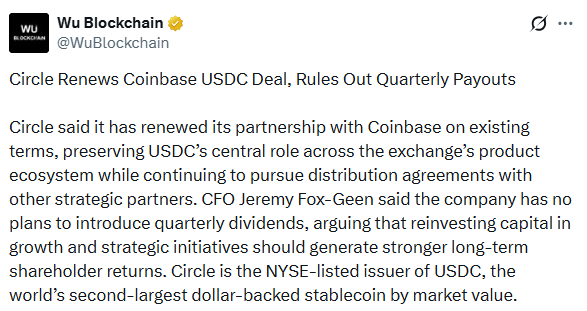
Circle confirmed it has renewed its distribution partnership with Coinbase on existing terms, preserving USDC's role across the exchange's products. The announcement came inside Circle'sQ2 2026 earnings release, published August 5. Circle CFO Jeremy Fox-Geen also confirmed the company has no plans to introduce quarterly dividends, saying reinvested capital is expected to generate stronger long-term shareholder returns than direct payouts. This article separates what changed (the earnings numbers, the stock reaction) from what didn't (the Coinbase terms themselves), and explains why those two threads are being reported together.
Glossary, for readers new to these terms:Reserve return rate is the yield Circle earns on the cash and Treasuries backing USDC. Adjusted EBITDA is operating profit before certain non-cash and one-time costs. A basis point is 1/100th of a percentage point. A death cross is a technical chart pattern where a stock's short-term moving average falls below its long-term moving average, often read as a bearish signal.
Circle Coinbase USDC Deal: What Was Renewed
Per Circle's statement, the renewed Coinbase agreement keeps USDC integrated across Coinbase's existing product suite. Circle said it continues to pursue separate distribution partnerships with other strategic partners. Circle did not disclose the specific revenue-sharing terms of the Coinbase agreement in its earnings release, and no separate joint announcement from Coinbase confirming the renewal was located as of publication — this article's account of the terms relies on Circle's own characterization.
 Source: X(formerly Twitter)
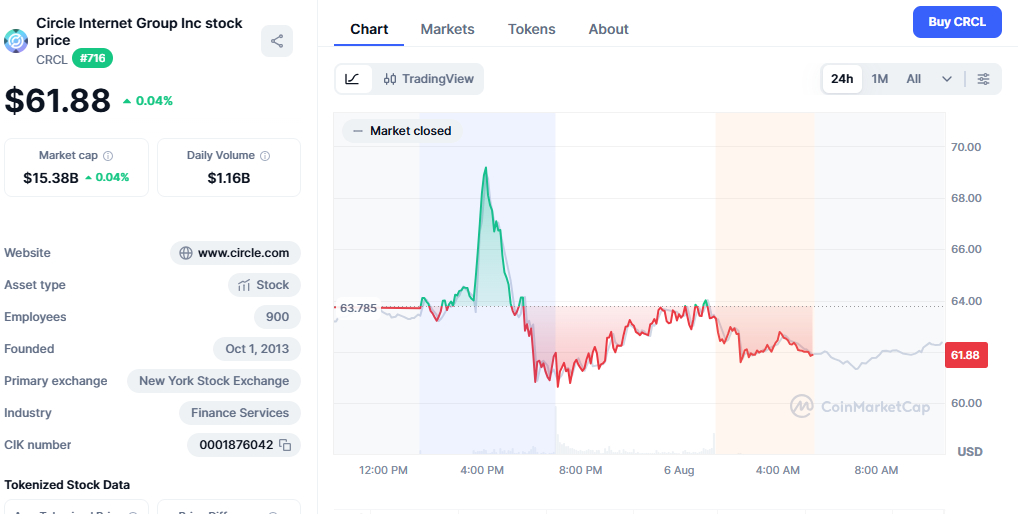
Circle is the NYSE-listed issuer of USDC, the world's second-largest dollar-backed stablecoin by market value, trading under ticker CRCL. As of 10:00 AM ET today, per CoinMarketCap data, CRCL traded at approximately $61.88, up 0.04% on the day, with a market cap near $15.38 billion and daily trading volume of roughly $1.16 billion.
Circle Q2 2026 Earnings: Results vs. Q1 at a Glance
Metric
Q1 2026
Q2 2026
Change
Revenue & reserve income
Not separately restated here
$701.3 million
+7% YoY
USDC circulation
$77.0 billion
$73.3 billion
−4.8% sequentially
On-chain transaction volume (quarterly)
Higher base quarter
$14.8 trillion (up 151% YoY)
−31% sequentially
Adjusted EBITDA
—
$143 million (~50% margin)
+8% YoY; margin down 329 bps YoY
Reserve return rate
Higher
3.5%
−66 basis points
Net income
−$482.1 million (year-ago loss)
$48.2 million
Swing of ~$530 million
Earnings per share came in at $0.18–$0.19 (reporting varies slightly by source), beating consensus estimates. Circle also disclosed forward-looking milestones: its Arc blockchain mainnet is confirmed for a September 16, 2026 launch, with founding validators including BlackRock, DTCC, Mastercard, Visa, Standard Chartered, Galaxy, ICE, Global Payments, MoneyGram, SBI Group, and Sumitomo Corporation.
BlackRock is expected to deploy its BUIDL fund — a tokenized money market fund — on Arc, while DTCC plans to tokenize DTC-custodied assets on the network. Circle also said it received a federal trust bank charter from the Office of the Comptroller of the Currency (OCC), allowing it to operate under direct federal banking oversight. Full-year guidance for "other revenue" was raised to $310–$330 million, up from a prior $150–$170 million range.
 Cicle Q2 earnings
Why CRCL Stock Fell Despite Beating Estimates
Despite the earnings beat, CRCL shares came under renewed analyst pressure. Mizuho reportedly maintained an Underperform rating and $45 price target, citing the sequential USDC decline, the 31% sequential drop in on-chain transaction volume, and the 329-basis-point year-over-year fall in adjusted EBITDA margin as evidence that underlying trends are softer than the headline numbers suggest. This characterization is drawn from market coverage citing Mizuho's research; readers should treat it as reported analyst commentary rather than Circle's own framing, and verify directly against the original research note where possible.
 Source: CoinMarketCap Data
A separate Morgan Stanley downgrade earlier in the week reportedly cut its CRCL price target to $38 from $106, citing slower USDC growth, rising competition from tokenized money market funds, and the increasing cost of defending USDC's market share against rivals like Open USD. CRCL has fallen roughly 44% over the past three months and trades below both its 20-day and 50-day moving averages, with a bearish death cross pattern that formed in June. Analysts cited in market coverage point to $73 as a resistance zone where prior rebounds have stalled, $58.50 as near-term support, and $49.90 as the stock's 52-week low. These are technical reference points, not price predictions, and shouldn't be read as guidance on future performance.
What This Means for USDC Holders and Coinbase Users
For everyday Coinbase users, the renewal means no near-term change: USDC continues to function exactly as it does today across Coinbase's products, with no new fees, restrictions, or product changes disclosed. The more consequential story sits underneath the renewal. Circle's core revenue model depends on the spread between what it earns on reserves (the reserve return rate) and what it spends on distribution deals like the Coinbase partnership.
When USDC circulation shrinks and reserve yields fall simultaneously — both of which happened this quarter — that spread compresses from both directions at once, which is the specific mechanism analysts are pointing to when they call Circle's reserve-income model "rate and partner sensitive." Arc and the Circle Payments Network are Circle's stated answer to that dependency, but per Circle's own disclosures, Arc's mainnet hasn't launched yet and most of its projected revenue contribution is still ahead rather than realized.
Conclusion
Circle's Q2 2026 results show real year-over-year growth in revenue, USDC circulation, and transaction volume, alongside a renewed Coinbase distribution deal and two significant regulatory and infrastructure milestones. Set against that: USDC circulation and transaction volume both declined quarter-over-quarter, and the reserve yield Circle depends on for revenue continues to compress — a combination that explains why the stock fell on a quarter that beat earnings estimates.
Disclaimer
This article is for informational purposes only and does not constitute financial or investment advice. Figures are based on Circle's official Q2 2026 earnings release; analyst commentary attributed to Mizuho and Morgan Stanley is drawn from secondary market coverage and has not been independently verified against the original research notes. Stock prices, technical levels, and analyst price targets are time-sensitive and were current as of August 6, 2026, 10:00 AM ET. Always verify current figures through Circle's official filings and consult a qualified financial advisor before making investment decisions.