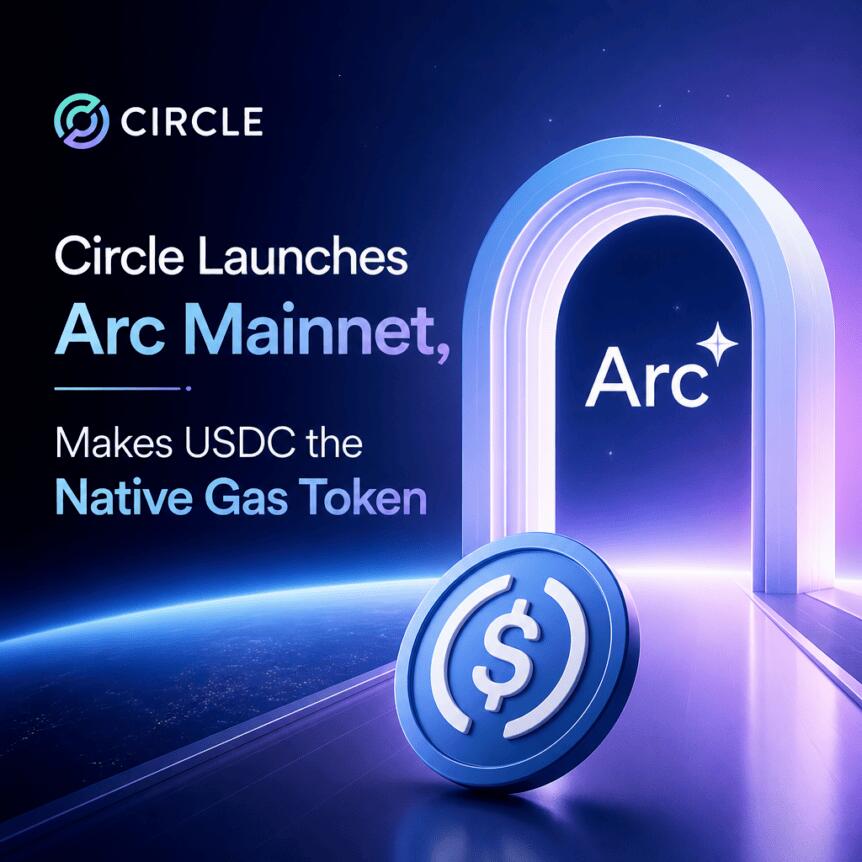
Circle has officially launched the mainnet of Arc, a new layer-1 blockchain designed around stablecoin payments and financial-market use cases—especially transactions driven by automation and
Circle has officially launched the mainnet of Arc, a new layer-1 blockchain designed around stablecoin payments and financial-market use cases—especially transactions driven by automation and “agentic” systems. The USDC issuer says Arc is built to make stablecoin-based value transfer more predictable for developers and institutions, positioning the network as infrastructure for programmable money.
According to an Arc blog post published this week, the network uses USDC as its native gas asset and offers Ethereum Virtual Machine (EVM) compatibility along with deterministic sub-second settlement finality. Arc also supports more than 20 fiat stablecoins, including USDC and EURC, and provides native access to tokenized assets such as BlackRock’s BUIDL and Circle’s USYC.
Key takeaways
- Arc mainnet launches as Circle’s new stablecoin-focused layer-1, with USDC as the network’s gas asset.
- The chain is EVM-compatible and targets deterministic sub-second settlement finality, aiming to reduce settlement uncertainty.
- Arc supports more than 20 fiat stablecoins and offers native availability for tokenized assets including BUIDL and USYC.
- Interoperability is a core feature via Circle’s Cross-Chain Transfer Protocol (CCTP) and Gateway, covering connections to more than 20 blockchains.
- Circle says it has completed a 10 billion ARC token genesis mint, but that mint is not presented as a commitment to a public token launch.
A stablecoin-native L1 built for fast, predictable settlement
Circle’s framing of Arc emphasizes reliability in stablecoin settlement rather than generalized crypto trading. In its announcement, Circle highlighted Arc’s “economic operating system” concept, describing the network as stablecoin-native infrastructure intended for developers and institutions building applications that rely on programmable money and global market rails.
Arc’s mainnet technical pitch centers on deterministic sub-second settlement finality—an attribute that can matter for payment flows, automated treasury operations, and on-chain programs where timing and outcome consistency are critical. In practice, “deterministic” finality is meant to give users more certainty about when transfers reach an irreversible end state, which is especially relevant for chained transactions executed by software agents.
USDC as gas and broad stablecoin support
Arc’s design keeps USDC at the center of day-to-day network activity. The chain uses USDC as the native gas asset, which can streamline liquidity expectations for stablecoin-first applications and reduce friction for teams that already build around Circle’s stablecoin ecosystem.
Arc also supports more than 20 fiat stablecoins, including USDC, EURC, JPYC, KRW1, and TRYB. Circle’s goal appears to be creating an execution environment where multi-currency stablecoin payments don’t require users to treat each asset as a separate integration problem.
On the asset side, Arc says tokenized financial products are available natively on the network. The list includes BlackRock’s BUIDL and Circle’s USYC, signaling Circle’s intent to connect stablecoin payment rails with tokenized real-world assets that can be transferred and used as on-chain value.
Interoperability via CCTP and Gateway
Rather than treating Arc as an isolated chain, Circle positions interoperability as one of its primary benefits. Arc states it can interoperate with more than 20 blockchains through Circle’s Cross-Chain Transfer Protocol (CCTP) and Gateway.
For investors and builders, this is a meaningful distinction: stablecoin payment networks often live or die by how easily value can move across ecosystems. By leaning on existing Circle interoperability tooling, Arc aims to reduce migration friction for applications that already rely on CCTP-style transfers or cross-chain stablecoin flows.
From testnet momentum to mainnet—and what’s next for ARC tokens
Circle’s Arc launch follows a public testnet debut in October 2025. At that time, Circle said more than 100 companies participated, naming firms including BlackRock, Goldman Sachs, Mastercard, and Visa. Circle later added more context in August, stating that over 100 institutional and ecosystem builders had taken part in Arc’s private mainnet ahead of the planned public launch.
Circle CEO Jeremy Allaire called Arc “the single most significant launch in Circle’s history since USDC itself.” In parallel, Circle also described Arc on X as infrastructure built for “programmable money, global markets, and agentic economic activity.”
Arc’s roadmap also includes potential changes to its network governance and security model. Circle said the project ultimately intends to broaden participation in network operations and explore a transition from Proof of Authority to Proof of Stake in 2027.
Separately, Circle said it completed the genesis mint of 10 billion ARC tokens this week. The company emphasized that the mint does not represent a commitment to launch the token publicly. That distinction matters for readers trying to assess whether the network is preparing for a future token distribution or whether ARC tokens are currently limited to technical or internal parameters.
With Arc now live, the immediate question for market participants is how quickly developers and institutions will migrate real payment and settlement flows to the new stablecoin-native L1—especially those relying on predictable finality and agent-driven execution. The remaining uncertainty is whether Arc’s planned shift toward Proof of Stake will arrive on the expected timeline, and whether the genesis-minted ARC supply will later translate into a public token offering.
This article was originally published as Circle Launches Arc Mainnet, Makes USDC the Native Gas Token on Crypto Breaking News – your trusted source for crypto news, Bitcoin news, and blockchain updates.