CLARITY Act is emerging as a key focus in Washington’s ongoing debate over how digital asset markets should be structured and enforced. The legislation has gained fresh momentum after a coord
CLARITY Act is emerging as a key focus in Washington’s ongoing debate over how digital asset markets should be structured and enforced. The legislation has gained fresh momentum after a coordinated push from former U.S. national security and law enforcement officials urging the Senate to move forward without delay.
A 22-page letter published on June 2, 2026, by the Blockchain Association brought together 160 former senior officials from across federal enforcement and intelligence agencies. The development has added pressure on lawmakers as the bill advances toward an early July 2026 decision window.
What does the CLARITY Act mean for enforcement and oversight structure?
The CLARITY Act is being presented by supporters as a framework aimed at strengthening oversight of digital asset markets rather than weakening enforcement authority. Former officials argue that clearer federal rules improve visibility into crypto transactions by bringing activity into regulated financial channels where it can be monitored more effectively.
CLARITY Act Draws Support From 160 Former Law Enforcement and Intelligence Officials 5
The coalition behind the letter includes former IRS Criminal Investigation leadership such as James Lee, former FinCEN digital currency advisor Michele Korver, and former DOJ Asset Forfeiture Chief Jai Ramaswamy. They argue that structured oversight improves the ability of agencies to trace illicit financial flows and respond to cross-border financial crime.
Supporters say CLARITY Act improves coordination between key agencies including the DOJ, FBI, Treasury, FinCEN, and IRS Criminal Investigation units. They also argue that fragmented oversight has historically created gaps that make digital asset investigations more difficult, especially when funds move through offshore or opaque systems.
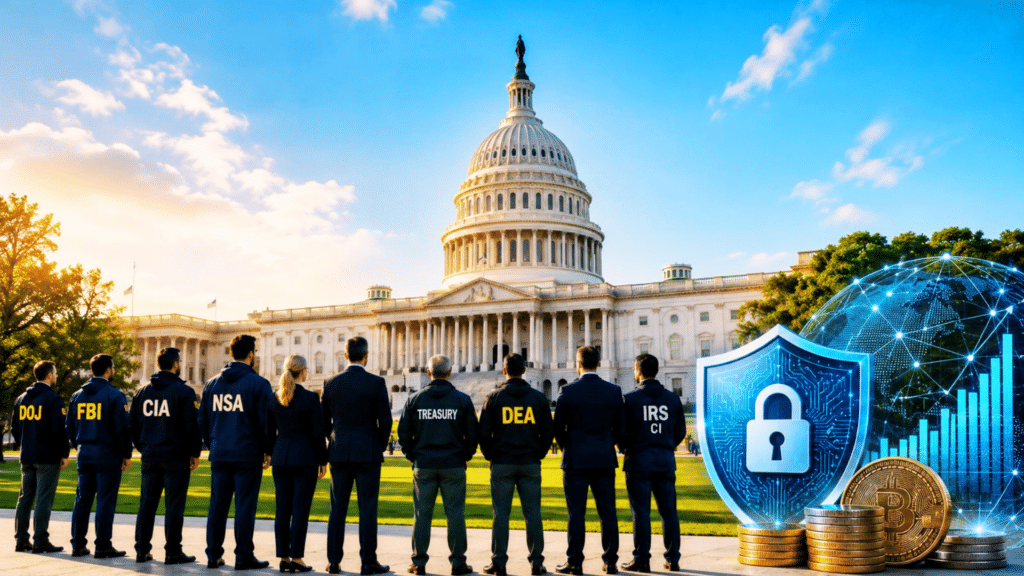
CLARITY Act has received support from 160 former senior officials across agencies including the DOJ, FBI, CIA, NSA, Treasury, DEA, and IRS Criminal Investigation. The coalition argues that the legislation strengthens national security by improving enforcement visibility across digital financial systems.
In their view, clearer rules reduce the likelihood of illicit activity shifting into unregulated offshore environments where investigative access becomes limited. They also argue that improved coordination between agencies and private sector compliance systems enhances the ability to detect fraud, money laundering, and sanctions violations.
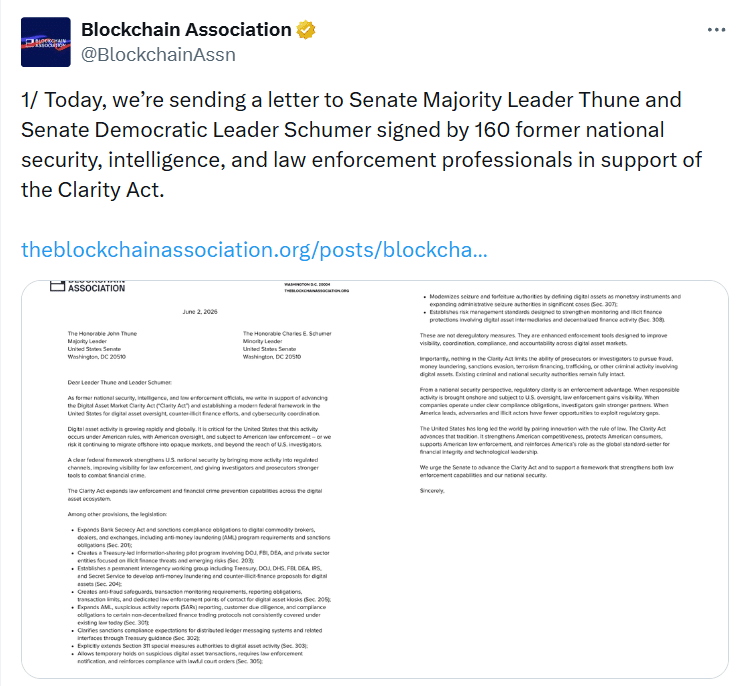
The Blockchain Association stated on X that it had sent a letter to Senate Majority Leader John Thune and Senate Democratic Leader Chuck Schumer, noting that 160 former national security and law enforcement officials supported the push for the Act and urged the Senate to take immediate action.
CLARITY Act Draws Support From 160 Former Law Enforcement and Intelligence Officials 6
What do supporters say about enforcement priorities in the legislation?
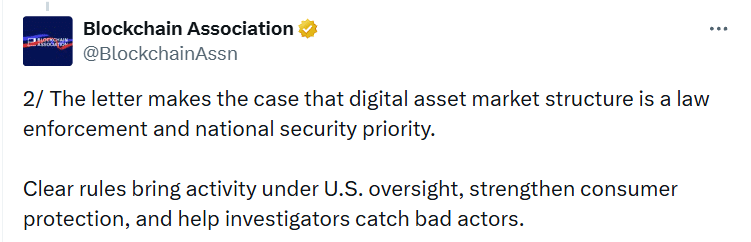
Supporters describe CLARITY Act as an enforcement-strengthening measure that expands tools for detecting and preventing financial crime in digital markets. The X post from the Blockchain Association stated that “clear rules bring activity under U.S. oversight, strengthen consumer protection, and help investigators catch bad actors,” reinforcing its enforcement-focused framing.
That statement reflects the wider view among supporters that the Act would improve transparency, reinforce compliance systems, and increase accountability across the digital asset space. From this perspective, the legislation is not aimed at reducing oversight but at making enforcement more structured, consistent, and operationally effective.
CLARITY Act Draws Support From 160 Former Law Enforcement and Intelligence Officials 7
What enforcement provisions are included in the Act?
CLARITY Act introduces several enforcement-oriented provisions highlighted by the signatories as central to its impact on financial crime prevention. Section 201 expands the Bank Secrecy Act and anti-money laundering obligations to digital commodity brokers and exchanges, extending traditional compliance frameworks into crypto markets.
Section 203 establishes a Treasury-led illicit finance information-sharing pilot involving the DOJ, FBI, and private sector participants. Section 204 creates a permanent interagency counter-illicit finance working group to improve coordination across enforcement bodies. Section 205 introduces anti-fraud safeguards for digital asset kiosks, which have been frequently linked to scam-related activity.
Section 301 extends reporting requirements, including SAR and KYC obligations, to certain non-decentralized DeFi platforms. Section 302 clarifies sanctions compliance expectations for blockchain-based messaging systems. Section 303 extends Treasury’s Section 311 authority to digital assets, while Sections 305, 307, and 308 modernize asset seizure powers and allow temporary holds on suspicious transactions during investigations.
What concerns are being raised against the Act?
CLARITY Act has also faced opposition from law enforcement skeptics and some senators who argue that defining digital asset market structure in statute could create unintended consequences for criminal enforcement. One of the central concerns is that statutory definitions might narrow how courts interpret existing criminal statutes or create unintended compliance safe harbors that complicate investigations.
The bill advanced through the Senate Banking Committee on May 14 with a 15–9 vote after extended debate over enforcement scope. Critics also warn that expanded compliance obligations could place significant pressure on smaller developers and decentralized protocols, potentially reshaping parts of the innovation landscape.
Civil liberties observers have additionally raised concerns about privacy implications tied to expanded reporting requirements and enforcement tools such as temporary transaction holds, which could affect user funds during ongoing investigations.
How does the Act interact with broader regulatory frameworks?
The Act also raises questions about how regulatory authority will be shared between agencies such as the SEC and CFTC. By defining market structure more clearly, the legislation could reduce uncertainty but may also create jurisdictional overlap depending on how enforcement boundaries are interpreted in practice.
CLARITY Act Draws Support From 160 Former Law Enforcement and Intelligence Officials 8
Supporters argue that clearer definitions will reduce confusion and improve consistency across markets. Critics however caution that real-world application will depend on how regulators and courts interpret the law once implemented meaning legal clarity in statute may not eliminate future disputes.
Industry participants could face changes in compliance expectations under the legislation, especially firms that operate across jurisdictions where regulatory responsibilities depend on how digital assets are categorized.
Conclusion
CLARITY Act now awaits a full Senate vote after clearing committee approval on May 14. The timeline remains active as policymakers consider broader negotiations linked to early July 2026 planning targets.
The Blockchain Association has stepped up engagement with Senate offices and sustained policy discussions to build broader support for the bill. The Act remains central to debate over U.S. digital-asset regulation as lawmakers weigh enforcement strength, compliance costs, and innovation objectives. The final outcome will rest on lawmakers resolving outstanding concerns.
Glossary
Blockchain Association: Crypto industry policy group
Senate Vote: U.S. law decision by senators
Law Enforcement Endorsement: Support from security officials
AML (Anti-Money Laundering): Rules against illegal money flow
FinCEN: U.S. financial crime agency
Frequently Asked Questions About CLARITY Act
Who supports the CLARITY Act?
The bill is supported by former officials from agencies such as the FBI, DOJ, CIA, Treasury, and IRS.
They believe the bill can improve oversight and help fight financial crime in crypto markets.
How could the CLARITY Act affect crypto markets?
It could bring clearer rules and stronger oversight for digital asset businesses.
What is one main goal of the CLARITY Act?
One main goal is to bring more crypto activity under U.S. regulatory oversight.
When could the Senate vote on the CLARITY Act?
The Senate is expected to consider the bill during the coming weeks.
Sources
Cryptotimes
X
Theblockchainassociatiom
Theblock
X