The CLARITY Act was absent from the U.S. Senate’s Aug. 4 schedule, narrowing the window for lawmakers to advance the crypto market structure bill before their August recess. Summary H.R. 3633
The CLARITY Act was absent from the U.S. Senate’s Aug. 4 schedule, narrowing the window for lawmakers to advance the crypto market structure bill before their August recess.
Summary
- H.R. 3633 was not included in the Senate’s official Tuesday schedule.
- No cloture motion had been filed for the bill, leaving Friday as the earliest possible vote if leadership acts Wednesday.
- Polymarket traders placed the chance of passage in 2026 at 23%, down 42%.
- A dispute over the bill’s treatment of DeFi has added pressure during its final legislative window.
CLARITY Act left off the Senate schedule
Senators convened at 10:00 a.m. ET on Tuesday before breaking until 2:15 p.m., according to the Senate Daily Press schedule.
Following leadership remarks, the chamber was expected to resume consideration of the motion to proceed to H.R. 6500, a vehicle for a continuing resolution, after cloture.
The schedule also listed possible votes on Erica Schwartz’s nomination to lead the Centers for Disease Control and Prevention and a group of 74 nominations considered together. It did not mention H.R. 3633, formally known as the Digital Asset Market Clarity Act.
You might also like: CLARITY Act delay could trigger another crypto sell-off: Bernstein
The omission does not prevent Senate leaders from adding the crypto bill later. However, no cloture motion had been filed on H.R. 3633 as of Tuesday, leaving lawmakers without the procedural step needed to move toward a vote.
Analyst Ted Pillows said that if Senate leadership waited until Wednesday to file cloture, Friday would likely be the earliest day for a procedural vote.
https://x.com/TedPillows/status/2084248812999041421
Thune still wants a market structure vote
Senate Majority Leader John Thune has continued to identify digital asset market structure as a legislative priority, although government funding remains ahead of it.
“We have a bunch of stuff that we have to finish, and we’ll just stay here until we finish it,” Thune said.
Asked specifically about the crypto bill, he added:
“I think market structure we’ll get a vote on. Whether we can get on it or not, we’ll see.”
Thune previously described market structure legislation as a candidate for Senate consideration, but said funding the government was the chamber’s most urgent task. The Senate is now working through the continuing resolution as the recess deadline approaches.
Without floor action this week, the CLARITY Act could face a longer delay. Lawmakers will have a limited legislative calendar after returning, with the November elections likely to compete for attention.
DeFi dispute adds pressure on lawmakers
The schedule setback follows a dispute between the Blockchain Association and the National Sheriffs’ Association over how the latest bill would regulate decentralized finance.
In an eight-page response sent to Thune and Senate Minority Leader Chuck Schumer on Aug. 3, the Blockchain Association rejected claims that the July 22 draft gives DeFi protocols, software developers, mixers and bridges a “blanket exemption” from anti-money laundering and sanctions rules.
The industry group argued that the legislation distinguishes intermediaries controlling customer funds or transactions from developers who only publish neutral software. Registered brokers, exchanges and other intermediaries would remain subject to compliance requirements.
The National Sheriffs’ Association has argued that developer protections could leave gaps that make financial crime investigations harder. However, other law-enforcement groups have supported the legislation’s control-based framework. A Blockchain Association letter published in June carried signatures from 160 former national security, intelligence and law-enforcement officials.
Polymarket odds fall to 23%
Prediction-market traders have become less confident that the CLARITY Act will clear Congress this year.
A Polymarket contract asking whether H.R. 3633 will become law in 2026 placed the probability at 23%. The chart showed the odds down 42%, with approximately $3.9 million in trading volume.
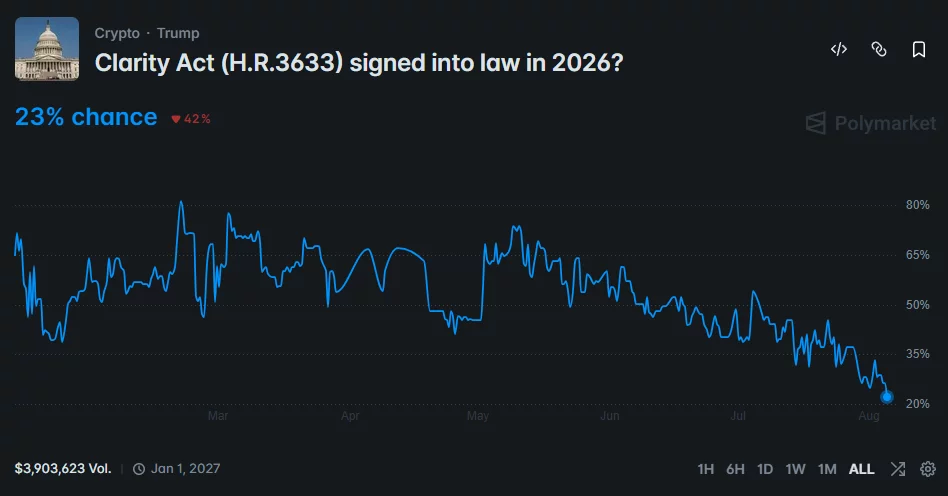
Source:
PolymarketThe decline reflects market sentiment rather than an official forecast. The bill remains alive, but its path depends on Senate leadership filing cloture and securing enough support to begin floor consideration.
For the U.S. crypto industry, the legislation could define the respective roles of the Securities and Exchange Commission and Commodity Futures Trading Commission. For now, the missing Senate slot and unresolved procedural steps leave that regulatory framework waiting for another opening.
Read more: BNY taps Galaxy for institutional crypto staking