CLARITY Act News: Why Coinbase Brian Armstrong Opposes January Draft? Coinbase CEO Brian Armstrong has rejected claims that his company is to blame for the Senate stall on crypto market struc
CLARITY Act News: Why Coinbase Brian Armstrong Opposes January Draft?
Coinbase CEO Brian Armstrong has rejected claims that his company is to blame for the Senate stall on crypto market structure legislation. In a September 19, 2026 post on X, he said The Wall Street Journal is preparing a story that pins the failure on Coinbase and on him personally.
The dispute follows days after the Senate failed to advance the bill. This CLARITY Act News update covers the main claims and the wider market context.
At a Glance
Armstrong says the WSJ is preparing a story blaming Coinbase and him.
He says four January concerns were fixed in the draft that cleared committee about four months later.
The Senate failed to advance the bill earlier this week.
Bloomberg reports the CFTC sent a crypto market proposal to the White House on September 17.
CoinShares says BTC may struggle to break $80,000 by year-end.
Galaxy Research expects no further legislative progress this year.
Why Armstrong Opposed the January Draft
Armstrong says he opposed sending the January draft to a committee vote because it needed serious work on DeFi, tokenization, CFTC authority and stablecoin rewards. In his view, the text had major issues that would have harmed crypto. He also argued that support was fractured, which made the bill unpassable at that point.
He accused the Journal of repeating bank lobby talking points. The WSJ story had not been published when this article was written, so those characterizations are his own.
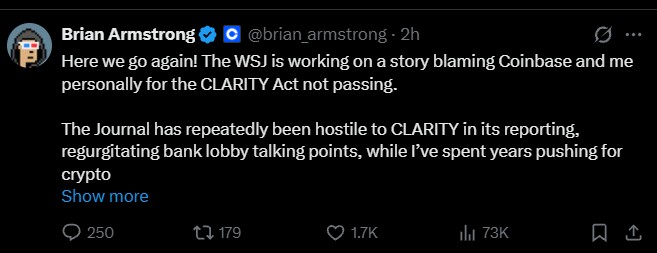
Source: Brian Armstrong
How the Draft Changed Before the Committee Vote
Armstrong says he worked with several parties who improved the text. According to him, all four items he flagged were resolved in the draft that went through committee roughly four months later. He calls the final version sent to the Senate great and says he strongly supported it.
These accounts come from Armstrong alone. The sources reviewed do not independently confirm what changed between drafts or who deserves credit.
Issue
January Concern
Armstrong's Later Claim
DeFi
Needed major work
Fixed
Tokenization
Needed major work
Fixed
CFTC authority
Needed major work
Fixed
Stablecoin rewards
Needed major work
Fixed
Why the Bill Failed to Advance in the Senate
Galaxy Research says the Senate failed to advance the bill on Tuesday. Senator Thom Tillis kept the ability to reconsider the cloture motion before this Congress ends, and some behind-the-scenes efforts aim to revive it. Galaxy still expects no progress this year.
CoinShares says the main disagreements center on ethical provisions, and a revised version could return as early as early next year. None of the reports reviewed call the effort permanently over.

Source: Alex Thorn
CFTC Moves Ahead With Crypto Rules
Bloomberg reports that the CFTC is accelerating crypto rulemaking. Documents from the White House Office of Management and Budget show a proposal on crypto asset trading and market regulation was submitted on September 17. It remains under White House review and has not been formally issued.
The timing matters because the original bill would have made the CFTC the primary regulator of digital asset markets. Galaxy adds that under Chairman Mike Selig, the agency has advanced proposed rules on prediction markets, widened stablecoin use as derivatives collateral and allowed the first onshore bitcoin perpetual futures contracts. Agency rules still differ from legislation, and a future administration could reverse them.
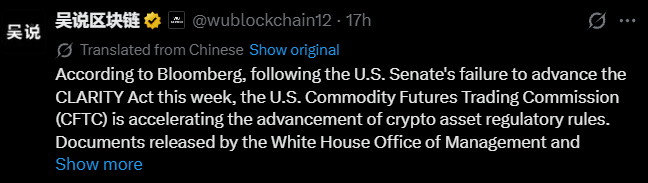
Source: Wu Blockchain
CoinShares Warns of Fed Policy and Legislative Pressure
CoinShares names two short-term pressures: a hawkish Federal Reserve and the blocked bill. The Fed believes inflation remains too high, and its latest projections show no room for rate cuts before 2027. That supports the US dollar and short-term Treasury yields. The Iran conflict is also lifting energy prices, which raises the odds of another rate hike this year.
If inflation does not improve, the firm says BTC may struggle to break $80,000 before year-end. That is CoinShares' view, not a guaranteed outcome.
Why Bitcoin Faces Less Regulatory Uncertainty Than Altcoins
CoinShares separates Bitcoin from the rest of the market. Because Bitcoin's regulatory status is relatively clear, the stalled bill has limited impact on it. Ethereum and other altcoins face greater uncertainty over classification and oversight, which helps explain why traders keep watching the legislation.
Galaxy Research: Progress May Pause Until Next Year
Alex Thorn of Galaxy argues that crypto will get clarity one way or another, pointing to supportive agencies. He says 100% of the top 30 global banks are building digital asset products. He also lists what only Congress can fix:
The CFTC cannot give itself spot market authority.
No interpretive release preempts 50 state regimes.
Relief for non-custodial developers can be reversed unless written into federal law.
Thorn suggests using the next two years to prove that spot markets can be surveilled, tokenized securities can settle around the clock and stablecoins can work at scale. He also notes that Commissioner Hester Peirce leaves the SEC in November.
Timeline of Key Developments
Date
Development
January 2026
Armstrong opposes the draft
About four months later
Revised draft clears committee, per Armstrong
Tuesday, this week
Senate fails to advance the bill
September 17, 2026
CFTC sends proposal to the White House
September 19, 2026
Armstrong disputes blame; Galaxy sees no progress this year
Conclusion: What the Setback Means for Crypto Regulation
Three threads are moving at once. Armstrong is defending his record, the CFTC is pushing rulemaking, and analysts are flagging the limits of both. Agency action may offer short-term guidance, but areas needing statutory authority still depend on Congress. DeFi, tokenization, stablecoins and CFTC jurisdiction are likely to stay central as this story develops.
YMYL Disclaimer: This article is for informational purposes only and is not financial, investment, legal or tax advice. Statements from Armstrong, CoinShares, Galaxy Research and Bloomberg are attributed to those sources and were not independently verified. Consult a qualified professional before making financial decisions. Cryptocurrency is volatile and carries a high risk of loss. Past performance does not guarantee future results. Do your own research and never invest more than you can afford to lose.