CLARITY Act News: SEC and CFTC May Enter As Senate Vote Falls 10 Short The U.S. Senate failed to advance the CLARITY Act on September 16, 2026, after a procedural vote came up well short of t
CLARITY Act News: SEC and CFTC May Enter As Senate Vote Falls 10 Short
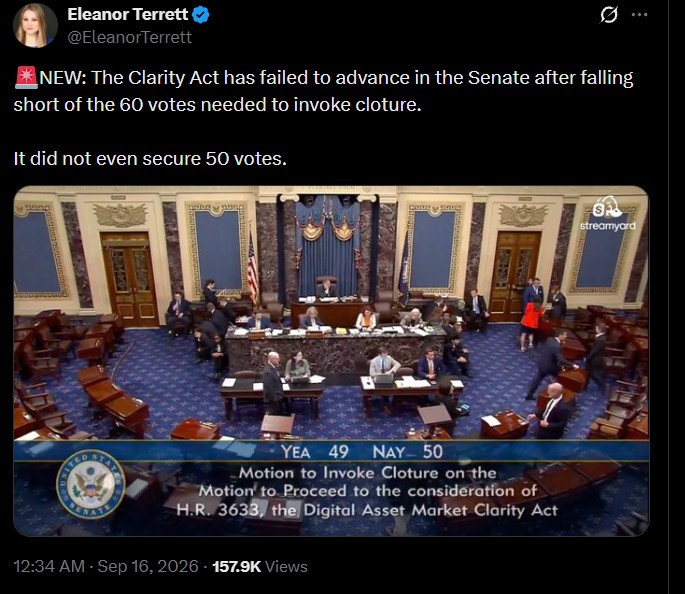
The U.S. Senate failed to advance the CLARITY Act on September 16, 2026, after a procedural vote came up well short of the 60 votes needed to invoke cloture. According to reporting from crypto journalist Eleanor Terrett, support for the bill did not even reach 50 votes, a steeper shortfall than many industry watchers had expected heading into the session. Today's crypto market fell 3.3%, whereas Bitcoin and Ethereum slid after the Senate Vote Results.
The vote was a test of whether the Senate would move forward with debate on the long-anticipated crypto market-structure bill. It was not a final up-or-down vote on every provision inside the legislation, but rather a gatekeeping motion that determines whether a bill can proceed toward passage at all. Because it failed, the CLARITY Act cannot move forward in its current form without further Senate action.
At a Glance: CLARITY Act Senate Vote
Key Detail
What Happened
Vote type
Senate procedural cloture vote
Required threshold
60 votes
Support received
Fewer than 50 votes in favor, per reports
Result
Failed to advance
Date
September 16, 2026
Next step
Possible bipartisan talks; SEC and CFTC rulemaking
CLARITY Act Senate Vote: What Happened and Why It Matters
Cloture is the Senate mechanism used to end debate and move a bill toward a final vote. Reaching it typically requires 60 votes, a threshold designed to force broad, bipartisan agreement before major legislation advances. The CLARITY Act missed that mark by a wide margin, falling short of even a simple majority.
The size of the gap matters. A close miss might have suggested the bill was one or two negotiations away from passage. Instead, the result signals deeper disagreement over how digital asset markets should be regulated in the United States, and it raises real questions about whether comprehensive market-structure legislation can be revived before the next election cycle.
Source: Eleanor Terrett
Why Did the CLARITY Act Fail in the Senate?
Reporting from Semafor indicates that every Democratic senator voted against advancing the bill, reportedly over concerns that it would not sufficiently limit the executive branch's influence over crypto policy.
At the same time, unity that White House advisors had hoped for among Republicans did not hold. A handful of Republican senators, described as having close ties to traditional banking interests, also voted no.
These are reported explanations rather than confirmed, singular motives, and different senators may have had different reasons for their votes. Some analysts have pointed to banking-industry lobbying as a factor working against the bill, though that should be treated as informed speculation rather than a fact unless senators themselves confirm it.

Source: Elana X
Brian Armstrong Reacts: SEC and CFTC Could Move Ahead Without Congress
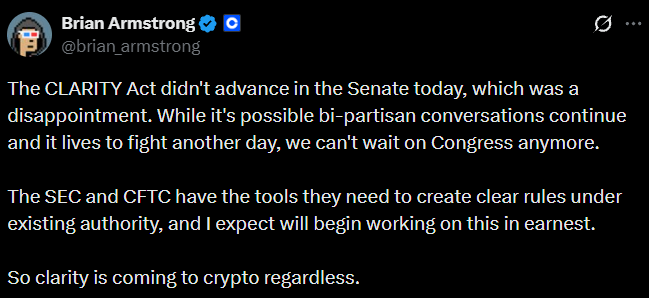
Coinbase CEO Brian Armstrong called the outcome disappointing but argued the industry cannot simply wait on Congress. In his view, the SEC and CFTC already hold sufficient authority to issue clearer crypto rules on their own, and he expects both agencies to begin that work.
Armstrong also pointed to the GENIUS Act, which already sets a legal framework for stablecoins, suggesting that some of the concessions built into the CLARITY Act were difficult for the industry to accept in the first place. These are Armstrong's own opinions, not confirmed regulatory or legal outcomes.
Source: Brian Armstrong
Brad Garlinghouse Calls for Review as Ripple Backs Regulatory Rulemaking
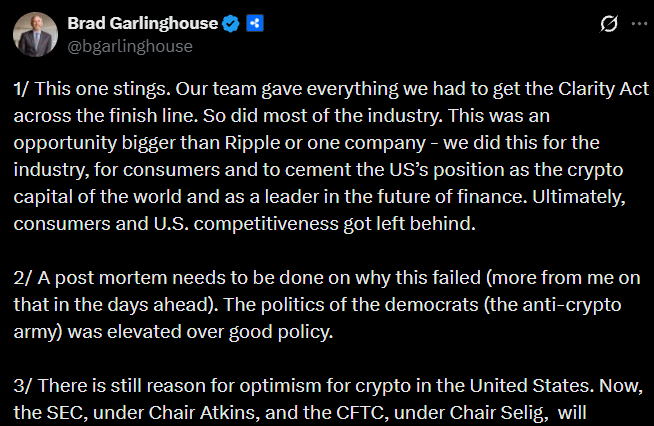
Ripple CEO Brad Garlinghouse said the industry had pushed hard for the bill and framed its failure as a setback for consumers and U.S. competitiveness in financial services. He indicated a fuller review of what went wrong would follow.
Looking ahead, Garlinghouse pointed to SEC Chair Atkins and CFTC Chair Selig as figures who could help close regulatory gaps through agency rulemaking, and said Ripple intends to stay involved in that process. These statements reflect Garlinghouse's own assessment of the vote's political dynamics.
Source: Brad Garlinghouse
Chris Dixon Says Crypto Policy Push in Washington Is Not Over
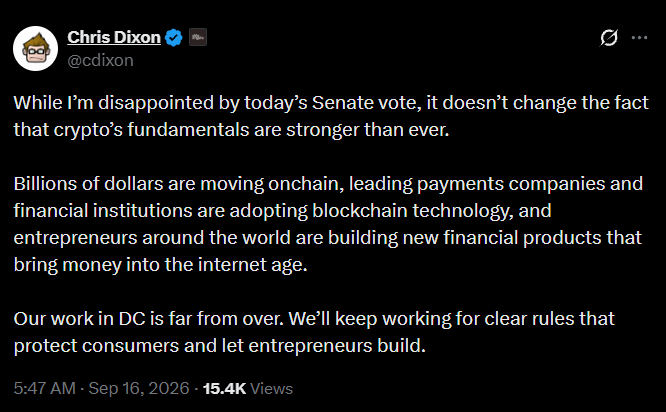
a16z crypto partner Chris Dixon said the Senate result does not change the underlying strength of the industry. He pointed to continued growth in on-chain activity, faster adoption of blockchain infrastructure by payment companies and financial institutions, and ongoing product development by entrepreneurs worldwide. Dixon indicated that policy efforts in Washington will continue, with a focus on rules that protect consumers while still allowing room for innovation.
Source: Chris Dixon
CLARITY Act Timeline: From Senate Push to September 16 Defeat
Earlier in 2026: Bipartisan negotiations and heavy industry lobbying built momentum around crypto market-structure legislation.
Mid-September: The Senate approached a key cloture test on the bill.
September 16: The cloture vote failed, with support falling short of both 60 and 50 votes.
Immediately after: Industry leaders, including Armstrong, Garlinghouse, and Dixon, issued public reactions.
Next phase: Attention shifts toward possible renewed talks and regulatory rulemaking.
What Happens to Crypto Regulation After the CLARITY Act Setback?
A failed cloture vote does not permanently end the possibility of future legislation, though it does make near-term passage unlikely. Bipartisan negotiations could resume, but there is no guarantee a revised bill will reach the floor again soon.
In the meantime, the SEC and CFTC may take on a larger role through rulemaking under their existing authority, an approach several industry leaders have already endorsed. Notably, this would be separate from the GENIUS Act, which addresses stablecoins specifically and remains in effect regardless of what happens to broader market-structure legislation.
For now, the practical effect is a delay rather than a full stop. Legislative momentum has cooled, but regulatory agencies and the industry itself appear set to keep pushing for clearer rules through other channels.
Conclusion
The CLARITY Act's failure to advance marks a significant, if not final, setback for U.S. crypto market-structure legislation. With Congress stalled, attention now turns to the SEC and CFTC, along with continued industry lobbying, to determine how quickly regulatory clarity actually arrives.
Disclaimer: This article is for informational purposes only and does not constitute financial, legal, or investment advice. Cryptocurrency markets are volatile and involve significant risk. Always conduct your own research and consult a qualified professional before making financial decisions.