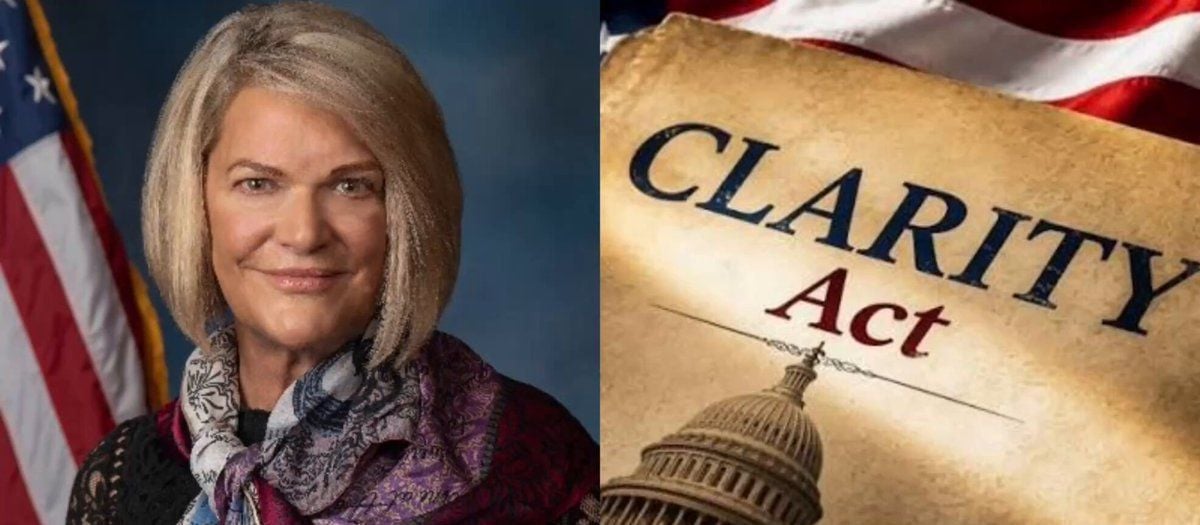
Lummis Confident on Senate Floor Vote Senator @SenLummis has expressed confidence that the Senate will hold a floor vote on the Digital Asset Market Clarity Act before the August legislative
Lummis Confident on Senate Floor Vote
Senator @SenLummis has expressed confidence that the Senate will hold a floor vote on the Digital Asset Market Clarity Act before the August legislative recess, potentially bringing to a close 11 months of high-stakes bipartisan negotiations over a comprehensive regulatory framework for digital assets.
Negotiations on the Digital Asset Market Clarity Act, better known as the CLARITY Act, are set to conclude as the Senate pushes to hold a floor vote before the August 2026 recess.If the bill fails to move forward before lawmakers leave town, there is little room in the calendar for another push before the midterms, which could shift control of Congress and send the legislation back to the starting line.
The bill passed the House in July 2025 with a 294-134 bipartisan vote, and the Senate Banking Committee approved it by a 15-9 vote on May 14, 2026.The CLARITY Act needs 60 Senate votes to clear the upper chamber, requiring at least seven Democratic votes to reach that threshold.
300-Page Revision and What It Covers
The current revision of the bill runs to roughly 300 pages and incorporates extensive Democratic amendments designed to harden consumer protections and strengthen federal anti-money laundering standards as they apply to the broader digital asset market, including the $300 billion-plus stablecoin sector.
A 309-page bill text released in May contains a compromise prohibiting interest or yield on idle stablecoin balances while permitting activity-based rewards, and adds new provisions including a DeFi trading protocol framework, an insolvency safe harbor for digital commodity transactions, and strengthened illicit finance measures.
Bipartisan negotiations are coming down to the wire, with Republicans and crypto-friendly Democrats yet to reach final agreement on key sticking points such as ethics rules for government officials and illicit finance provisions.
By contrast with the GENIUS Act, which focused narrowly on stablecoins, the Clarity Act would cover a much broader swath of the industry, including $BTC and $ETH. Securing jurisdictional finality on those assets is widely seen as a prerequisite for deeper institutional integration of digital assets into mainstream financial markets.
Sources:Clarity Act negotiations reach critical point as Senate races toward August recess (Crypto Briefing)Crypto bill faces make-or-break moment ahead of August recess (The Hill)US Crypto Policy Tracker: Legislative Developments (Latham & Watkins)