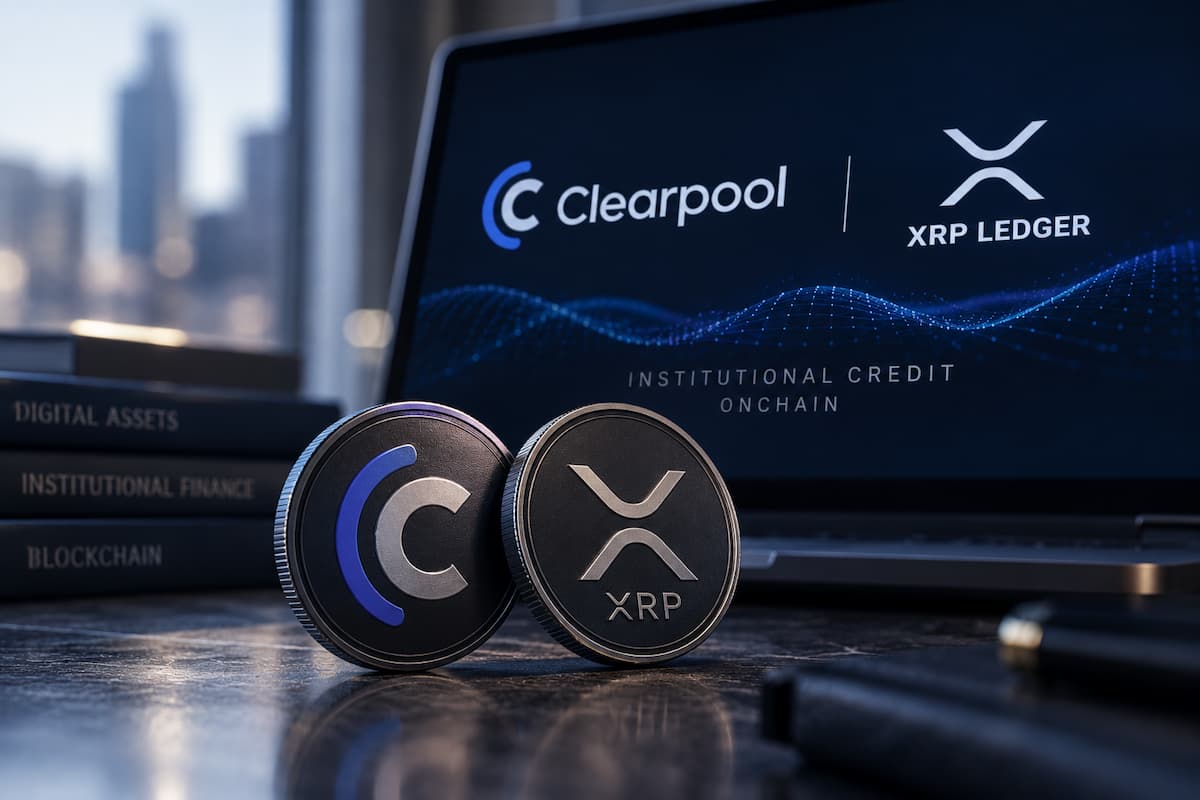
Clearpool Plans XRPL Expansion With CPOOL Token Migration
Key Facts Clearpool, an institutional credit protocol, is expanding its operations onto the XRP Ledger. A CPOOL token bridge connects holdings on Clearpool’s existing chains to positions on X
A
AnonymousCryptoCompass newsroom
September 13, 2026
3 min read
NEWS
CryptoCompass editorial visual for defi coverage.
Key Facts
Clearpool, an institutional credit protocol, is expanding its operations onto the XRP Ledger.
A CPOOL token bridge connects holdings on Clearpool’s existing chains to positions on XRPL.
Clearpool describes itself as building “institutional credit, native to XRPL” on its own site.
Clearpool, a decentralized credit marketplace that connects institutional borrowers to on-chain lenders, is expanding its protocol onto the XRP Ledger, with a token bridge letting CPOOL holders move balances between its established chains and the new XRPL deployment. The company’s own site now describes itself around the framing of “institutional credit, native to XRPL”, a notable repositioning for a protocol that built its reputation on Ethereum and other established smart-contract chains.
Why an Established DeFi Protocol Would Add a New Chain
Clearpool’s core business, matching institutional borrowers with permissioned, on-chain lending pools, depends on liquidity and on the specific institutions willing to participate as counterparties. Ethereum and its rollups have historically been where that institutional liquidity concentrated. Ripple has spent years building direct relationships with banks and payment providers through its cross-border settlement business, which gives XRPL an institutional audience that is different in composition from typical DeFi liquidity, even if it is smaller in raw on-chain volume today. A protocol like Clearpool expanding onto XRPL is a bet that this institutional audience, already comfortable with Ripple’s compliance-oriented pitch, is a better fit for permissioned credit products than the more retail-heavy liquidity that dominates elsewhere in DeFi.
The mechanics of the expansion matter as much as the strategic reasoning. Clearpool’s own documentation on the CPOOL bridge describes how the token moves between chains, a detail worth understanding because any cross-chain bridge introduces its own security surface distinct from the risk of either chain individually. A bridge exploit has been the single most common source of major losses across DeFi in recent years, precisely because it requires trusting the bridge’s own custody or verification mechanism on top of trusting the underlying chains.
What Actually Determines Whether This Expansion Works
Adding a chain is a technical announcement; migrating meaningful lending volume onto it is a much slower process that depends on whether real institutional borrowers and lenders actually show up on XRPL rather than treating it as a secondary venue. Clearpool’s published roadmap frames XRPL as part of a broader multi-chain strategy rather than a replacement for its existing markets, which is the more realistic read: this is Clearpool hedging its distribution across more institutional rails, not abandoning the chains where its existing lending activity already lives.
Wall Street's eyes are on one thing today: the Fed. The FOMC (Federal Open Market Committee, the group that sets US interest rates) hands down its rate decision this afternoon, and gold-backe
Nearly two-thirds of the circulating ZEC supply participated in a key governance vote this week, as Zcash holders overwhelmingly approved a proposal to cut block times to 25 seconds and backe
Argentina has committed to implementing the OECD’s Crypto-Asset Reporting Framework and starting the automatic exchange of information on crypto transactions by September 2029, bringing the c