The Cobo Wallet app will shut down on Monday, November 30, 2026, at 17:00 German time. Anyone who has not withdrawn their balance by then will pay 2 percent of their remaining coins every mon
The Cobo Wallet app will shut down on Monday, November 30, 2026, at 17:00 German time. Anyone who has not withdrawn their balance by then will pay 2 percent of their remaining coins every month from January, but at least the equivalent of $100. For small holdings, that means the money is gone after the first deduction. You should therefore withdraw now, while the app still works normally and before a queue builds up at the deadline.
The announcement comes from Cobo itself. On October 15, the company published a notice on the shutdown of the Cobo Wallet app, stating that the app will be discontinued "From December 1, 2026, 00:00:00 (UTC+8)". The time refers to the Beijing and Singapore time zone, which is seven hours ahead of German winter time. In Germany, the service therefore ends on November 30 at 17:00, not at midnight.
Only the consumer wallet is affected, meaning the app for retail customers. Custody for businesses and Cobo's other divisions continue to operate. For you as a retail investor, this means your bitcoin, ether, stablecoins and other tokens need a new home by a week on Monday, ideally a wallet whose keys you hold yourself. You will find a selection in our software wallet comparison.
Cobo Wallet app: why the provider is closing its retail wallet
Cobo is a digital asset custody provider that for years has mainly served exchanges, funds and other companies. According to the company, the retail app has not accepted new sign-ups since 2021. Since then, Cobo has concentrated on its institutional wallet business, and the consumer app only kept running for existing customers.
With the October notice, the company is drawing a line under it. Cobo does not name a successor for retail customers. Anyone who wants to remain a customer is referred to the institutional products, which are aimed at businesses. For retail investors, that leaves only a move to another provider or into self-custody.
Self-custody means that you hold the private key to your coins yourself, usually in the form of a recovery phrase of 12 or 24 words. No company can then deduct fees or block access. The downside: if you lose the phrase, nobody can help you.
Account fee after November 30: 2 percent a month, at least $100
Whatever is still in the app after the cut-off date is treated by Cobo as a residual balance subject to a monthly account maintenance fee. The rules from the notice in detail:
- The fee is 2 percent of the remaining holdings per month.
- If that amount is below the equivalent of $100, Cobo deducts $100 instead.
- The fee is charged on the first day of the following month at 00:00 Beijing time, for the first time on January 1, 2027, for December. In Germany, that is always the previous day at 17:00.
- Cobo deducts the fee directly in coins, without conversion. The company calculates the dollar value using CoinMarketCap prices at the time of the deduction.
- If the entire residual balance is worth less than $100, it is collected in full in a single step.
According to Cobo, anyone who does not withdraw in time agrees to this arrangement. The fee keeps running until everything has been withdrawn or fully used up.
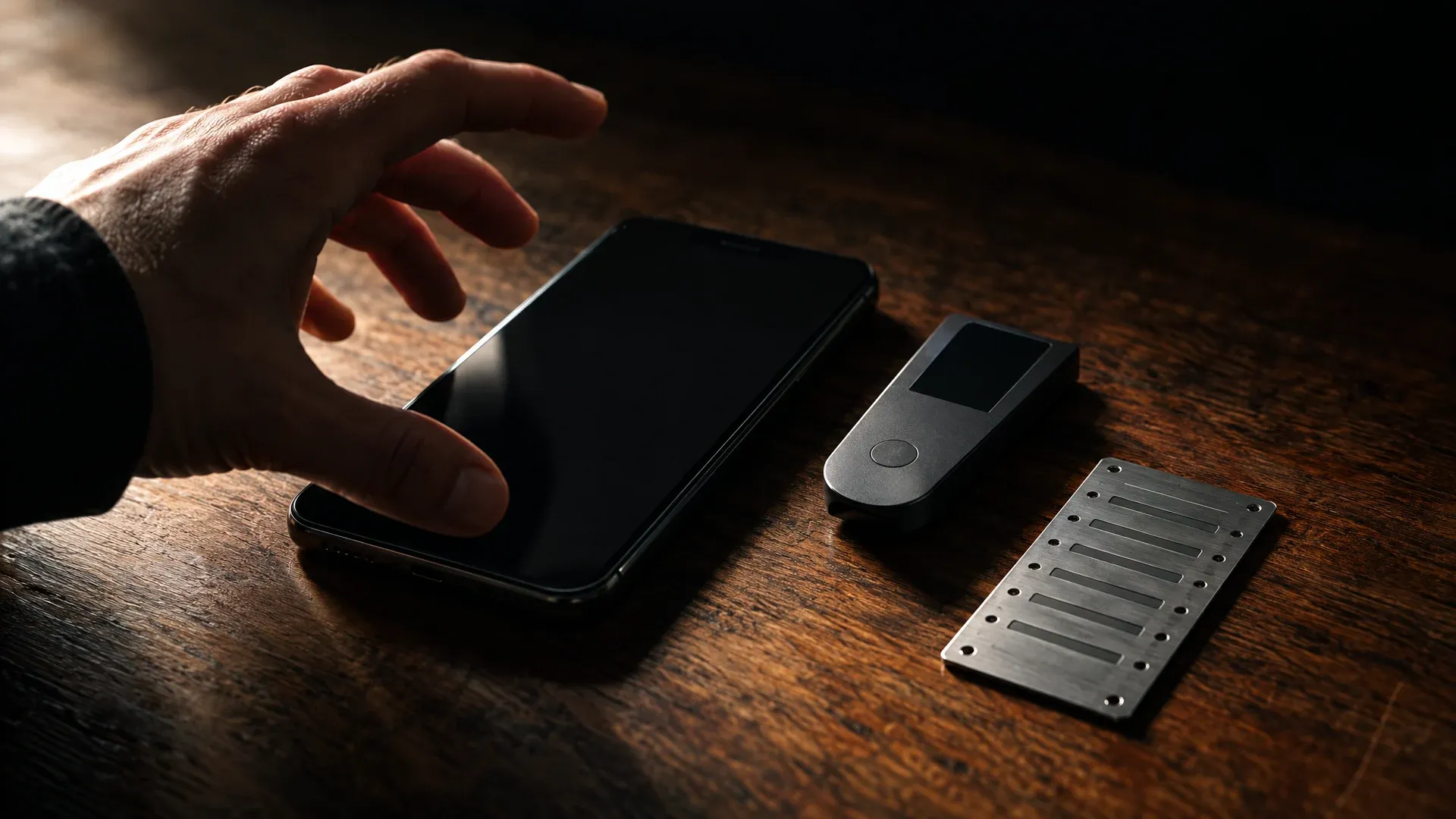
A wallet whose recovery phrase only you know is a suitable new destination for your Cobo balance.
Worked examples: how quickly the minimum fee eats up small balances
In its notice, Cobo gives three examples showing how hard the minimum fee hits small accounts:
- Anyone who leaves 1 bitcoin and 10 ether in the app loses 0.02 BTC and 0.2 ETH a month, exactly 2 percent, because the value is above $100.
- Anyone holding only 1,000 USDT would mathematically owe 20 USDT. Because that is below the minimum fee, Cobo deducts 100 USDT.
- Anyone holding only 60 USDT loses the full 60 USDT at the first deduction.
For the 1,000 USDT example, this means that after ten months of 100 USDT each, the balance is used up. By comparison, at 2 percent without a minimum, around 785 USDT would still be left after a year. The minimum fee is therefore the real burden for all holdings below $5,000, because only above that value does 2 percent exceed $100.
A second effect concerns accounts holding several coins. Cobo spreads the minimum fee proportionally across all tokens in the account, measured by their dollar value. So anyone holding small remainders in many different coins loses some of each. Small remainders that are barely worth withdrawing because of the network fee are therefore no reason to leave the rest of the balance behind: the $100 is charged on the total value, however it is made up.
Withdrawing funds from Cobo Wallet: the steps before the deadline
Before you start the first withdrawal, get an overview: which coins are in the app, on which blockchains and in what quantity? Record your holdings with a screenshot. That helps later with checking and with your tax return.
- Set up a destination wallet: Create a new wallet that supports all the blockchains of your coins. For larger amounts, a hardware wallet makes sense, a small device that stores the keys offline. Our hardware wallet comparison offers an overview.
- Check the network: Many tokens exist on several blockchains, USDT for example on Tron, Ethereum and others. When withdrawing in the app, choose the same network that your destination wallet uses for that address. The wrong network can make the coins unreachable.
- Send a test amount: First send a small amount and wait until it shows up in the new wallet. Only then move the rest.
- Budget for fees: Every withdrawal costs a network fee. With very small remainders, the withdrawal may barely be worth it. It is then often cheaper to swap the remainder in the app beforehand into a coin you are withdrawing anyway, if the app still offers that.
- Do not wait until the last day: At the deadline, many users will want to withdraw at the same time. Anyone who only starts on the afternoon of November 30 risks a withdrawal not being processed in time.
If you would rather keep your coins on an exchange than in your own wallet, look for authorisation under the European MiCA regulation. MiCA is the EU legal framework for crypto-assets that obliges providers to hold a licence, maintain capital and segregate client funds. Our comparison of regulated crypto exchanges shows which providers meet these requirements.
Replace saved Cobo addresses at exchanges and mining pools
One point in the notice is easily overlooked. Cobo asks all users to remove or replace any Cobo addresses they have saved as receiving addresses at exchanges, mining pools or other platforms. Otherwise coins will keep arriving there after the shutdown, and the same fee rule applies to those payments.
Miners who have their payouts sent automatically to a Cobo address are particularly affected, as are investors with savings plans or automatic withdrawals at an exchange. Check the stored address in every account that regularly sends you coins. That includes address books and whitelists at exchanges, where only previously confirmed destination addresses are allowed.

Anyone who has saved a Cobo address as a fixed payout destination at an exchange or mining pool should replace it before the shutdown.
Phishing after the shutdown: fake migration apps and bogus support
When a provider closes, fraudsters often appear offering supposed help with the move. Cobo itself warns about this in the notice. The company writes that it will never send users direct messages, never ask for a password, recovery phrase or private key, and never require them to install another app in order to "migrate" funds.
Only download the app via the official App Store and Google Play listings that Cobo links in the notice, and only use the cobo.com website. Anyone claiming to be support who contacts you via social networks, messengers or email is very likely not from Cobo. Never enter your recovery phrase into a website or a form under any circumstances.
Tax rules for moving coins between your own wallets and for fees paid in crypto depend on your country; our comparison of crypto tax software helps you document old purchases and the move cleanly.
Cobo in the deadline calendar: more shutdowns at the end of November
Cobo is not the only provider setting a deadline in these weeks. Several exchanges and projects are discontinuing services, changing their fees or ending withdrawal windows. Our overview of crypto withdrawal deadlines collects these cut-off dates in one place. If you hold balances with several providers, you can handle all the moves in one go and plan network fees better.
Cobo Wallet: no account fee until 17:00 on November 30
- Choose a new wallet: Set up a wallet that supports all your coins and networks, for example from the software wallet comparison, and back up the recovery phrase offline.
- Withdraw everything and swap addresses: Transfer every holding out of Cobo Wallet with a test amount first and replace saved Cobo addresses at exchanges and pools. If you prefer a custodian, you will find authorised providers in the comparison of regulated crypto exchanges.
- Keep records: Export the history from the app and import it into crypto tax software so that the purchase dates of your coins remain documented.
(As of November 22, 2026. This article is not investment advice. Prices and fee structures change; check the terms with the provider before you buy.)