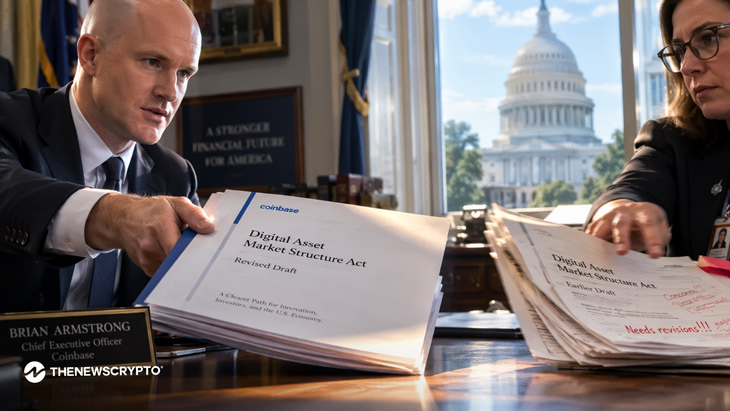
Coinbase CEO Brian Armstrong has criticized the Wall Street Journal (WSJ) over its recent coverage and an anticipated story regarding the crypto CLARITY Act, claiming that the publication’s r
Coinbase CEO Brian Armstrong has criticized the Wall Street Journal (WSJ) over its recent coverage and an anticipated story regarding the crypto CLARITY Act, claiming that the publication’s reporting could misrepresent his role and views around the legislation.
In a recent post on X, Armstrong suggested that WSJ is working on a story that could present a misleading narrative about his influence on the Senate’s decision to reject the CLARITY Act. Armstrong pointed to what he described as a consistent pattern in the Journal’s coverage, alleging that its reports have largely sided with the traditional banking sector’s opposition to the bill.
According to Armstrong, WSJ has maintained a “hostile” stance toward the CLARITY Act, repeatedly echoing views advanced by banking interests. He argued that these perspectives run counter to efforts to bring regulatory transparency to the digital asset sector.
Coinbase CEO Brian Armstrong argued that the Wall Street Journal’s reporting aligns closely with traditional banking interests and risks misinforming the public about both his stance and the broader crypto industry’s work on the CLARITY Act.
Coinbase, launched in 2012, is a leading US-based cryptocurrency exchange serving millions of users worldwide.
Mini dictionary: CLARITY Act, a proposed piece of US legislation designed to provide clearer regulatory guidelines for digital assets, with particular focus on defining the roles of agencies such as the SEC and CFTC in overseeing cryptocurrencies and DeFi products.
Armstrong clarifies his position on the bill
Armstrong reported that he actively participated in efforts to improve the CLARITY Act, asserting that he did not attempt to undermine the bill, contrary to what he expects WSJ to suggest in its upcoming article. Instead, he claimed that Coinbase and other industry participants worked collaboratively to enhance the legislation.
He acknowledged previously voicing opposition to the bill earlier in the year. However, Armstrong clarified that his objections were directed at a draft version, not the final version that reached the Senate for consideration.
Armstrong cited several significant issues with the earlier version of the bill, including unresolved questions on decentralized finance (DeFi), tokenization, the Commodity Futures Trading Commission’s (CFTC) oversight, and incentives linked to stablecoins. He insisted that these concerns prompted his initial reluctance to support the legislation before it advanced to a committee vote in January.
He also remarked that, at that stage, the bill lacked the necessary support to successfully pass a Senate vote. Armstrong said that rather than abandoning the initiative, Coinbase joined industry stakeholders to address outstanding challenges.
According to Armstrong, the final version of the CLARITY Act resolved his major concerns, making it suitable for approval from the Senate. He stated that all four key points he previously highlighted were resolved after stakeholder input over a period of roughly four months.
Armstrong emphasized that improvements made to the CLARITY Act addressed concerns over DeFi, tokenization, regulatory authority, and stablecoin rewards, and that the final bill deserved Senate passage.
The post Coinbase CEO Brian Armstrong disputes Wall Street Journal claims on CLARITY Act appeared first on COINTURK NEWS.