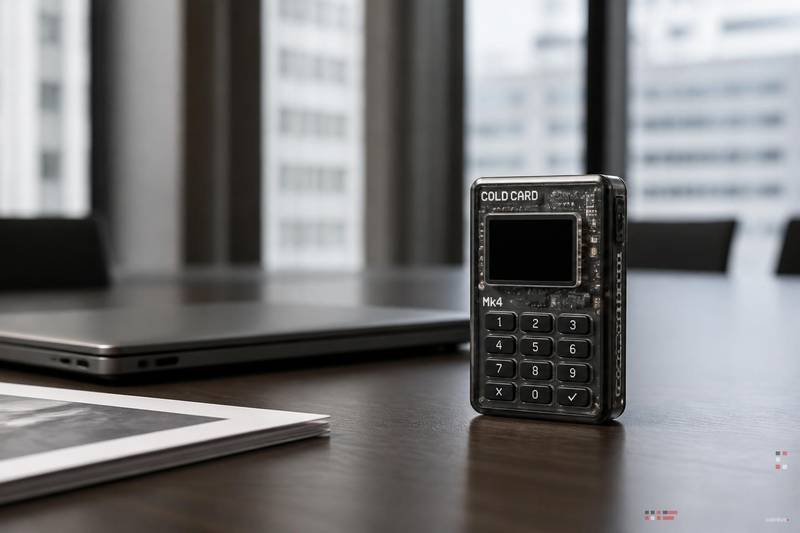
A wave of reported attacks against Coldcard hardware wallets has put the spotlight back on self-custody, with unconfirmed reports pointing to large sums of Bitcoin drained from affected devic
A wave of reported attacks against Coldcard hardware wallets has put the spotlight back on self-custody, with unconfirmed reports pointing to large sums of Bitcoin drained from affected devices. Here is what the available evidence supports about the Coldcard exploit, and why a wallet-level failure is not the same as a failure of Bitcoin itself.
What Happened in the Coldcard Exploit
The incident centers on Coldcard hardware wallets and how certain devices generated their wallet seeds. Coldcard maker Coinkite published a seed generation warning for the Mk3 device, flagging risk tied to how entropy was handled when new seeds were created.
Reporting on the scale of losses remains unconfirmed and has escalated over time. Early coverage described a claim that roughly $40 million in Bitcoin was stolen across about 500 Coldcard wallets, and later coverage tracked the figure climbing as the exploit reportedly topped $100 million in stolen BTC. These totals come from a limited number of sources and should be treated as unverified.
For non-technical readers, the practical takeaway is narrow: the risk attaches to how affected seeds were created, not to a blanket break of every Coldcard. Users generating fresh wallets on impacted firmware were the focus of concern, and a suspected fourth wave of attacks reportedly put a further 449 BTC at risk, according to unconfirmed reports.
What the Incident Reveals About Hardware Wallet Security
Hardware wallets reduce exposure by keeping keys offline, but they do not remove every attack surface. Seed generation, firmware trust, and backup handling all sit outside the chip and depend on both vendor code and user practice.
The mitigation path here was a product fix. Coldcard shipped firmware 5.6.1, which added user-supplied entropy for new seeds, directly addressing the seed generation concern raised in the incident. For holders, the actionable step following such disclosures is to verify firmware status and, where advised, move funds to a freshly and safely generated wallet.
This is the line between product security and user operational security. A vendor can patch a flawed default, but only the holder controls how a seed is generated, stored, and verified. Transparent disclosure from the vendor is what makes that user response possible in the first place.
Why a Wallet Exploit Is Not a Bitcoin Exploit
None of this touched the Bitcoin protocol. The exploit lived at the wallet and vendor layer, and Bitcoin's base-layer security depends on decentralized mining and consensus, not on any single wallet vendor's firmware.
That separation is the core point. A compromised seed-generation routine can cost individual users, and the reported losses underscore that, but it does not weaken the chain those coins live on. Security researcher Jameson Lopp publicly discussed the incident, the kind of open scrutiny that pushes vendors to patch faster.
The constructive angle is that exposed weaknesses got fixed in the open. A public warning, escalating scrutiny, and a shipped firmware update with added entropy is the transparent-iteration loop working as intended. The broader lesson, echoed in coverage framing the losses as a self-custody wake-up call, is that resilience comes from weaknesses being disclosed and hardened, not from pretending they do not exist.
What to watch next: further confirmation or revision of the loss totals, additional attack waves against unpatched or vulnerable seeds, and adoption of updated firmware across the affected device base.
Additional source references: source document 1.
Disclaimer: This article is for informational purposes only and does not constitute financial or investment advice. Cryptocurrency and digital asset markets carry significant risk. Always do your own research before making decisions.
Read original article on coinlive.me