Five days after the first sweep, the Coldcard incident has stopped looking like a single event and started looking like a slow harvest. Blockchain analysts tracked a fourth round of drains ru
Five days after the first sweep, the Coldcard incident has stopped looking like a single event and started looking like a slow harvest. Blockchain analysts tracked a fourth round of drains running through Monday, and the running total of observed losses is now closing on $114 million. What has not happened is the price collapse many traders expected. Bitcoin reclaimed $63,000 in Asian hours on Tuesday and touched just above $64,100 overnight, up roughly 2 percent on the day.
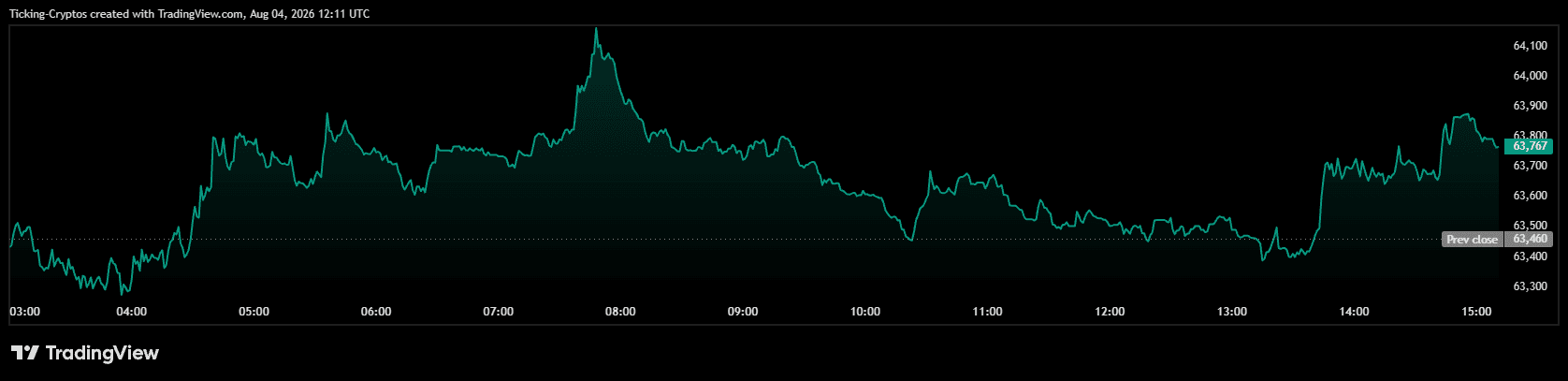
That gap between the severity of the security failure and the calm in the order book is the real story right now.
What actually happened to the Coldcard wallets?
The failure was not a phishing attack, not malware, and not physical access to anyone's device. It happened at the moment each wallet was created.
Coldcard firmware calls a function to pull randomness when it generates a recovery seed. Two implementations of that function sat in the codebase with the same signature: the hardware random number generator that Coinkite wrote for the STM32 chip, and a software fallback inherited from MicroPython. A preprocessor guard checked only whether a build setting was defined and never tested its value, so the build completed against the software fallback without a single warning.
The result was seeds that looked completely normal. The firmware kept producing valid BIP-39 recovery phrases, and the values passed routine testing because they appeared random enough, which is exactly why the weakness sat undetected for so long. Block's analysis showed that an attacker able to determine or narrow down the device UID, timer state, and prior call history could reproduce candidate output streams offline, without ever touching the device.
Block traced the change to a commit dated 1 March 2021, shipped in firmware 4.0.0 that same month. That means some of the affected wallets were quietly guessable for more than five years.
How large are the losses now?
The figures have moved every day, and the reason is that different firms are measuring different transaction sets.
The first public number came from Coinkite's own advisory and Chainalysis: roughly 594 BTC, about $38 million, taken from around 500 wallets in a 25 minute window that ended just before 02:00 UTC on 31 July. Galaxy Research then mapped a separate and larger sweep, identifying 1,196 addresses holding about 1,082.65 $BTC, worth roughly $70.2 million, drained across 41 minutes.
A third wave surfaced over the weekend. By Monday the tally across three waves stood at roughly 1,367 BTC, close to $89 million, taken from about 4,585 addresses. The average haul per address fell with each round, which suggests the operator worked through the large balances first and then moved down to wallets worth a few thousand dollars. The fourth wave ran through Monday and took roughly 449 BTC from 709 addresses on the revised count, and Galaxy has not confirmed whether the same operator is behind it.
Add it up and observed losses are in the $114 million to $116 million range, from a bug in a device whose entire purpose was to make this impossible.
Which devices are affected, and does a firmware update fix it?
This is the part that matters most for anyone holding a Coldcard.
Coinkite says the issue covers Mk3 firmware versions 4.0.1 through 4.1.9, and its updated advisory also includes seeds generated on Mk4, Mk5, and Q devices before the latest firmware fixes. The initial advisory suggested Mk4, Q, and Mk5 were clear, so the scope has widened since Friday.
Updating does not repair anything. A weak seed is already a weak seed, and new firmware cannot retroactively add entropy to a key that was generated years ago. The correct sequence is to update the device first, generate a completely new seed, and only then move funds across after verifying the replacement wallet.
Block, Trezor, and Ledger have all confirmed their own devices are unaffected.
Was AI used to find the bug?
Coinkite thinks so, and said as much publicly.
The company assumes someone ran AI tooling over previous versions of its open-source firmware to surface the flaw, and noted that it had put one of the best available models over its own code a few weeks earlier and the model found nothing serious. Its blunt conclusion was that attackers and defenders now hold the same tools, and in this case the tools only helped one side.
There is a second detail worth flagging. Investigators found the operator used a paid account at a well known blockchain services provider to run the queries needed for the sweep, with the provider apparently serving what looked like ordinary requests. Block has handed the information to authorities.
Taken together, the incident redraws the threat model for cold storage. Cold storage guarantees that a key is unguessable. Holders read that as a guarantee that a key is unreachable. Those are not the same promise, and the cost of finding flaws in the first one keeps falling.
Why has Bitcoin held up despite all of this?
Because the money that left those wallets did not leave the market, and because positioning never got panicked.
Options desks show no stress. The 30 day implied volatility index has sat near 37 percent for several sessions, and the most traded contracts on Deribit are calls at $68,000 and $70,000, which are bullish bets. Spot flows told a similar story: ether funds took small inflows while Bitcoin funds saw an outflow, an unusual split for a market where BTC normally leads.
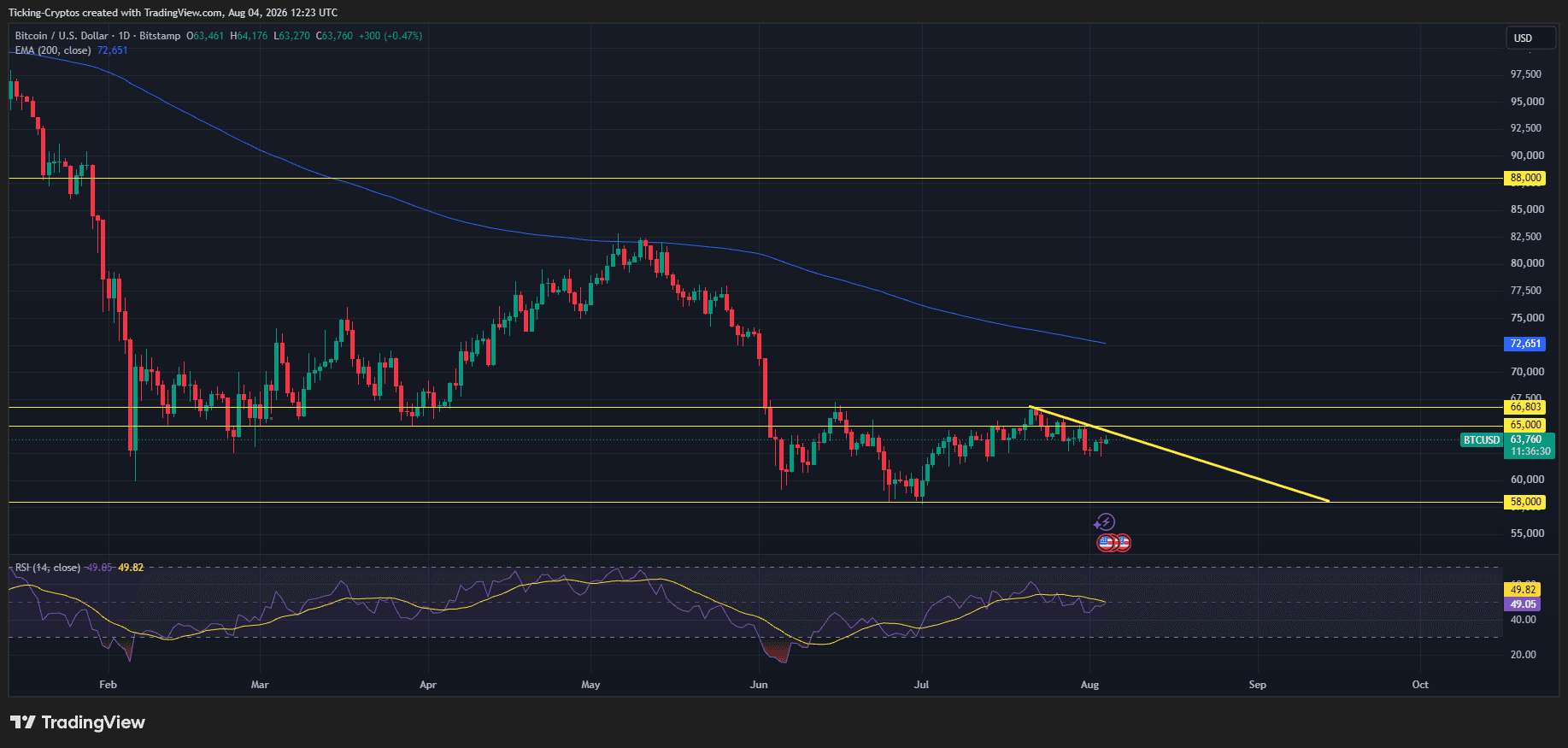
The bigger drag on price this week arguably is not the hack at all. Strategy disclosed on Monday that it sold 1,638 BTC for about $105 million between 27 July and 2 August, its third sale of 2026, at an average price of $63,957 against a cost basis of $75,419. Proceeds went to preferred dividends and STRC buybacks rather than back into Bitcoin. Holdings now sit at 842,138 BTC and the company has not bought any in more than five weeks.
A treasury company selling below its own cost basis is a clearer signal about demand than a wallet exploit is.
What should holders take from this?
Three practical points.
First, verify at creation, not after. Every major failure of this class, including the 2023 Milk Sad PRNG bug, happened at the moment the wallet was made, which is the one moment a user cannot independently check no matter how disciplined they are afterwards. Generating a seed with a verifiable process, or splitting risk across devices from different manufacturers, addresses that directly.
Second, single vendor concentration is a risk in itself. Roughly 500 holders in the first wave alone shared the same failure because they shared the same supply chain.
Third, keep the numbers in perspective. TRM Labs counted 207 separate incidents in the first half of 2026, the most ever recorded in a half year period, yet total losses came to about $972 million, less than half the $2.3 billion stolen in the first half of 2025. More attacks, smaller hauls. The Coldcard event is severe because of where it broke, not because of its size.
What to watch next
The immediate level is $63,000, which has been reclaimed and lost twice in three days. A third failure would point to thinner support below $62,500. Beyond price, two things will shape the aftermath: whether consumer protection or financial regulators respond at all, which will tell us how governments intend to classify hardware wallets, and whether Galaxy confirms the fourth wave came from the same operator or a copycat working from published research.