Overview The blockchain industry is entering a period where technological innovation alone is no longer sufficient to establish long term credibility. As digital assets become increasingly in
Overview
The blockchain industry is entering a period where technological innovation alone is no longer sufficient to establish long term credibility.
As digital assets become increasingly integrated into regulated financial markets, investors, institutions, and regulators are placing greater emphasis on governance, transparency, legal identity, standardized disclosure, and operational accountability. While innovation remains essential, the ability to demonstrate compliance is becoming an equally important competitive advantage.
ATEG Capital presents an interesting case study in this evolving landscape. Rather than treating compliance as a final milestone before market entry, the company has publicly documented a sequence of governance and transparency initiatives that appear designed to strengthen regulatory credibility alongside technological advancement.
This article examines those publicly available developments and considers what they may indicate about the broader direction of Europe's digital asset ecosystem under the Markets in Crypto Assets Regulation (MiCA).
Trust Is Documented, Not Declared
For much of blockchain's history, projects often prioritized rapid innovation ahead of regulatory clarity.
Whitepapers frequently served as marketing documents.
Governance structures were often informal.
Legal infrastructure was sometimes viewed as secondary to product development.
That environment is changing.
As institutional participation continues to expand across digital asset markets, demonstrable compliance is becoming one of the industry's strongest competitive advantages.
Rather than evaluating a single announcement, it is more meaningful to examine the broader sequence of governance related initiatives undertaken by ATEG Capital.
Markets reward confidence.
Confidence follows transparency.
Compliance Is Becoming Infrastructure
Institutional investors rarely assess technology in isolation. They evaluate governance, legal identity, operational transparency, risk disclosure, independent verification, and corporate accountability as part of a broader assessment of organizational maturity.
This reflects a fundamental shift in how digital asset projects are evaluated.
As uncertainty declines, perceived investment risk often declines with it.
The same principle increasingly applies to blockchain.
Rather than asking only whether a protocol is technologically innovative, sophisticated market participants are increasingly evaluating whether it is structured to operate responsibly within evolving regulatory frameworks.
Compliance reduces uncertainty.
Step One: Establishing Legal Identity
One of the earliest foundations of institutional credibility is legal identity.
ATEG Capital operates as an Austrian legal entity and publicly provides its Legal Entity Identifier (LEI), an internationally recognized identification system used across global financial markets to uniquely identify legally registered organizations.
The company also makes its legal documentation publicly accessible through its official documentation portal.
LEI Certificate
ATEG Handbook
An LEI should not be interpreted as regulatory approval.
Instead, it demonstrates that an organization has chosen to identify itself through internationally recognized financial infrastructure rather than operating anonymously.
That distinction matters.
Anonymous projects can launch.
Institutional ecosystems require identifiable participants.
Identity precedes accountability.
Step Two: Public Documentation Instead of Marketing Narratives
ATEG Capital maintains a dedicated documentation portal where its ecosystem whitepaper, handbook, legal documentation, LEI certificate, and independent smart contract review are publicly accessible.
Whitepaper
This approach reflects one of the core principles underlying MiCA.
Material information should be available before investment decisions are made.
Not afterward.
Making documentation publicly available helps reduce information asymmetry between project teams and market participants while allowing stakeholders to conduct independent due diligence.
Transparency begins with accessibility.
Step Three: Alignment With MiCA Disclosure Standards
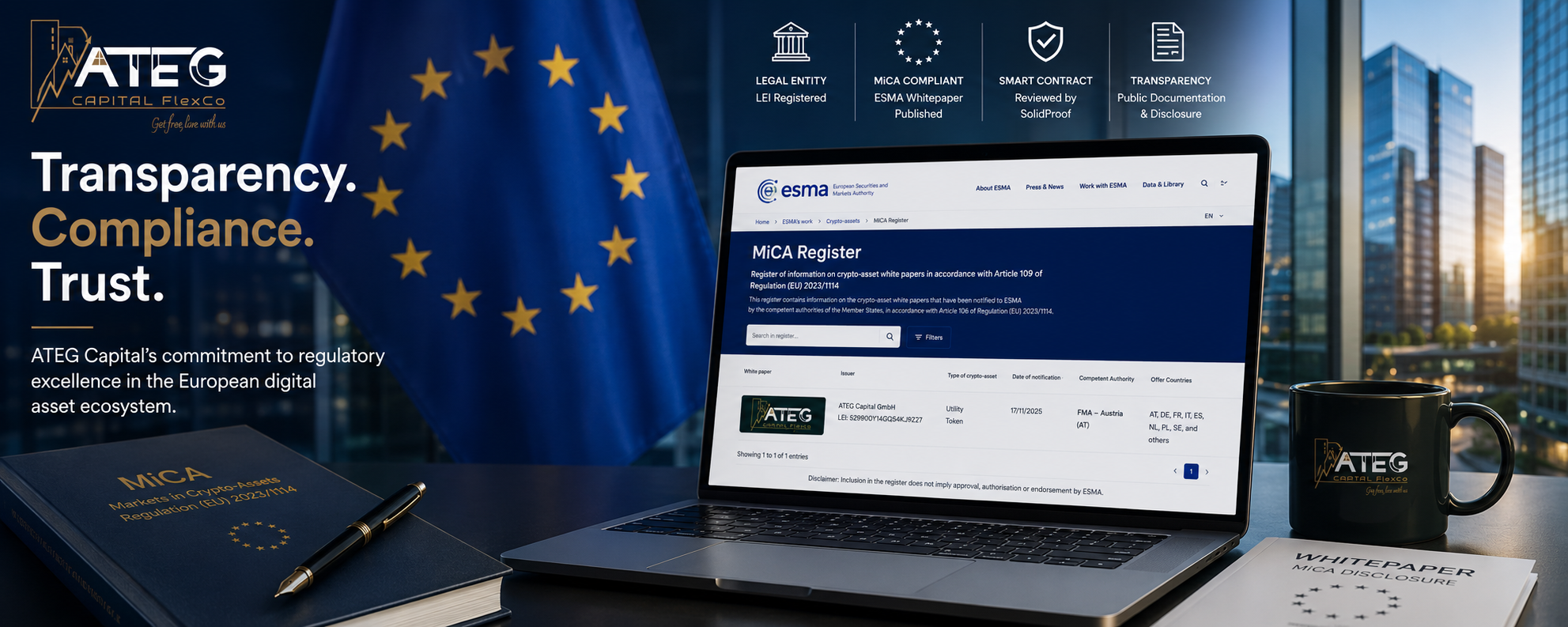
One of the company's most significant publicly documented milestones is the publication of the ATEG.DV crypto asset whitepaper within the European Securities and Markets Authority (ESMA) MiCA Register.
ESMA MiCA Register
Under MiCA, crypto asset whitepapers are intended to provide standardized disclosures relating to the issuer, technology, governance structure, associated risks, token design, and other material information that may assist market participants in making informed decisions.
Equally important is understanding what this publication does not represent.
ESMA explicitly states that publication of a crypto asset whitepaper does not constitute approval, authorization, endorsement, or certification by any European authority.
Responsibility for the document remains entirely with the issuer.
This distinction is frequently misunderstood.
The significance lies in disclosure, not endorsement.
Disclosure informs.
It does not certify.
Step Four: Independent Smart Contract Review
Corporate governance represents only one dimension of transparency.
Technical assurance is another.
ATEG Capital publicly provides an independent smart contract review conducted by SolidProof and references this assessment within its security documentation.
The company also references Know Your Customer (KYC) verification together with a TrustNet Security Score of 95.95.
SolidProof Audit
Independent technical reviews cannot eliminate every future risk.
However, they help reduce information gaps by enabling external specialists to evaluate deployed smart contracts using standardized methodologies.
For institutional observers, independent verification generally provides stronger assurance than internal claims alone.
Verification strengthens credibility.
Step Five: Transparent Tokenomics
Another notable aspect of ATEG Capital's governance approach is its commitment to transparent tokenomics.
The company publicly discloses its maximum token supply, vesting schedules, founder allocations, strategic reserves, burn mechanisms, freeze mechanisms, distribution objectives, deflationary model, and burn testing process.
This level of transparency enables analysts and investors to evaluate governance incentives, ownership concentration, and long term sustainability with greater confidence.
Markets generally price uncertainty.
Transparency helps reduce it.
Visible incentives create measurable trust.
A Pattern Rather Than Isolated Events
Viewed independently, each milestone, including the Legal Entity Identifier (LEI), public documentation, MiCA whitepaper publication, independent smart contract review, and transparent tokenomics, may appear incremental.
Viewed collectively, however, they suggest something more significant.
They indicate a governance strategy.
Rather than treating compliance as a final checkpoint before entering the market, ATEG Capital appears to be integrating legal identity, regulatory disclosure, technical assurance, and public documentation throughout the broader development of its ecosystem.
That distinction is becoming increasingly relevant as regulatory maturity emerges as a competitive differentiator across Europe's digital asset landscape.
Consistency builds reputation.
What This Means for the Industry
MiCA is reshaping expectations across Europe's digital asset ecosystem.
Projects are no longer evaluated solely on technological innovation.
Increasingly, they are assessed according to the quality of their governance, the strength of their disclosure standards, corporate transparency, operational accountability, and independent verification.
ATEG Capital's publicly documented initiatives reflect this broader evolution toward institutional readiness and transparent governance.
Whether this strategy ultimately translates into long term commercial success remains a question for the market.
From a governance perspective, however, the company's progression illustrates a broader trend already influencing the next generation of blockchain ecosystems across Europe.
Conclusion
The evolution of blockchain is no longer defined exclusively by technological advancement.
It is increasingly shaped by trust.
Trust supported by legal identity.
Trust strengthened through transparent disclosure.
Trust reinforced by independent verification.
ATEG Capital's publicly documented governance framework provides an example of how blockchain organizations may position themselves within an increasingly regulated European market.
While compliance does not guarantee commercial success, it establishes a stronger foundation for credibility, institutional engagement, and long term confidence.
As digital assets continue to mature, the projects most likely to earn sustained institutional trust may not simply be those that innovate the fastest.
They may be the ones that establish transparency, accountability, and responsible governance from the very beginning.
Technology attracts attention.
Compliance sustains confidence.
Transparency creates longevity.