How Do ContraCop AI Agents Automate Wallet and On-Chain Monitoring? Watching a crypto wallet by hand does not scale. Transfers happen at any hour, on more than one network, and one missed mov
How Do ContraCop AI Agents Automate Wallet and On-Chain Monitoring?
Watching a crypto wallet by hand does not scale. Transfers happen at any hour, on more than one network, and one missed move can matter.
Automated monitoring fills that gap. Instead of refreshing an explorer all day, a person describes what to watch and lets software do the waiting.
This guide follows one request from a typed sentence to an inbox alert, and shows what each agent does along the way.
Key Takeaways
A user describes the behaviour to watch in plain words, and the platform turns it into a monitoring rule.
Eleven agents share one rule engine, so each one follows the same checked structure.
Rules run on Ethereum and Solana, and alerts arrive by email.
What Is the Contracop Protocol?
ContraCop is an AI-powered Web3 security platform. It brings smart contract analysis, token risk assessment, rug pull detection, live blockchain monitoring and wallet intelligence into one place, across several chains. The agent system is the monitoring side of that platform.
Monitoring sounds technical, but the idea is simple. The sections below take it one step at a time.
Source: official website.
What Are On-Chain AI Agents?
On-chain agents are small automated watchers. Each one has a single job on a blockchain and reports when something matches.
ContraCop autonomous agents do not need anyone online. Once a condition is deployed, it keeps running until the user stops it.
What Is a ContraCop AI Agent?
A ContraCop agent is a monitoring job set up from one platform. It can watch wallets, follow tokens, flag risk, track activity and send an alert when something matters.
Think of it as a saved question: what should be watched, and when should the user hear about it? The user states the behaviour in a sentence, and ContraCop compiles it into a rule and runs it on Ethereum and Solana, with alerts by email.
Eleven such agents exist, each aimed at a different kind of question. The sections below cover how they work.
How Do ContraCop AI Agents Monitor Wallets?
Every agent compiles to the same validated guideline structure and runs on the same worker. Nobody has to host a server or write code.
Wallet tracking then becomes a choice of agent. The site groups six of its eleven agents under wallet activity:
Agent
What it watches
Wallet Guard
Transfers above a size the user sets
Exchange Flow
Funds moving to an exchange, bridge or mixer
Whale Alert
Unusually large movement in either direction
Token Activity
Token transfers, with an option to follow one token only
Watchlist
One guideline applied to many addresses at once
Dormancy
Any activity on a wallet that has gone quiet
The six agents fall into three kinds of trigger. Wallet Guard and Whale Alert react to size. Exchange Flow reacts to where funds are going. Dormancy reacts to silence ending. Watchlist and Token Activity change the scope rather than the trigger.
Each of these produces ContraCop wallet monitoring alerts. ContraCop agent alerts go out by email, so there is no dashboard to keep open.
How Does ContraCop Turn Instructions Into a Monitoring Rule?
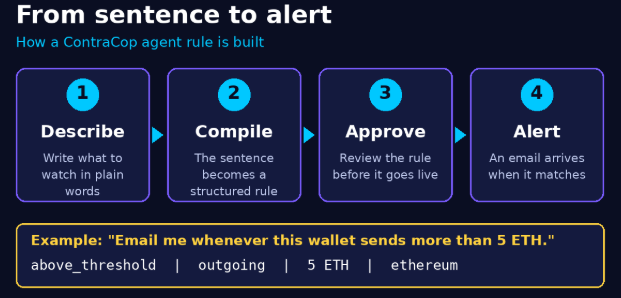
The user writes a sentence. ContraCop compiles it into a structured rule and shows it for approval before anything is deployed.
The site gives one example: "Email me whenever this wallet sends more than 5 ETH." It compiles like this:
Field
Compiled value
Condition
above_threshold
Direction
outgoing
Detail
5 ETH
Network
ethereum
That compiled form is a ContraCop on-chain monitoring rule. In plain words, it means an email about outgoing transfers above 5 ETH, until the user stops it.
Because all eleven agents share one ContraCop rule engine, a Whale Alert rule and a Dormancy rule are handled the same way.
Reading the compiled protocol before approving is the best habit. If the amount or direction is wrong, every alert after it will be wrong too.
Who Gets the Most From This?
The site does not name an ideal user, but the use cases are easy to picture. A small team might watch its treasury wallet for large outflows. A trader might follow a counterparty wallet. A holder might keep an eye on one token.
In each case the pattern is the same. The person decides what counts as unusual, and the guideline watches for it.
How to Deploy an AI Agent on ContraCop
The site shows a simple flow:
Describe the on-chain behaviour to watch, in plain words.
Let ContraCop compile that sentence into a rule.
Review the compiled condition on screen.
Approve it, and the agent goes live.
Wait for alerts by email.
Screens may change over time, so the website stays the final guide.
Can ContraCop AI Agents Track Tokens on Ethereum and Solana?
The site says rules run on both networks. The Token Activity agent covers token transfers and can follow a single token. That is ContraCop token tracking in practice.
Token activity tracking helps when a token matters to a person, such as one they hold or one they build. A sudden burst of transfers is easier to notice with a rule than by eye.
The table below matches common jobs to the agents above.
Job
Agent that fits
Watch a wallet for large outgoing transfers
Wallet Guard
Spot funds heading to an exchange or mixer
Exchange Flow
Notice a sleeping wallet waking up
Dormancy
Apply one rule to many addresses
Watchlist
Follow one token's transfers
Token Activity
Catch unusually large movement
Whale Alert
How On-Chain Monitoring Works With AI Agents
The whole flow comes down to four moves: describe, compile, approve and alert. The AI handles the translation. The user keeps the final say.
That split matters. A typed sentence can be vague, while a compiled rule is exact. Showing the rule before it goes live lets the user catch a wrong number or the wrong network early, when the fix is still free.
Good Habits for Monitoring Rules
Start with one wallet and one rule, then add more.
Check the amount, direction and network before approving.
Use Watchlist when many addresses need the same rules.
Stop rules that are no longer needed, since they run until stopped.
Treat alerts as information. ContraCop describes its output as data-driven security insights, not financial guarantees.
Final Thoughts
ContraCop AI agents turn a manual habit into a written rule. The user states what matters, checks the compiled version, and gets an email when it happens.
That is the real value of automated monitoring: less watching, with the user still in control. For anything beyond this guide, the website and the official whitepaperare the places to confirm details.
Disclaimer: This article is for information only and is not financial advice. Features may change, so check the official website before relying on any detail.