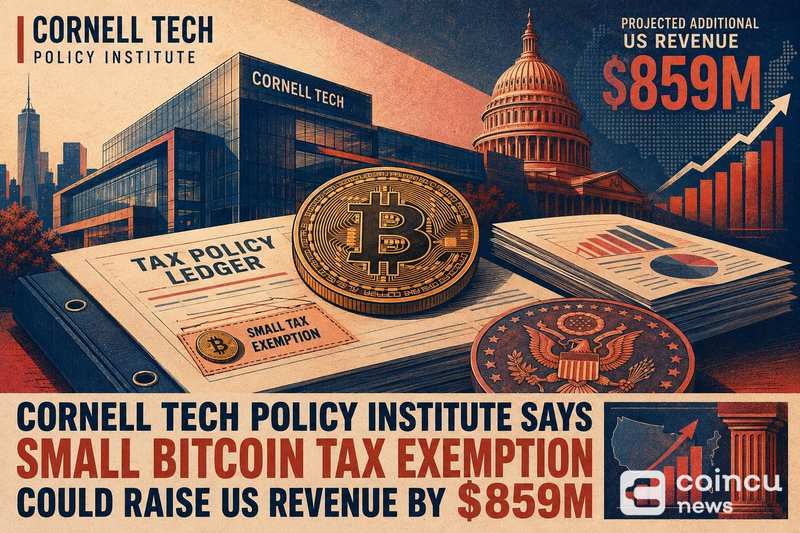
A policy estimate attributed to the Cornell Tech Policy Institute holds that exempting small Bitcoin transactions from US capital gains tax could raise federal fiscal revenue by roughly $859
A policy estimate attributed to the Cornell Tech Policy Institute holds that exempting small Bitcoin transactions from US capital gains tax could raise federal fiscal revenue by roughly $859 million over a 10-year window, reframing a small Bitcoin transactions capital gains tax exemption as a revenue-positive measure rather than a giveaway, though the figure remains a research projection and not enacted law.
What the Cornell estimate claims, and what it does not
The core claim is narrow: carving out small Bitcoin transactions from capital gains treatment could, over a decade, add roughly $859 million to US fiscal revenue, per the estimate credited to the Cornell Tech Policy Institute. As of publication, the underlying research documentation was not independently verifiable in full, and the number should be read as an institute projection rather than a scored, official figure. For related coverage, see What Is Bitcoin L2 Finality? Sequencers, Proofs, and Withdrawal Confidence.
No US statute currently grants such a de minimis exemption. A related legislative vehicle, Senate Bill 2207 in the 119th Congress, sits in the federal pipeline as text, not law, meaning the exemption discussed here is conditional on legislative action that has not occurred. For related coverage, see Hackers Target $8.7 Billion Mt. Gox Bitcoin Wallets.
Why a tax carveout could lift revenue rather than cut it
The counterintuitive logic is that capital gains treatment on every Bitcoin payment creates a compliance friction that suppresses reportable activity, so a targeted exemption on small transactions could increase overall taxable economic activity even as it forgoes tax on the smallest transfers. The Cornell estimate frames the net effect as positive over the full 10-year horizon, which implies the projected behavioral and compliance gains outweigh the direct revenue given up. For related coverage, see Bitcoin ETFs Rebound as Ethereum and XRP ETFs Lose Momentum.
Because the exemption is scoped to small transactions, the mechanism targets everyday spending use cases rather than large investment disposals, limiting the direct revenue foregone while easing the reporting burden that currently attaches to routine Bitcoin payments. The institute's reasoning, as attributed, rests on that behavioral response; readers should treat the $859 million as contingent on those assumptions holding.
What it would mean for spending Bitcoin in the US
Under current US treatment, spending Bitcoin is a taxable disposal, so a coffee bought with BTC can trigger a capital gains calculation, a friction that discourages transactional use. A small-transaction carveout would remove that calculation for low-value transfers, which is the segment most relevant to merchant acceptance and consumer payments.
That utility angle connects to longer-running measurement of where Bitcoin is actually used for payments, a theme reflected in the Cornell Bitcoin adoption index tracking El Salvador and Venezuela, and to the settlement economics explored in analyses of how Bitcoin L2 fees are calculated. A policy proposal, however, does not guarantee legislative change, and none of the adoption context alters the fact that the exemption is not yet law.
How policymakers may weigh it
The estimate is framed at the US federal fiscal level, and capital gains treatment is a federal matter, so any change would run through Congress rather than agency rulemaking alone. Tax simplification framed as revenue-positive can draw interest across policy camps, but a research proposal is not a scored bill, and the distinction matters for anyone tracking whether the idea gains traction.
The concrete trigger to watch is legislative movement on de minimis crypto tax text such as the S.2207 bill page; absent a committee vote or scoring by an official body, the $859 million projection stays a research claim. The Cornell Tech Policy Institute's public work is catalogued on its institute site index for readers seeking the primary documentation.
FAQ
Is this exemption already US law? No. It is a policy proposal and estimate; no statute currently exempts small Bitcoin transactions from capital gains tax.
What is a "small" Bitcoin transaction here? The available research frames the exemption around low-value, transactional use rather than large disposals, but a precise dollar threshold is not established in the verifiable evidence.
Why would an exemption raise revenue? The attributed reasoning is that reduced compliance friction increases overall reportable economic activity, offsetting the tax foregone on the smallest transfers.
Does it apply to all crypto? The estimate as presented is specific to Bitcoin; broader crypto application is not supported by the available evidence.
Disclaimer: This article is for informational purposes only and does not constitute financial or investment advice. Cryptocurrency and digital asset markets carry significant risk. Always do your own research before making decisions.
The post Cornell Tech Policy Institute Says Small Bitcoin Tax Exemption Could Raise US Revenue by $859M was initially published on Coincu.