Why $NEAR Intents and Liberdus could change how everyday users interact with Web3. We often talk about mass adoption in crypto, but there's something we tend to overlook. What happens after s
Why $NEAR Intents and Liberdus could change how everyday users interact with Web3.
We often talk about mass adoption in crypto, but there's something we tend to overlook.
What happens after someone buys their first cryptocurrency?
Imagine a newcomer holding $ETH who wants to send money to a friend using another blockchain.
They quickly discover that owning crypto and actually using it are two different experiences.
Different networks, wallet addresses, gas fees, bridges, transaction approvals...
What should be a simple payment suddenly becomes a technical challenge.
And that raises an interesting question:
Are we building crypto applications for everyday people, or expecting everyone to become a blockchain expert?
Blockchain technology has made impressive progress.
We have faster networks, decentralized exchanges, smart contracts, and increasingly sophisticated cross-chain infrastructure.
Yet the user experience remains fragmented.
Someone might need one application to communicate, another to manage their wallet, and a third to move assets between networks.
For experienced users, this may feel normal.
But imagine explaining all these steps to someone using crypto for the first time.
That's where the problem becomes obvious.
People don't need to understand how internet protocols work to send an email. They simply open an application and communicate.
Why shouldn't crypto payments become just as intuitive?
This is where intent-based technology becomes particularly interesting.

NEAR Intents introduces a different approach to cross-chain transactions.
Instead of asking users to manually determine every step required to move assets, the system allows them to specify their desired outcome.
For example, a user might want to exchange a supported asset on Ethereum for another asset on a different blockchain.
Independent solvers can compete to fulfill that request.
The user focuses on the result, while the underlying infrastructure coordinates much of the execution.
Of course, this doesn't eliminate transaction costs, liquidity requirements, or security considerations.
But it could significantly reduce the technical complexity users encounter.
And that's an important distinction: making blockchain technology easier to use without requiring users to understand every mechanism behind it.

Now let's consider something interesting.
Many financial transactions begin with conversations.
A freelancer discusses a project with a client before receiving payment.
Friends organize an event and split expenses.
Someone living abroad sends financial support to family members.
Communication comes first. The payment follows.
Yet in crypto, these activities often happen in completely separate applications.
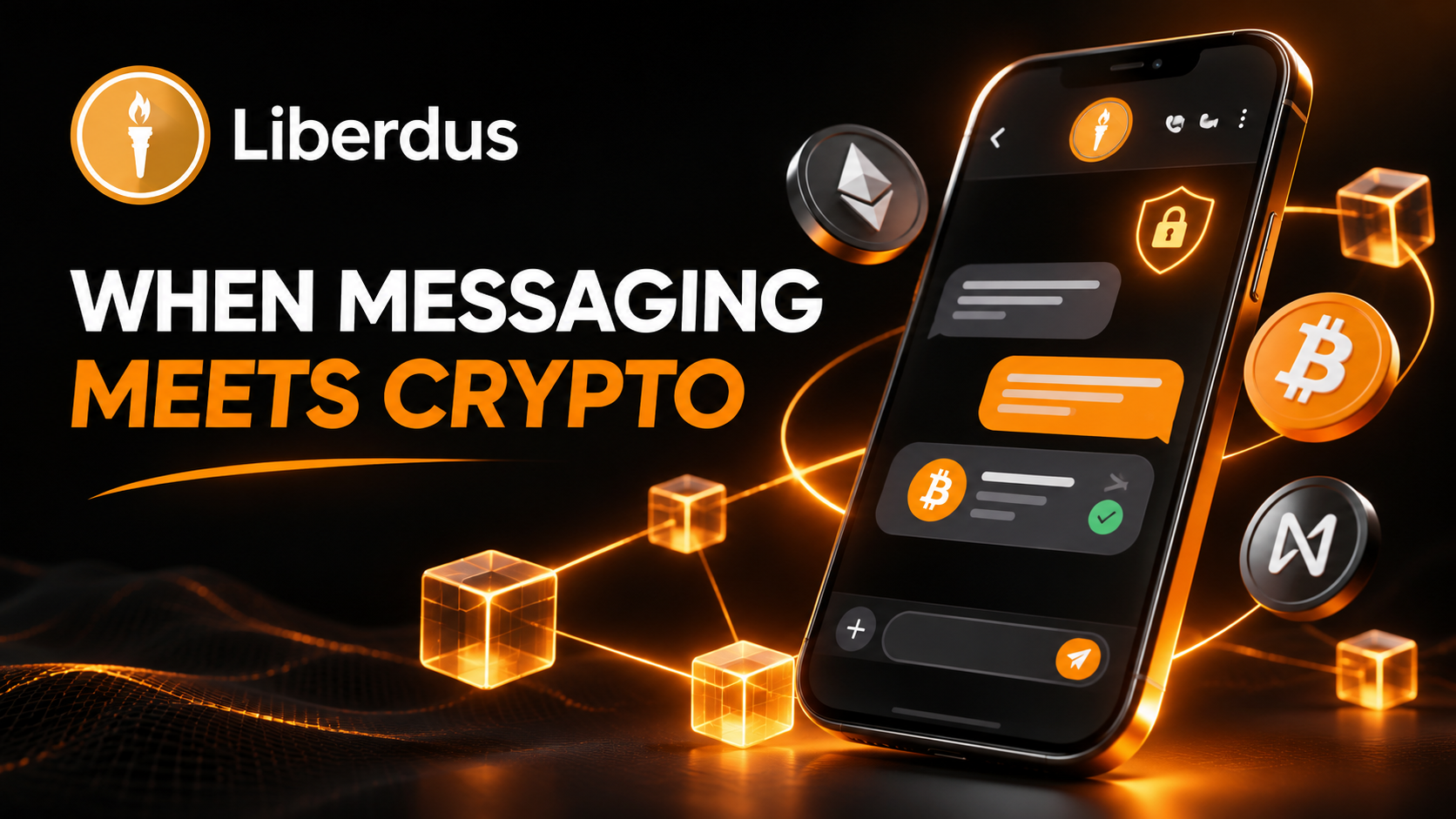
This is why Liberdus' planned integration with NEAR Intents deserves attention.
Imagine chatting privately with someone and initiating a supported cross-chain transaction from the same environment.
Instead of constantly switching between wallets, messaging applications, and bridges, users could manage more of the interaction in one place.
The opportunity isn't simply adding crypto payments to a messenger. It's making financial interactions feel like a natural extension of communication.
That could make Web3 more approachable for people who currently find blockchain technology intimidating.
There's another side to this discussion.
A smoother interface doesn't guarantee a better transaction.
Users still need clear information about fees, exchange rates, supported networks, and transaction approvals.
And while private messaging can protect conversations, blockchain transactions may still expose information on public networks.
That's why transparency matters.
Liberdus' NEAR Intents integration remains a planned development, and its actual user experience will need to be evaluated once available.
The real challenge will be balancing convenience, security, privacy, and user control.
Removing unnecessary complexity is valuable. Removing important information isn't.
For years, crypto innovation has focused heavily on infrastructure.
But perhaps the next meaningful step toward adoption will come from applications that make this infrastructure easier to access.
Messaging is already familiar to billions of people.
Payments are already part of everyday conversations.
Connecting these experiences could help introduce more users to decentralized financial technology.
And that's why I'm interested in what Liberdus is building with $NEAR Intents.
Not because it guarantees mass adoption, but because it explores a practical question:
What if using crypto no longer felt like using crypto?
What if it simply felt like sending a message?
Liberdus is a decentralized messaging platform focused on private communication and cryptocurrency payments.
It offers end-to-end encrypted messaging, account creation without mandatory phone numbers or emails, decentralized infrastructure, and integrated crypto functionality.
Its roadmap includes NEAR Intents integration, multi-chain EVM compatibility, and decentralized governance.
The broader goal is to combine private communication and digital financial interactions while giving users greater control over their online experience.
Learn more: https://liberdus.com
Now I'm curious: would you use a messaging app that lets you communicate privately and move crypto across supported blockchains? Or would you rather keep messaging and payments separate?