Which Countries With Spot Bitcoin ETFs Are Leading the Global Market? The countries with spot Bitcoin ETFs now include Canada, the United States, Brazil, Hong Kong, Australia, and Switzerland
Which Countries With Spot Bitcoin ETFs Are Leading the Global Market?
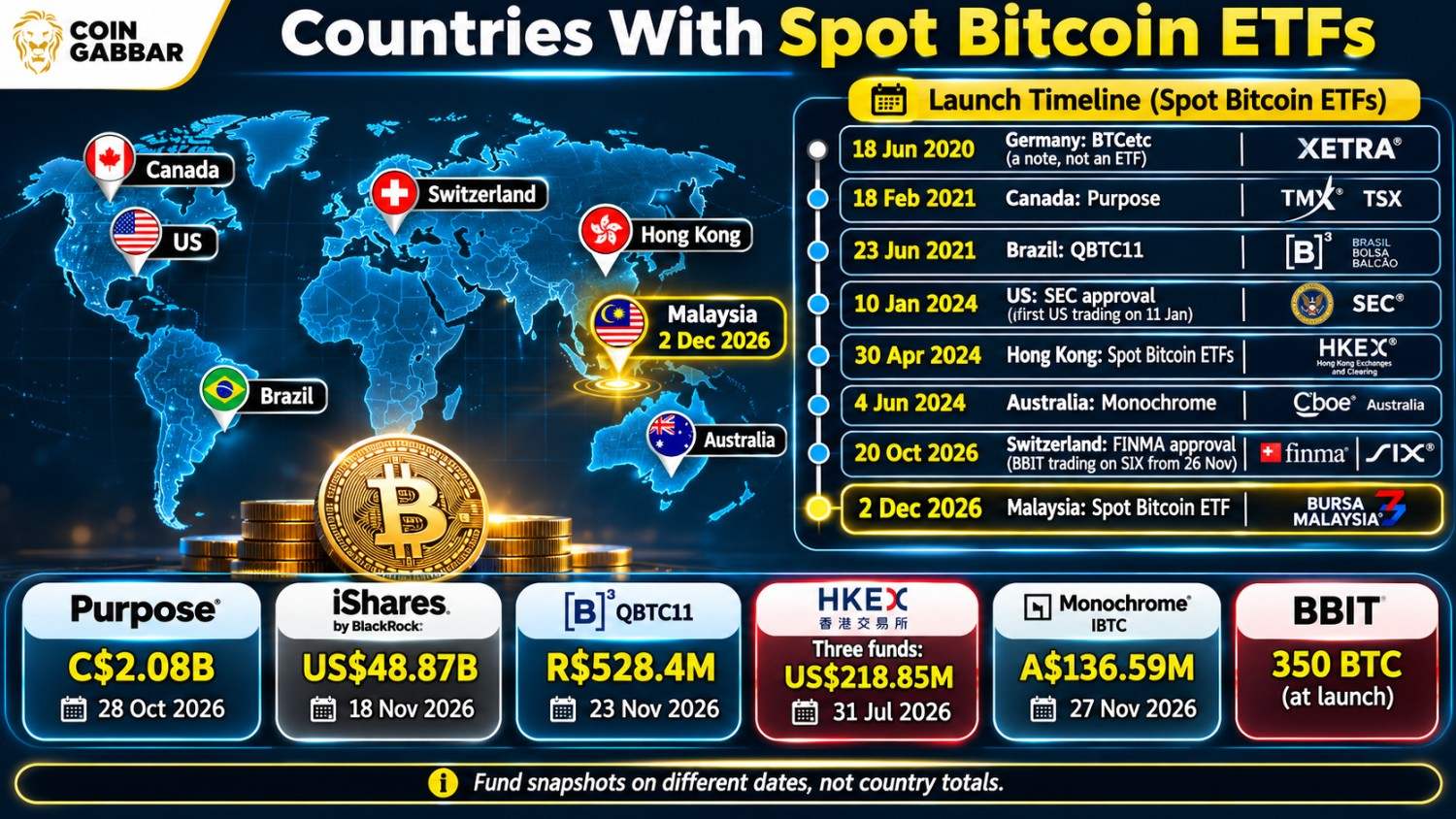
The countries with spot Bitcoin ETFs now include Canada, the United States, Brazil, Hong Kong, Australia, and Switzerland. Malaysia is due to join on Wednesday, 2 December 2026, when Halogen's Shariah-screened fund lists on Bursa Malaysia. Germany and other European markets offer physically backed notes, which are a different legal product from a fund.
A product once blocked in the United States now lists across Asia, Europe, and Latin America. The mix of funds, notes, and exchanges is confusing. Each market below therefore carries its launch date and one dated figure, so the list of countries with spot Bitcoin ETFs stays checkable.
What Is a Spot Bitcoin ETF, and How Is It Different From a Futures Fund?
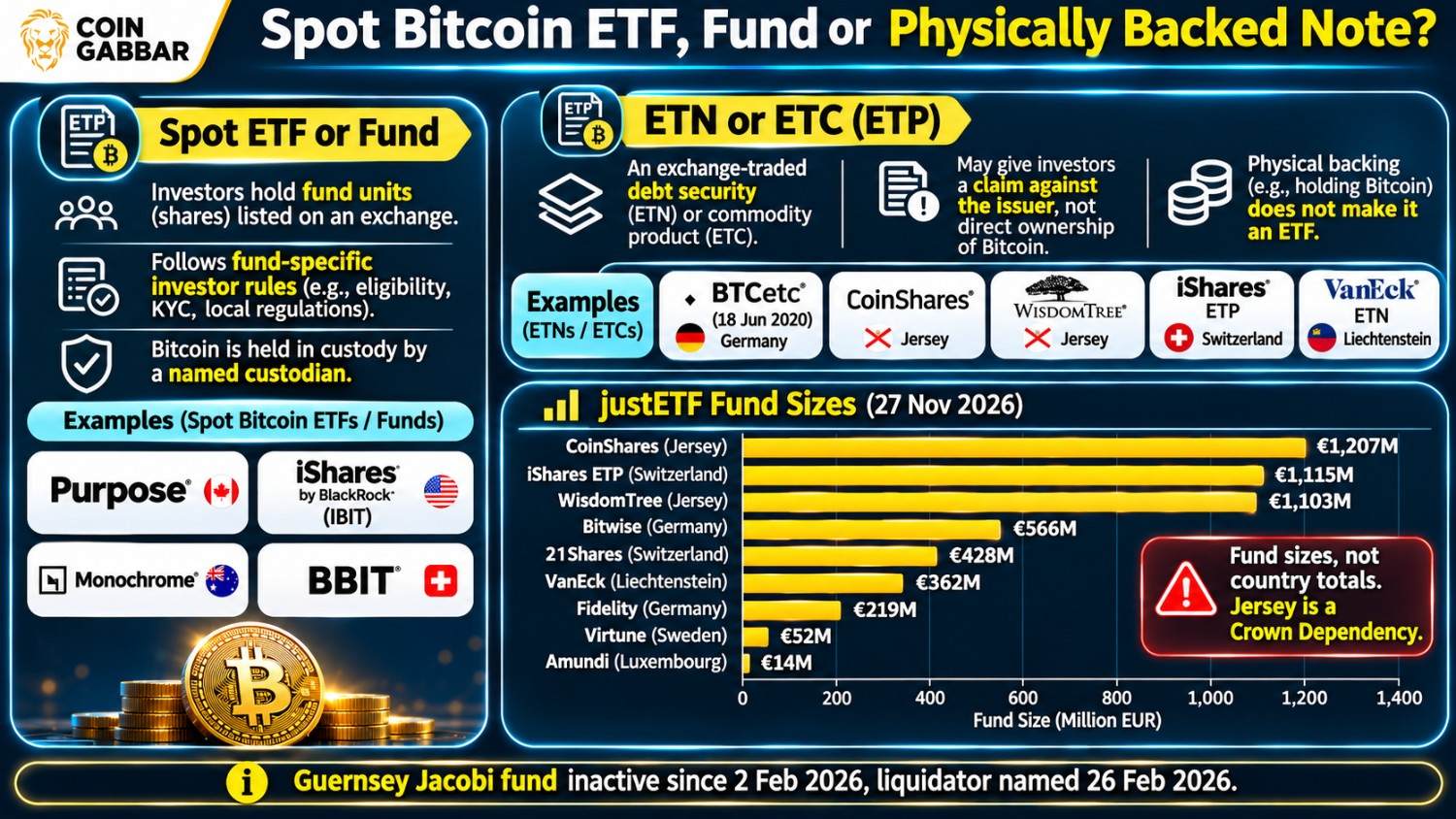
A spot fund holds real BTC, or a structure that represents it, so the share price follows the coin's market price minus fees. A futures fund holds contracts linked to BTC instead. That adds roll costs and can drift from the coin's price.
Such a funds does not give each shareholder private keys. A custodian holds the coins, and investors hold units through a normal brokerage account. Redemption rules depend on the fund. Hong Kong, for example, lets eligible participants subscribe with BTC in kind.
Which Are the Countries With Spot Bitcoin ETFs Today?
This list separates direct funds from other exchange-traded products. Counting both together would overstate the number of countries with spot Bitcoin ETFs. Older global lists also relied on data from early 2024, so they miss the newest launches.
Canada: The First Direct-Custody Fund
The Toronto Stock Exchangelisted Purpose Bitcoin ETF on Thursday, 18 February 2021, at 14:30 UTC, and called it the world's first fund of its kind. It trades under BTCC.B and BTCC.U. Purpose Investments reported assets of C$2.08 billion on 28 October 2026.
United States: The Largest Market
The SEC approved exchange rule changes for these products on Wednesday, 10 January 2024 (~4:00 p.m. ET / 21:00 UTC), asChair Gensler's statement explains. Trading began on Thursday, 11 January 2024, at 09:30 a.m. ET (14:30 UTC). The agency calls them exchange-traded products, though the market says ETFs. BlackRock's IBIT reported US$48.87 billion in net assets on 18 November 2026.
Brazil and Australia
Brazil's QBTC11 began trading on the B3 exchange on Wednesday, 23 June 2021. It tracks the CME CF Bitcoin Reference Rate and reported net assets of R$528.4 million on 23 November 2026.
Monochrome IBTC (Australia) launched on Cboe Australia on Tuesday, 4 June 2024, at 00:00 UTC / 10:00 a.m. AEST. As at 27 November 2026, it had assets of A$136.59 million and charged an annual fee of 0.25%.
Hong Kong: Asia's First
HKEX began trading three BTC funds and three Ether funds on Tuesday, 30 April 2024, 01:30 UTC / 09:30 a.m. HKT, as theexchange's announcement shows. The managers are China AMC, Bosera HashKey, and Harvest. The three BTC funds held US$218.85 million combined on 31 July 2026.
Switzerland: The Newest Direct Fund
FINMA approved the fund called BBIT on Tuesday, 20 October 2026. It has been traded on the SIX Swiss Exchange since Thursday, 09:00 CET (08:00 UTC) on 26 November 2026. The sponsor, BIT Asset Management,reports 350 BTC at launch, held in cold storage at AMINA Bank.
CoinGabbar covered the approval in its report onSwitzerland's first Bitcoin ETF.
European Markets With Physically Backed ETPs
Germany's BTC, etc., was launched on Xetra on Thursday, 18 June 2020, as a centrally cleared, physically backed note. It is an ETN and not an ETF. On 27 November 2026, just ETF listed CoinShares' physical product (Jersey) at €1,207 million, iShares' physical product (Switzerland) at €1,115 million, and WisdomTree's physical product (Jersey) at €1,103 million. Those are fund sizes and not country totals, and Jersey is a Crown Dependency, not a sovereign country.
One historic entry needs care. The Guernsey-based Jacobi fund has been inactive since 2 February 2026, and a liquidator was named on 26 February 2026.
What Makes Malaysia's December 2, 2026 Listing Different?
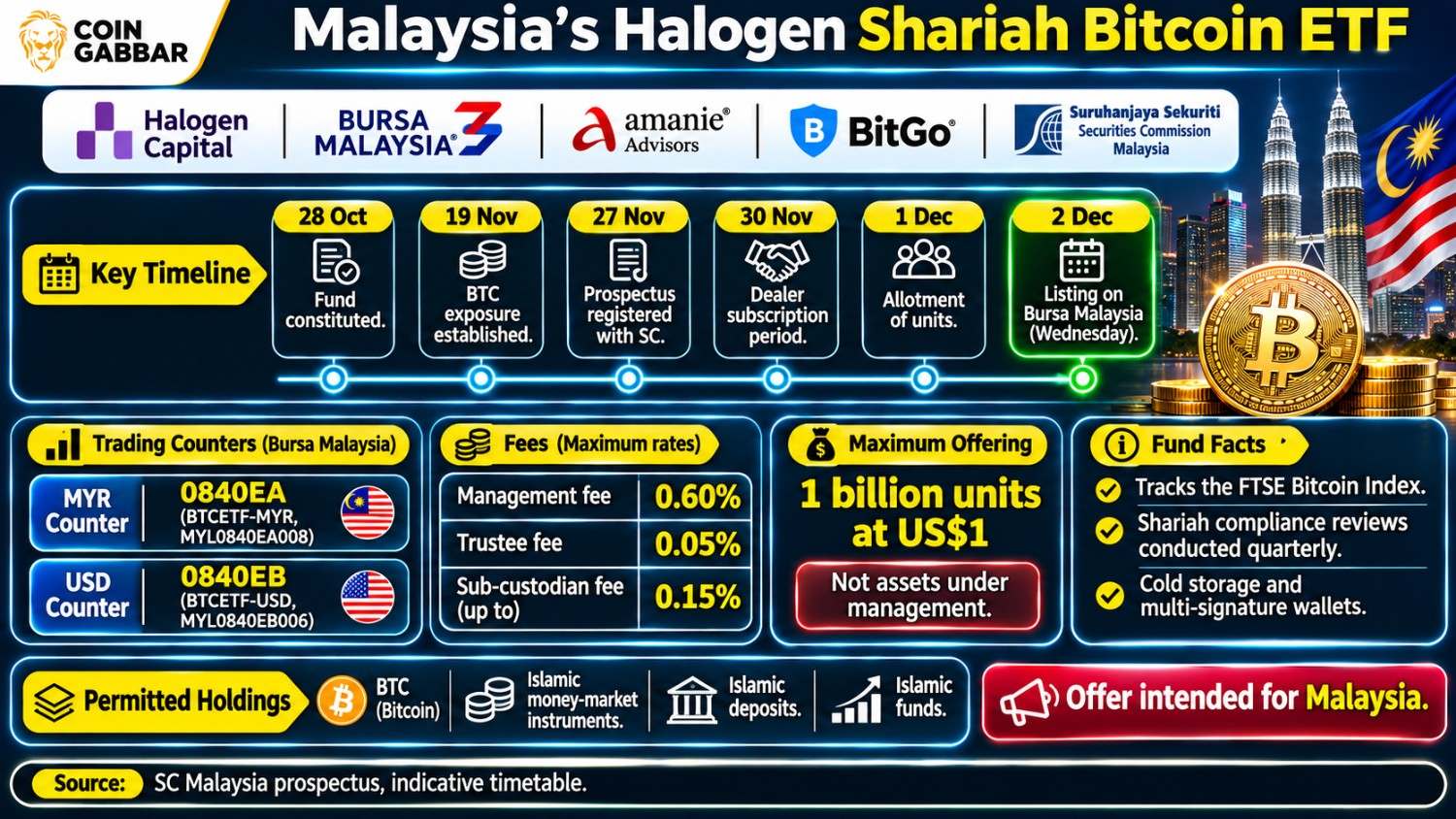
Halogen Capital's fund is the first digital-currency ETF on Bursa Malaysia, and its manager calls it the first Shariah-compliant one. Malaysia would become the seventh market among countries with spot Bitcoin ETFs. Theregistered prospectus gives an indicative timetable. The fund was constituted on 28 October. Exposure began on Thursday, 19 November, and the prospectus was issued on Friday, 27 November. A dealer subscribes on Monday, 30 November; units are allotted on Tuesday, 1 December; and the listing follows on 2 December at 09:00 a.m. MYT (01:00 UTC).
The fund aims to track the FTSE Bitcoin Index within Shariah limits. Amanie Advisors certified it and reviews it every quarter. BitGo Bank & Trust is the sub-custodian, using cold storage and multi-signature wallets. Units trade under 0840EA in ringgit and 0840EB in dollars. Maximum yearly fees are 0.60% for management, 0.05% for the trustee, and 0.15% for the sub-custodian.
The one-billion-unit figure at US$1 each is a maximum offer and not assets under management. The prospectus also says the offer is meant for Malaysia. It is not an offer in other places. A guide to crypto ETFs explains how such funds work, and a note on the Shariah question covers the religious debate.
Which Countries Could Approve Spot Bitcoin ETFs in 2027 and 2028?
Japan and South Korea are the likeliest next additions to the countries with spot Bitcoin ETFs, yet neither has approved a product. Japan's Financial Services Agency repeated on 31 October 2025 that its investment-trust rules do not allow domestic crypto funds. SBI Global Asset Management has discussed BTC and Ether funds if the law changes, and 2028 is a possible window. No law has passed, and no launch date exists. SBI's goal of JPY 5 trillion in assets is a company target and not a forecast. A guide to Japan's crypto rules follows the reform.
South Korea's government outlined a plan on 14 July 2026 to support law changes for digital-asset funds. Its Financial Services Commission met on 24 November 2026 about a new legislative proposal. A plan to amend a law is not an approval, and no first listing date has been set. A guide to South Korea's crypto rules covers the background.
How Can Investors Check if a Fund Is Available to Them?
A listing in one country does not mean every investor can buy it.
Five checks help.
Does the broker offer the fund?
May residents of that country buy it?
Does the broker support the exchange and currency?
Is the product a fund, a trust, a note, or a futures product?
What are the fees, custody, and redemption terms?
Overseas access to US funds depends on residence, local securities law, broker rules, and tax. Halogen's offer is also limited to Malaysia on paper. Even among countries with spot Bitcoin ETFs, access differs by investor.
Expert Opinion: Do More Countries With Spot Bitcoin ETFs Help Investors?
Supporters argue that familiar brokerage accounts remove wallet and key risks for ordinary savers. Critics reply that fees, custody concentration, and limited access can offset the convenience and that a listing does not promise easy redemption. The fund versus note gap also matters, because a note holder may carry a claim against the issuer.
CoinGabbar research uses a three-part Wrapper, Access, and Cost test. The wrapper asks whether the product is a fund, a trust, or a note. Access asks whether the investor's broker and residence allow a purchase. Cost asks what fees and custody terms apply. Headline counts of countries with spot Bitcoin ETFs hide these differences.
Checklist: Before Buying a Crypto Fund
Confirm the legal structure and the exact issuer.
Check the fund's own assets and the date of the figure.
Compare fees, currency costs and custody arrangements.
Read the redemption terms and any residence limits.
Conclusion: What the Map of Countries With Spot Bitcoin ETFs Shows
The map grew from Germany's 2020 note and Canada's 2021 fund to the US in 2024, Asia in 2024, Switzerland in November 2026, and Malaysia on 2 December. Investors still need to check the wrapper, the access rules, and the costs, because a listing alone proves little. Japan and South Korea are the next markets to watch.
Disclaimer: This article gives general facts and is not investment, legal, or tax advice. Crypto prices can fall sharply, and fund assets change with prices and investor flows. Rules in countries with spot Bitcoin ETFs can change after the date below, and product availability differs by country. Related reading covers BTC price analysis and crypto regulation.