Crypto Card Payments Hit a Stunning $12.5B Record Crypto card payments reached a record $12.5 billion, according to PaymentScan data first shared by The Kobeissi Letter on X. The figure is up
Crypto Card Payments Hit a Stunning $12.5B Record
Crypto card payments reached a record $12.5 billion, according to PaymentScan data first shared by The Kobeissi Letter on X. The figure is up 140% year to date and 247% from October 2025 levels.
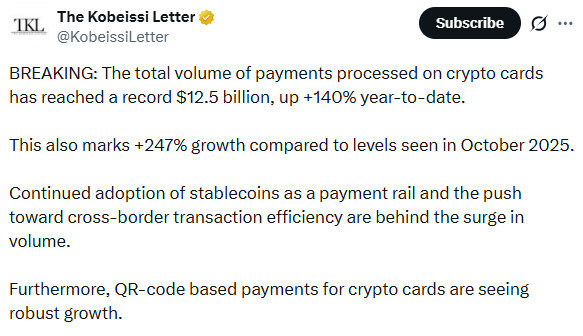
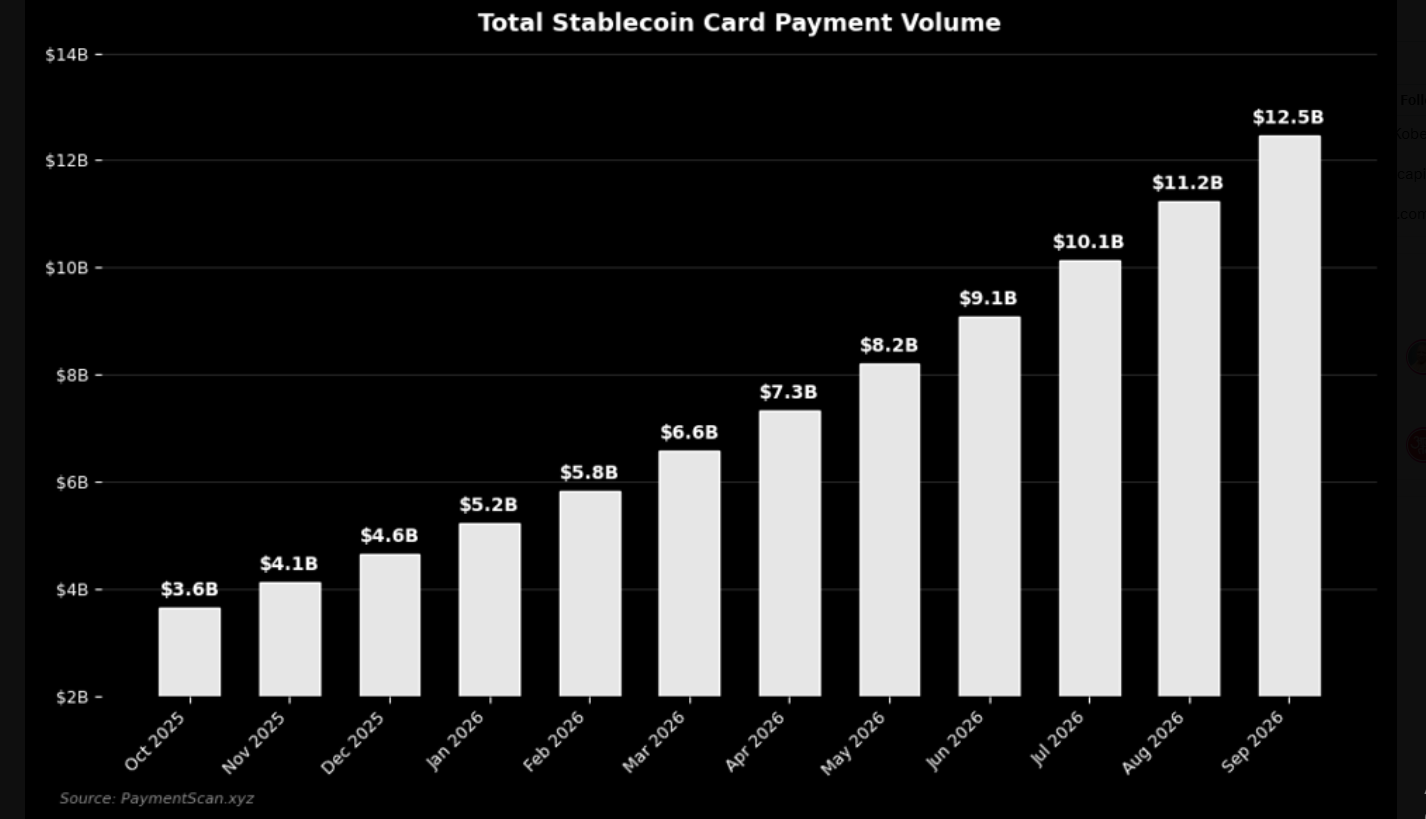
The numbers come from PaymentScan data, a platform that tracks stablecoin card activity using onchain data. Its chart lists the $12.5 billion total under September 2026.
The Numbers Reveal How Fast Card Spending Is Growing
Monthly volume rose in every period on the chart. It started at $3.6 billion in October 2025 and moved to $4.1 billion in November. December closed at $4.6 billion, and January 2026 came in at $5.2 billion.
Growth continued through spring and summer. April printed $7.3 billion, June $9.1 billion, and July $10.1 billion. August reached $11.2 billion, so September added about $1.3 billion, or roughly 11.6%, in one month. The 140% year-to-date figure lines up with the move from $5.2 billion in January.
Why Crypto Card Payments Are Rising
The post points to two main drivers. Stablecoins are being used more as a payment rail, and users want more efficient cross-border transactions. QR code payments are also growing quickly.
That demand shows up at Jupiter Spend, one of the largest on-chain card providers. Activated cards there grew 55% quarter over quarter, with demand for QR payments cited as a key reason.
Jupiter's documentation explains how Jupiter QR Pay works. Users fund a Spend account with USDC on Solana, scan a merchant code, and the payment settles through local rails. The listed markets are Vietnam, Thailand, the Philippines, and Singapore.
Merchants do not need a Jupiter integration, and Jupiter notes QR Pay is not supported for new card accounts issued under its newer card program.
Why It Matters for Stablecoin Payments
The data shows stablecoins moving beyond trading and transfers into daily spending. Crypto card payments let users spend stablecoin balances where merchants already accept cards or local QR networks.
That keeps the crypto step on the user side. Demand for dollar stablecoins also ties into wider regulation and market changes, covered in recent stablecoin news.
Cross-border use stands out as a clear focus. A user holding dollar stablecoins can pay in local currency through QR or card networks without a bank transfer.
The Biggest Questions Behind the $12.5B Payment Surge
Several points are not confirmed. The post does not split volume by card issuer or region. It also does not say how much growth came from newly listed cards compared with existing ones. The 55% figure for Jupiter Spend measures activated cards, not payment volume.
Monthly volume can also shift with new listings and seasonal spending. Whether crypto card payments keep rising at this pace in the coming months is not yet known. Wider market updates sit in the daily crypto news today roundup.
Expert Take: What to Watch Next in Crypto Card Payments
The data suggests crypto card payments grew every month from October 2025 to September 2026. The 11.6% gain in September is a useful number to compare against the next monthly print. Activated card counts and the share of QR payments are the other signals tied to Jupiter.
The main risks include regulation of card issuers, foreign exchange fees on non-dollar spending, and reliance on stablecoin reserves. The main uncertainty remains whether the growth reflects lasting use or a wave of new card launches.
Conclusion
Crypto card payments reached $12.5 billion in September 2026, and the chart shows steady growth across twelve months. Stablecoin rails and QR payments are the cited drivers. Details on issuer split and long-term durability are still missing.
Disclaimer:This article is for information only and is not financial advice. Crypto assets are volatile and carry risk, and past volume does not predict future results. Do your own research before making any financial decision.