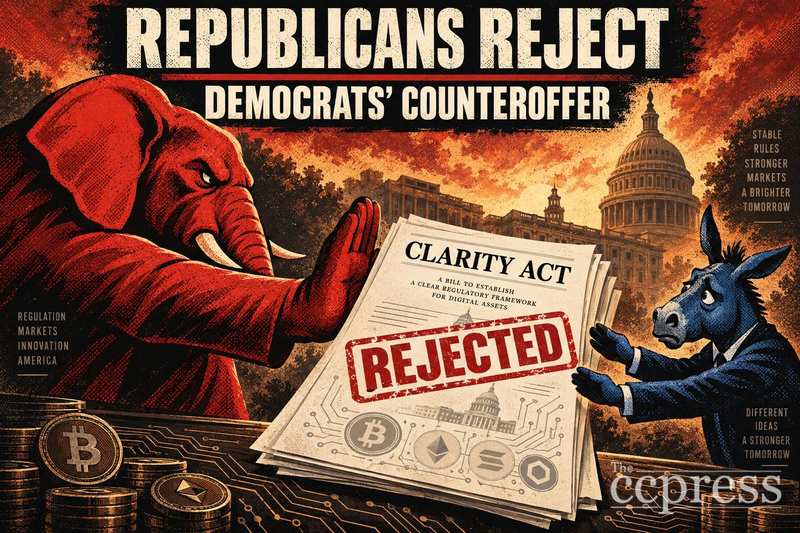
The crypto CLARITY Act has stalled in the Senate, failing to clear a procedural hurdle amid bipartisan opposition that pits Republican defectors against Democrats demanding tougher ethics gua
The crypto CLARITY Act has stalled in the Senate, failing to clear a procedural hurdle amid bipartisan opposition that pits Republican defectors against Democrats demanding tougher ethics guardrails.
The Senate failed to advance the CLARITY Act in a cloture vote on September 15, 2026, according to reporting from the New York Post. Cloture is a procedural step, not final passage. A stall here means the bill could not clear the motion to proceed, not that the Senate formally rejected it. For related coverage, see Galaxy CEO: US Crypto Legislation at Risk if Clarity Act Stalls.
That distinction matters. This was a roadblock, not a burial. The setback echoes an earlier failure to clear a Senate vote that already put the industry on edge. For related coverage, see Crypto Clarity Act advances, awaits full Senate vote and Trump’s signature.
Where the crypto CLARITY Act stands in the Senate
The bill’s identity is well established. The official House-engrossed text of H.R. 3633, from the 119th Congress, names it the Digital Asset Market Clarity Act of 2025, per the U.S. Government Publishing Office.
That version builds a dual-regulator framework. Title III covers SEC intermediary registration and Title IV covers CFTC digital-commodity intermediary registration, splitting oversight of digital commodities between the two agencies.
The House-engrossed bill also carves out decentralized-finance exclusions in sections 309 and 409 and folds in an Anti-CBDC Surveillance State Act title. Those are features of the House text, not confirmation of whatever amended language the Senate was weighing.
One caution runs through this whole story: the official document is the House version. The current Senate amendment text was not publicly accessible, and it should not be conflated with the House-passed bill. The bill’s earlier journey, when it advanced toward a full Senate vote, is a very different chapter from where it sits now.
What is behind the bipartisan Senate opposition?
The cloture threshold was the wall. Advancing the bill required 60 votes, according to the Post. The disputed exact tally is omitted here because the official Senate roll call was unavailable and reports conflict.
Reported cloture threshold
60 votes
According to the New York Post, advancing the CLARITY Act required 60 votes for cloture. This procedural threshold is not a final-passage requirement. The official roll call was unavailable, and the disputed vote tally is omitted.
The opposition crossed party lines. The Post named Republican senators Susan Collins, Josh Hawley and Jerry Moran among the no votes. Those individual votes remain attributed to that reporting pending the official roll call.
Democrats came from a different angle. They objected to insufficient restrictions on officials profiting from crypto, an ethics concern rather than a market-structure one, according to the Post. That split is what makes the resistance bipartisan: different motives, same outcome.
A separate legal fault line drew industry alarm before the vote even happened. Coin Center’s Jason Somensatto flagged last-minute changes to the Blockchain Regulatory Certainty Act language, warning that revised text weakens protection for developers.
“The revised language would still provide important protections for non-controlling blockchain developers under the Bank Secrecy Act (BSA), but it removes the BRCA’s explicit protection against criminal liability under 18 U.S.C. § 1960.” — Jason Somensatto, Coin Center
That is a subtle but sharp distinction. Registration relief under the Bank Secrecy Act is not the same as immunity from criminal money-transmission liability, and Coin Center argues the new draft keeps one while dropping the other. Concerns over provisions like stablecoin yield rules have dogged the bill through its Senate journey.
What to watch next for the crypto CLARITY Act
The immediate industry reaction was measured, not panicked. Fireblocks U.S. policy director Jessica Martinez told the Post that large institutions are already building under the existing framework, while more cautious banks and asset managers wait for rules that can survive court challenges or a change of administration.
“Without it, adoption continues, just more unevenly and with fewer institutions willing to move at scale.” — Jessica Martinez, Fireblocks
Whether the bill gets another shot is unsettled. A search summary suggested a motion to reconsider was filed, but according to unconfirmed reports no underlying motion record was available, so a second vote is not established. The bill’s fate has also been shaped by Democrats’ counteroffer in earlier rounds of negotiation.
Claims that the setback permanently kills the legislation should also be treated with caution. According to unconfirmed reports and forecasts in the coverage, some see the door closing on 2026, but no official determination rules out further consideration.
The broader market gave no clean verdict. Bitcoin traded at $75,596 in a contextual snapshot, down 3.8% on the day, though that move cannot be pinned on the vote. The Fear & Greed Index sat at 69, in “Greed” territory, a reading unrelated to this legislation.
So the CLARITY Act limps forward, wounded by an unlikely coalition. Can crypto’s biggest legislative push survive a Senate where both parties found reasons to say no?
Disclaimer: This article is for informational purposes only and does not constitute financial or investment advice. Cryptocurrency and digital asset markets carry significant risk. Always do your own research before making decisions.
The article Crypto CLARITY Act Stalls Amid Bipartisan Senate Opposition first featured on theccpress.com.