The crypto crash has left a lot of portfolios deep in the red. $Bitcoin is down about 25% since January, $Ethereum about 38%, and many altcoins have lost even more. There is one small upside
The crypto crash has left a lot of portfolios deep in the red. $Bitcoin is down about 25% since January, $Ethereum about 38%, and many altcoins have lost even more. There is one small upside to that pain: in many countries, crypto losses can lower your tax bill.
The strategy is called tax loss harvesting, and the end of the year is when it matters most. Here is how crypto tax loss harvesting works in Germany, the US and the UK, what has changed in 2026, and the mistakes that can cost you the benefit.
What is crypto tax loss harvesting?
Tax loss harvesting means selling a coin that trades below your purchase price to turn a paper loss into a realized loss. That realized loss can then offset taxable gains you made elsewhere in the same year, so you pay tax on a smaller amount.
A loss on paper does nothing for your taxes. Only a sale (or a swap into another coin or a stablecoin, which most tax authorities also treat as a sale) makes it count. Many investors then buy the coin back to keep their position. Whether that is allowed depends on where you live.
Crypto tax Germany: how do crypto losses work?
In Germany, private crypto sales fall under section 23 of the Income Tax Act. The key rule: coins held for more than twelve months can be sold tax-free. That also means losses only count for coins you sell within those twelve months. A loss on a coin you held for 13 months is tax-free, and therefore worthless for your tax return.
A few more points matter:
- Losses only offset crypto and other private sales: they cannot reduce tax on your salary, rent or share gains.
- The 1,000 euro limit is a threshold, not an allowance: if your total gains from private sales stay below 1,000 euros a year, they are tax-free. Once you reach 1,000 euros, the full amount is taxable. Harvesting a loss can push you back below that line.
- Unused losses do not expire: you can carry them back one year or forward without limit, but only if you declare them in your tax return (Anlage SO).
- There is no explicit wash sale rule: you can buy the coin back, but the rebuy starts a new twelve-month holding period.
Here is a simple example. You made a gain of 4,000 euros trading coins you held for a few months. You also hold Ethereum you bought in June 2026 for 5,000 euros that is now worth 3,000 euros. Selling the Ethereum turns that into a realized loss of 2,000 euros, so only 2,000 euros of gains are taxed. At a personal tax rate of 42%, that saves you around 840 euros in income tax.
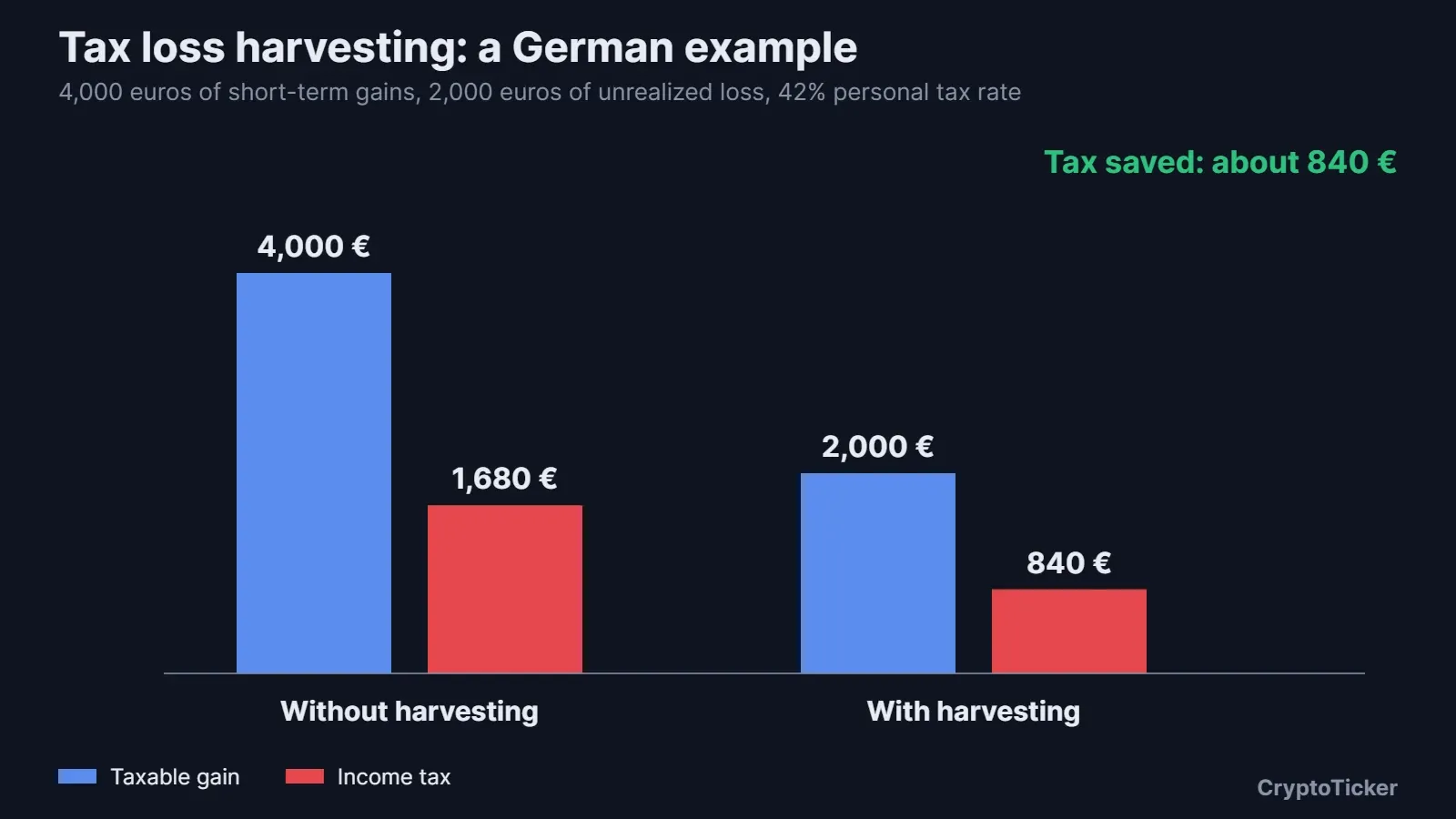
Tax loss harvesting in a German example
One more German detail is worth watching this year. In September, the Federal Ministry of Finance published a draft that would tax crypto bought from January 1, 2027 at a flat 25%, with no tax-free holding period. Coins bought before that date would keep the old rules. The cabinet has still not adopted the draft, and on November 11 BILD reported that the coalition may drop the plan, which the government has not confirmed. Until a new law passes, the one-year rule applies. If the draft does go through, coins you buy back before December 31, 2026 would stay under the current rules. Our guide to crypto tax in Germany tracks the reform.
Crypto wash sale rule: can US investors sell and buy back?
In the US, the wash sale rule blocks investors from claiming a loss on stocks if they buy the same stock back within 30 days. Under current law, that rule does not apply to crypto. US investors can sell a coin at a loss and buy it back right away, and still claim the loss.
The rules for using crypto losses on US taxes:
- Losses first offset capital gains, short-term against short-term and long-term against long-term.
- Up to $3,000 of net losses can offset ordinary income such as your salary each year.
- Anything above that carries forward to future years.
- The sale has to happen by December 31 to count for 2026.
There is a catch this year. In September, the House Ways and Means Committee advanced a bill (H.R. 10357, the Digital Asset Tax Certainty Act) that would extend the wash sale rule to crypto. As written, it would cover sales after September 14, 2026. The bill still needs to pass the full House and the Senate and be signed, and similar proposals have failed since 2021. But if it does become law, a quick sell and rebuy this fall could lose its tax benefit. Waiting more than 30 days before buying back is the safer route if you want to be sure.
Crypto losses in the UK: watch the 30-day rule
The UK is stricter. HMRC applies the same-day rule and the 30-day "bed and breakfasting" rule to fungible tokens like Bitcoin and Ether. If you sell at a loss and buy the same coin back within 30 days, the sale is matched with the new purchase instead of your original cost, and the loss largely disappears.
- The annual tax-free allowance for capital gains is £3,000 in 2026/27.
- Gains above it are taxed at 18% or 24%, depending on your income.
- Losses have to be reported to HMRC within four years of the end of the tax year in which they happened.
- The UK tax year ends on April 5, so you have until then, not December 31.
UK investors who want to stay invested can buy a different coin, or wait more than 30 days before buying back.
How to use crypto losses on taxes: a quick checklist
- Pull your full transaction history: from every exchange and wallet, including swaps and fees.
- Find your realized gains for 2026: you need to know what you want to offset before you sell anything.
- List the coins below your purchase price: in Germany, only coins you have held for less than twelve months.
- Check your local rule before buying back: no restriction in the US for now, a new holding period in Germany, the 30-day rule in the UK.
- Sell before the deadline: December 31 in Germany and the US, April 5 in the UK.
- Keep records and declare the losses: a loss you do not report cannot be carried forward.
Our free crypto tax calculator shows what a sale would mean for your tax bill before you make it.
Crypto crash taxes: mistakes to avoid
- Letting taxes drive the trade: a tax saving of a few hundred euros or dollars does not justify selling a coin you still believe in at the wrong moment, or buying one you do not want.
- Forgetting the costs: trading fees and spreads on the sale and the rebuy eat into the saving. Small positions are often not worth it.
- Selling coins that are already tax-free: in Germany, a loss on coins held for more than a year does not count.
- Missing a swap: trading one coin for another, or for a stablecoin, is usually a taxable sale too, with its own gain or loss.
- Poor records: without a clean history, you cannot prove your purchase price or holding period.
The crypto crash may not be over, and no one can say when prices will recover. But a loss you can use on your tax return is worth more than one that just sits there. If your situation is complex, talk to a tax adviser before the year ends.