Crypto Dusting Attack Privacy: How Tiny Transfers Track Wallets A crypto dusting attack is a tracking attempt in which tiny amounts of cryptocurrency are sent to many wallet addresses. Howeve
Crypto Dusting Attack Privacy: How Tiny Transfers Track Wallets
A crypto dusting attack is a tracking attempt in which tiny amounts of cryptocurrency are sent to many wallet addresses.
However, an unexpected small transfer alone does not prove that someone is targeting the wallet, since its purpose is unclear.
Receiving dust does not give the sender access to funds, private keys, or the recovery phrase, so crypto dusting attack privacy depends on what happens next. Some dust is spam, and some is bait for crypto wallet scams.
What Is a Crypto Dusting Attack? A Simple Explanation for Readers
A dusting attack works like leaving a tiny marker in many mailboxes and watching which ones get opened together.
If a recipient later moves that amount with other funds, the movement may reveal which addresses belong together.
The goal is tracking, not stealing. This guide explains how crypto dusting attacks work.
How Does Dust Help Track Wallet Addresses on a Public Blockchain?
On Bitcoin, dust is an output worth less than it costs to spend. The exact threshold depends on the output type, the transaction size, and fee assumptions.
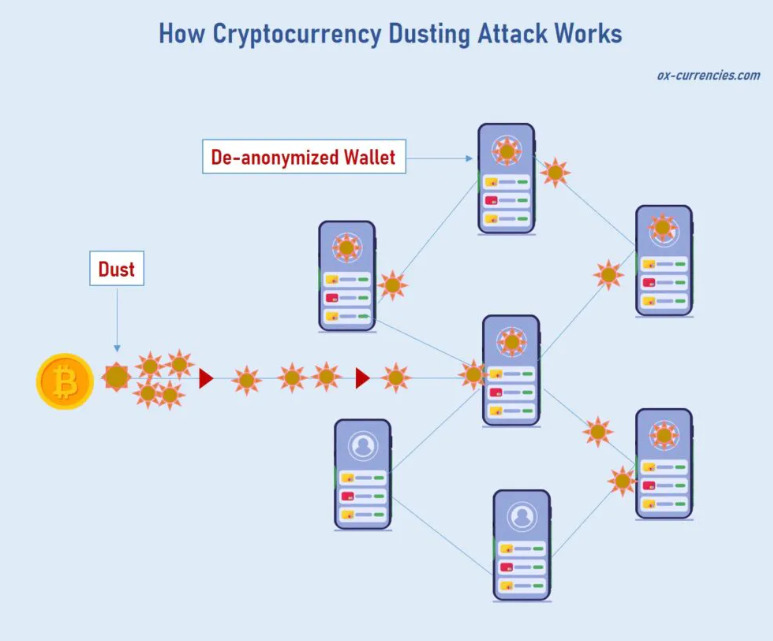
In wallet dusting, the sender spreads such amounts across many addresses and watches the public ledger, a form of blockchain address tracking.
On Bitcoin and other UTXO chains, a UTXO is an unspent transaction output, a separate coin lot with its own history.
If a wallet picks the dust lot together with other lots for one payment, analysts may guess that the addresses belong together. This guess is called transaction clustering.
It is a heuristic and not proof of identity. Bitcoin's draft proposal BIP 451 describes dust attacks and explains how consolidating with other UTXOs can expose possible links between addresses, a form of UTXO tracking.
How Can Dust Link Two Wallet Addresses? A Simple Bitcoin Example
A Bitcoin wallet receives a tiny, unexpected UTXO. The owner later combines it with another UTXO in one payment, so both inputs appear in the same transaction, and an analyst may infer one owner.
CoinJoin can make this inference less reliable, though it does not make every address untraceable. This hypothetical example shows how crypto dusting attackprivacy can weaken.
Does Dusting Work the Same Way on Ethereum and Other Chains?
Ethereum does not track separate coin lots. Each account just carries one balance, and that is the main difference from Bitcoin. The official Ethereum account documentation lays this out, including how accounts can talk to smart contracts.
That changes the dust story. A tiny deposit cannot get pulled into a payment alongside other coins because there are no coin lots to pick from.
So the Bitcoin-style link never forms. What analysts have left is the paper trail around an address: when transfers happen, which tokens move, and which contracts get used.
On-chain analytics tools read that trail. Fake tokens showing up in the history are another headache, and this piece onEthereum scams covers how to recognize them.
Can Receiving Dust Alone Give Anyone Access to Wallet Funds?
Receiving dust alone does not give the sender access to funds, private keys, or the recovery phrase. In crypto dusting attack privacy terms, the immediate risk is lost transaction privacy.
Losses happen only if the owner signs a malicious transaction, grants a harmful approval, or shares the recovery phrase.
Linking an address to a real person may also need exchange records or other off-chain data.
Dusting, Spam Tokens, and Address Poisoning: How Do They Differ?
Type
What arrives
Main goal
Tracking dust
Tiny coin amount
Link addresses together
Spam or scam token
Unknown token, sometimes with a suspicious name, message, or link
Lure the owner to a fake page.
Address poisoning
Tiny or zero-value transfer, or fake token
Place a lookalike address in history.
A token with a claim link follows the pattern of a fake crypto airdrop, where the page asks for a wallet connection.
A honeypot token can block selling after a purchase, while address poisoning invites a rushed copy and paste.
Which Daily Habits Protect a Wallet From Unwanted Dust Transfers?
Knowing how to avoid crypto dusting attacks starts with leaving dust unspent. Some wallets offer coin control, which lets the owner choose which UTXOs a payment uses.
Some also let owners lock a small output so it is not selected automatically. Not every wallet has these features, so official documentation should be checked.
On Bitcoin, using a fresh receiving address for every payment makes it harder to connect one payment to another.
It is a helpful habit, but it does not make a wallet anonymous. The Bitcoin privacy guidance also suggests keeping separate wallets for different purposes.
Many people keep one wallet for daily spending and another for long-term savings, and this guide on how to set up a crypto wallet walks through that split.
Separate wallets can limit the links between activities and support crypto dusting attack privacy, though they cannot promise anonymity.
Links inside unknown tokens should stay unopened, since fake airdrop websites exist to capture wallet connections.
Connecting a wallet alone does not let a website spend its tokens, but a malicious approval or permit signature can, so every wallet request needs review before signing.
What Should a Wallet Owner Do After Receiving Unknown Dust Coins?
Check the transaction on a trusted block explorer.
Avoid spending, swapping, selling, or merging the dust.
Check token approvals if an approval transaction was signed, then revoke suspicious permissions using the Ethereum approval-revocation guide.
Use a new receiving address for the next payment.
Disconnecting a wallet from a website does not revoke existing token approvals. An approval stays active until it is revoked, which is why phishing attacks via airdrops focus on getting one signed.
Expert Take: What Matters Most for Long-Term Wallet Privacy?
Consolidation is a key privacy concern on UTXO-based chains. When multiple UTXOs are spent together, analysts may infer a shared owner.
This remains a heuristic. Avoiding suspicious dust can reduce this tracking risk but cannot make crypto dusting attack privacy absolute.
Conclusion: Why Small Transfers Deserve a Closer Look From Owners
Crypto dusting attack privacy can weaken when dust is spent or merged, or when a wallet connects to whatever arrives with it.
Disclaimer:This article is for general information only and is not financial advice. Official wallet pages should be checked before acting, and crypto transfers are irreversible.