Crypto futures are forward contracts on bitcoin and other cryptocurrencies. They let you trade the price without owning the coins, bet on rising or falling prices and use leverage. The most c
Crypto futures are forward contracts on bitcoin and other cryptocurrencies. They let you trade the price without owning the coins, bet on rising or falling prices and use leverage. The most common form is perpetual futures: futures without an expiry date that stay close to the spot price through a regular balancing payment, the funding rate. In Germany, futures trading is permitted for retail clients. Legally, futures are financial instruments under the Markets in Financial Instruments Directive MiFID II, not crypto-assets under MiCA. You trade them on crypto exchanges that are additionally licensed as investment firms in the EU, or through your broker on futures exchanges such as CME and Eurex. How this works, what it costs and which providers are licensed is explained here.
- A CME bitcoin future covers 5 bitcoin, the micro contract 0.1 bitcoin and the Eurex nano contract 0.01 bitcoin.
- Perpetual futures have no expiry date; at OKX the funding rate is settled every 8 hours.
- On OKX’s bitcoin perpetual, long positions paid at 92 percent of the 270 settlements from August 5 to November 2, 2026.
- In total, holding a long position over these 90 days cost 1.51 percent of its value.
- Since February 24, 2026, ESMA has made clear that perpetual futures for retail clients can fall under the rules for contracts for difference.
- In Germany, gains from futures are taxed at a 25 percent flat-rate withholding tax, with no holding period.
What are crypto futures? Forward contracts with an expiry date
A future is a contract to buy or sell an underlying asset on a set date at a price agreed today. With crypto futures, the underlying is a coin or an index on a coin. Physical delivery almost never happens: on the expiry date, the difference between the agreed price and the settlement price is paid in cash. So you are not buying bitcoin, but a right to the price difference.
Classic bitcoin futures trade on regulated futures exchanges. At CME Group in Chicago, the standard contract covers 5 bitcoin and the micro contract a tenth of a bitcoin. Eurex in Frankfurt lists futures on the FTSE Bitcoin Index, a standard contract worth one bitcoin and, since May 5, 2025, a nano contract of one hundredth. For these futures you need a broker with access to futures trading that approves you after checking your experience. Contract sizes, margin and expiry dates are explained in our guide to bitcoin futures.
There is almost always a gap between the future and the spot price, known as the basis. If the future trades above spot, this is called contango; if below, backwardation. The gap closes on the expiry date, because the future is then settled at the spot price. Anyone wanting to hold a position for longer has to roll it into the next contract before expiry and pays the basis in the process.
Perpetual futures: futures without an expiry date
A perpetual future, or perp, is a future without an expiry date. You can hold the position for as long as you like, as long as your margin suffices. To stop the contract price from drifting away from the spot price, there is the funding rate. If the perp trades above spot, long positions pay a small percentage to short positions at fixed intervals. If it trades below, the payment flows the other way. This makes it worthwhile for traders to close any gap, and the contract stays close to the market.
What determines your position is not the last traded price but the mark price. The exchange derives it from an index of several spot markets, so that a single outlier in its own order book does not trigger liquidations. Settlement is usually in stablecoins such as USDT or USDC, and for some contracts in the coin itself.
Perpetual futures are so popular with traders because they combine three things: short positions without borrowing, leverage without a loan, and no expiry date to keep track of. The price for this is the funding rate, which almost always applies to a long position.

The funding rate balances the long and short sides and keeps the perpetual at the spot price. Illustrative image, AI-generated
Futures or perpetual futures: the differences at a glance
Future with expiry
Perpetual future
Term
fixed expiry date, such as the last Friday of the month
unlimited
Link to the spot price
basis closes at expiry
funding rate every few hours
Ongoing costs
rolling into the next contract
funding, usually paid by the long side
Trading venue
futures exchanges such as CME and Eurex, also crypto exchanges
crypto exchanges and decentralised perp exchanges
Contract size
fixed, from 0.01 to 5 bitcoin
freely selectable in small increments
Settlement
cash settlement in dollars or euros
usually in USDT or USDC
Access in Germany
broker with futures trading
crypto exchange with MiFID licence
In practice, that means: if you want to hedge a holding for a few weeks or have a clear view on a particular date, a future with expiry works well. If you trade short term and want to open and close positions flexibly, you choose the perp and factor the funding rate into your costs.
Funding rate: what a perpetual position really costs
The funding rate is the running price of a perpetual future. It is charged on the value of the position, not on your margin, and at fixed times. At OKX this happens every eight hours, three times a day. Anyone holding a position at the settlement time pays or receives the amount, regardless of how long the position has been open.
We analysed all 270 settlements of the bitcoin, ether and Solana perpetuals at OKX from August 5 to November 2, 2026, using the exchange’s public market data. The result is clear: on the bitcoin perpetual, long positions paid at 92 percent of settlements, on the ether perpetual at 89 percent and on Solana at 71 percent. The individual rate is small, averaging 0.0056 percent per settlement for bitcoin. Over 90 days, however, it adds up.
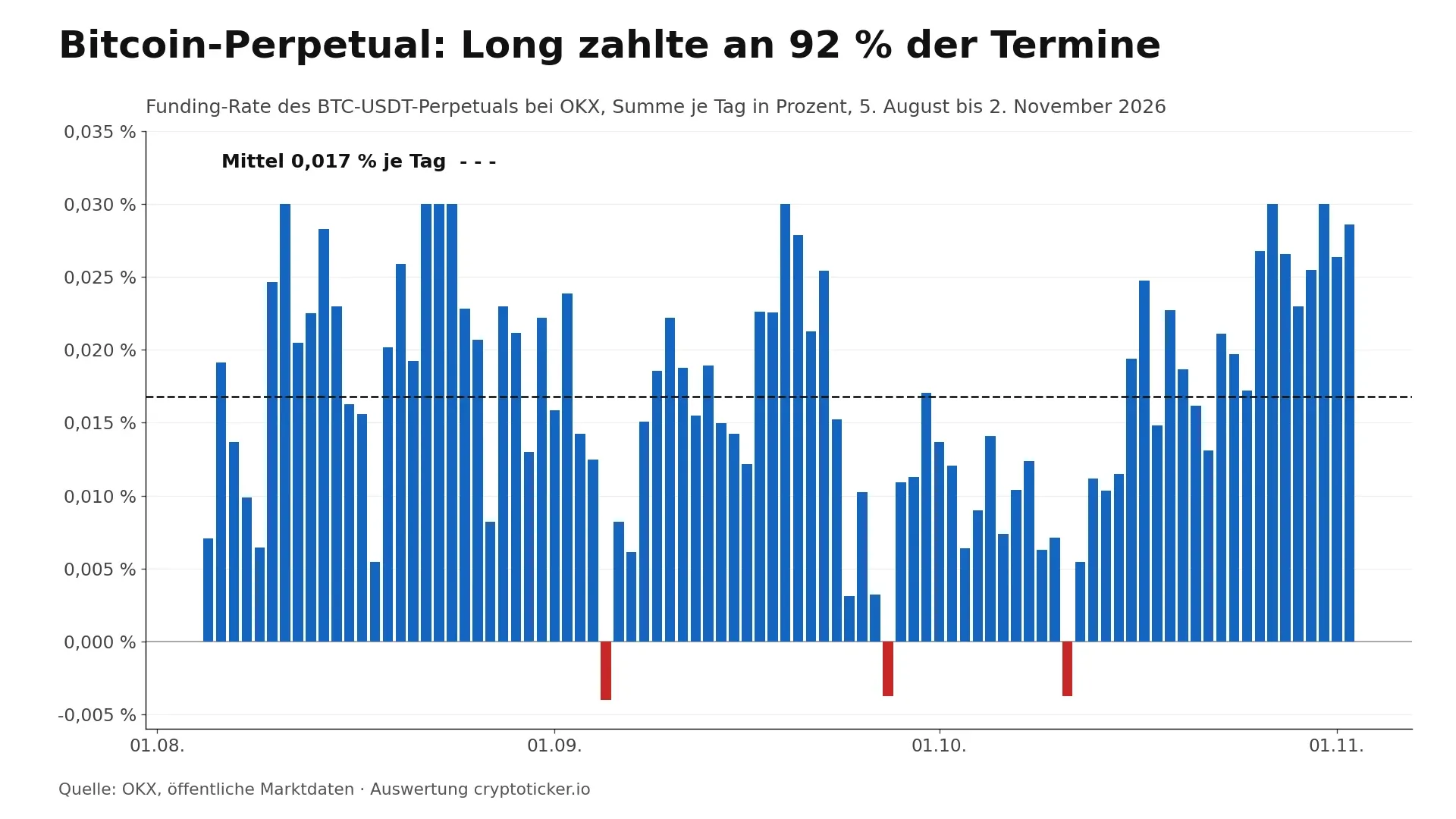
Funding rate of the BTC-USDT perpetual at OKX, 270 settlements from August 5 to November 2, 2026; when positive, long positions pay
Perpetual at OKX
Long paid
Funding over 90 days
Annualised
At 10x leverage on $1,000 margin
Bitcoin (BTC-USDT)
92% of settlements
1.51%
6.1%
$151
Ether (ETH-USDT)
89% of settlements
1.22%
5.0%
$122
Solana (SOL-USDT)
71% of settlements
0.93%
3.8%
$93
For a long position with ten times leverage, that means anyone who held $10,000 worth of bitcoin for three months paid $151 in funding, a good 15 percent of their $1,000 stake. Trading fees for opening and closing come on top. Short positions received these amounts over the same period. The calculation shows why perpetual futures are designed for short-term trades rather than long-term holding. How the funding rate is made up of a premium and an interest component, and how to calculate your own payment, is shown in our guide to the funding rate.
Perpetual futures and ESMA’s rules
Futures and perpetual futures on crypto-assets are derivatives and therefore financial instruments under the MiFID II directive. The crypto regulation MiCA does not cover them; it applies to buying, exchanging and storing crypto-assets. For you as an investor, that means an exchange needs a MiCA licence for spot trading and an additional licence as an investment firm for futures. Many large exchanges have therefore set up separate companies for derivatives in the EU.
On February 24, 2026, the European Securities and Markets Authority ESMA made clear that the product name does not matter: contracts marketed as perpetuals can also fall under the rules for contracts for difference. For retail clients, these rules impose a maximum leverage of 2:1 on crypto-assets, a forced close-out at 50 percent of required margin and protection against losing more than the account balance. What the industry has submitted to the European Commission on this is set out in our analysis of perpetual futures and the CFD rules.

Futures with an expiry date originated on futures exchanges, perpetual futures on crypto exchanges. Illustrative image, AI-generated
Crypto futures in Germany: exchanges with an EU licence
Five crypto exchanges offer retail clients in Germany futures or perpetual futures through a dedicated company licensed as an investment firm in the EU. All five allow up to ten times leverage on bitcoin. The table shows the position as of November 2, 2026, based on the providers’ contract documents and help pages.
Exchange
Company and supervisor
Product
Leverage for retail clients
In the EU since
Coinbase
Coinbase Financial Services Europe, Cyprus (CySEC)
futures with a five-year term and hourly funding, plus monthly and quarterly futures
up to 10x on bitcoin and ether
March 9, 2026
Kraken
Payward Europe Digital Solutions, Cyprus (CySEC)
perpetual futures without expiry, plus futures with expiry on bitcoin, ether and Solana
up to 10x on most contracts
May 20, 2025
OKX
OKX Europe Markets, Malta (MFSA)
X-Perps: futures with a five-year term, funding every eight hours
up to 10x
April 15, 2026
Gemini
Gemini Intergalactic EU Artemis, Malta (MFSA)
perpetual futures, settled in USDC
10x as standard
September 5, 2025
Robinhood
Robinhood Europe, Lithuania
perpetual futures on crypto-assets and other underlyings
up to 10x on bitcoin
summer 2025
Coinbase and OKX structure their perpetuals as futures with a five-year term. For you as a trader, they behave like perpetuals, because a funding rate keeps them at the spot price. Legally they are futures, and futures are exempt from the rules for contracts for difference, as the BaFin general administrative act also states. Kraken, Gemini and Robinhood offer perpetuals without an expiry date. Kraken routes orders to a regulated trading venue of its UK subsidiary Crypto Facilities, Coinbase to its US futures exchange. At OKX, the exchange itself is your counterparty and hedges every trade within the OKX group, as the X-Perps product page and the terms of use describe.
For getting started, the exchanges where you also buy coins on the spot market are a natural choice. At OKX and Coinbase, the spot account and the futures account sit under the same brand, and both exchanges hold a MiCA licence for spot trading. Before you can trade futures, the exchange checks your knowledge and experience with derivatives, as MiFID II requires.
You can reach futures with an expiry date on the large futures exchanges through a broker that offers futures trading. Eurex in Frankfurt has listed bitcoin futures since April 17, 2023 and ether futures since August 12, 2024, and CME in Chicago offers the micro contract of 0.1 bitcoin. Which brokers provide this access is shown in our crypto broker comparison.
Margin and liquidation in futures trading
For every futures position you post collateral, the margin. The ratio of position value to margin gives your leverage: if you post $1,000 for a $10,000 position, you are trading with ten times leverage. If the price moves against you, the margin shrinks. If it falls below the maintenance margin, the exchange forcibly closes the position; that is the liquidation. At ten times leverage, a move of around 9.5 percent against you is enough. How to calculate the liquidation price and position size yourself is shown in our guide to leverage trading with crypto.
Most exchanges offer two types of margin. With isolated margin, only the collateral of the individual position is at stake; with cross margin, your entire account balance serves as collateral. Cross margin delays liquidation but can cost the whole account if things go wrong.
Perp DEX: perpetual futures without a central exchange
Perpetual futures are also available on decentralised exchanges, known as perp DEXs. There you trade directly from your own wallet, without an account and usually without identity verification. Settlement is handled by a smart contract or a dedicated blockchain, and your collateral sits in a contract rather than with an exchange. The best-known perp DEX is Hyperliquid, alongside platforms such as Lighter, Aster and dYdX. Fees, leverage and liquidity are compared in our comparison of the best perp DEXs.
In its terms of use, Hyperliquid excludes persons from the US, the Canadian province of Ontario and sanctioned territories; Germany is not among them. The platform allows up to 40 times leverage on bitcoin and up to 25 times on ether. Perp DEXs have no licence in the EU, and the protective rules for retail clients do not apply there: there is no leverage cap under EU law, no negative balance protection and no supervisor in the event of a dispute. On top of that come their own risks, such as smart contract bugs or a failure of the price feed. How a perp DEX is built technically and who holds the keys is explained in our guide what is a perp DEX.
Tax on crypto futures in Germany
For tax purposes, futures and perpetual futures are forward transactions under Section 20(2) of the German Income Tax Act, because you receive a cash settlement of the difference, not coins. Gains are taxed at the 25 percent flat-rate withholding tax plus solidarity surcharge and, where applicable, church tax. The one-year period after which gains from held coins become tax-free does not apply to futures. Funding payments form part of the position’s result.
Losses from futures can be offset against other capital income; the 2024 Annual Tax Act removed the former limit of €20,000 a year for all open cases. Futures losses cannot, however, be offset against gains from sold coins. Foreign exchanges do not withhold any tax, so you enter the results yourself in Annex KAP of your tax return. The details are set out in our guide to tax on crypto futures. This section is not tax advice.
Who crypto futures trading suits: our conclusion
Crypto futures are a powerful tool for two tasks. They let you hedge a holding against falling prices without selling coins and interrupting a running holding period. And they let you act on a view of the price with little capital tied up, in either direction. Low leverage is enough for both.
Our recommendation: trade perpetual futures at an exchange licensed as an investment firm in the EU, and factor in the funding rate as a fixed cost. Our analysis shows that a long position in the bitcoin perpetual almost always pays; anyone who wants to stay long for more than a few weeks will often find it cheaper to buy the coin directly. For buying without leverage, you will find the licensed providers in our comparison of regulated crypto exchanges. If you want to share as little data as possible when buying, the routes are covered in our guide to buying bitcoin without KYC.
Futures and perpetual futures are complex leveraged products, and a total loss of the stake is possible. This guide is not investment advice. The links to OKX and Coinbase are partner links; they involve no extra cost for you.