The consultation window has closed and the cabinet is next. Associations and specialists had until October 6, 2026 to send the federal finance ministry their comments on the draft bill to ref
The consultation window has closed and the cabinet is next. Associations and specialists had until October 6, 2026 to send the federal finance ministry their comments on the draft bill to reform the taxation of certain crypto assets held privately. The draft of September 30 would abolish the one-year holding period for every crypto asset acquired after December 31, 2026. On Monday, October 12, the Bundestag's petitions committee holds a public debate on petition 201716, which calls for the holding period to be kept; on Wednesday, October 14, the cabinet is to adopt the draft. That still does not make it law: the Bundesrat and the Bundestag decide after that.
The comments now in the public domain all point the same way. The deadline was too short, the timetable unworkable for banks and exchanges, and one rule in the draft hits precisely those investors whose purchase data the selling platform does not hold. Matthias Steger, a tax adviser based in Potsdam, worked the numbers through in his submission to the ministry: in his example the tax withheld exceeds the tax actually owed "by a factor of ten".

The associations' submissions reached the federal finance ministry by October 6.
Crypto Tax Consultation Closed on October 6: Six Days for a New Tax
The ministry sent the draft to the associations under a cover letter dated September 30, 2026 and published it on its website the same day. According to that letter, quoted by crypto trade media, the deadline for comments ran to October 6, with the cabinet reading scheduled for October 14. Six calendar days lay between dispatch and deadline, among them a weekend whose Saturday was German Unity Day.
Criticism of that pace comes from camps that rarely line up together. The federal chamber of tax advisers calls a window of "only four full working days", as reported from its submission, "far too short". The German Banking Industry Committee, the umbrella body of the banking associations, considers a deadline of "not even one week for the introduction of a new taxation procedure" to be "inadequate". Frank Schaeffler, the FDP politician who made the September 30 dispatch public, had already set out the same six days on X at the time.
The short deadline is more than a procedural footnote for private investors. These submissions are the last chance to change the text before the cabinet adopts it. After that the draft bill becomes a government bill, and amendments run through parliament only.
Ten Times the Tax Withheld: What the Draft's Substitute Assessment Means
The draft moves gains from so-called exchange crypto assets such as bitcoin and ether out of section 23 and into section 20 of the German income tax act, in other words into investment income. From January 1, 2028 the selling platform is to withhold the tax directly, the way banks do today on equities: 25 percent capital gains tax plus the solidarity surcharge. To do that it has to know when you bought and at what price.
Where it does not, a fallback rule applies. If the paying agent knows neither the date nor the cost of acquisition and cannot rely on what you tell it, the draft says it is "to be assumed that acquisition took place after December 31, 2026", and the tax withheld "is assessed on 50 percent of the proceeds". For securities that substitute assessment base stands at 30 percent today. The explanatory memorandum gives no reason for the higher rate, Steger notes.
His worked example: you sell bitcoin for 40,000 euros, having bought for 38,000 euros, so the gain is 2,000 euros. On the real gain the withholding would come to 527.50 euros. Under the substitute assessment the platform books 20,000 euros and withholds 5,275 euros. "The amount withheld exceeds the tax owed by a factor of ten; the difference is only refunded on assessment (section 32d(4) of the income tax act)," Steger writes in his submission of October 5. The money would come back with the tax assessment notice, months after the sale.
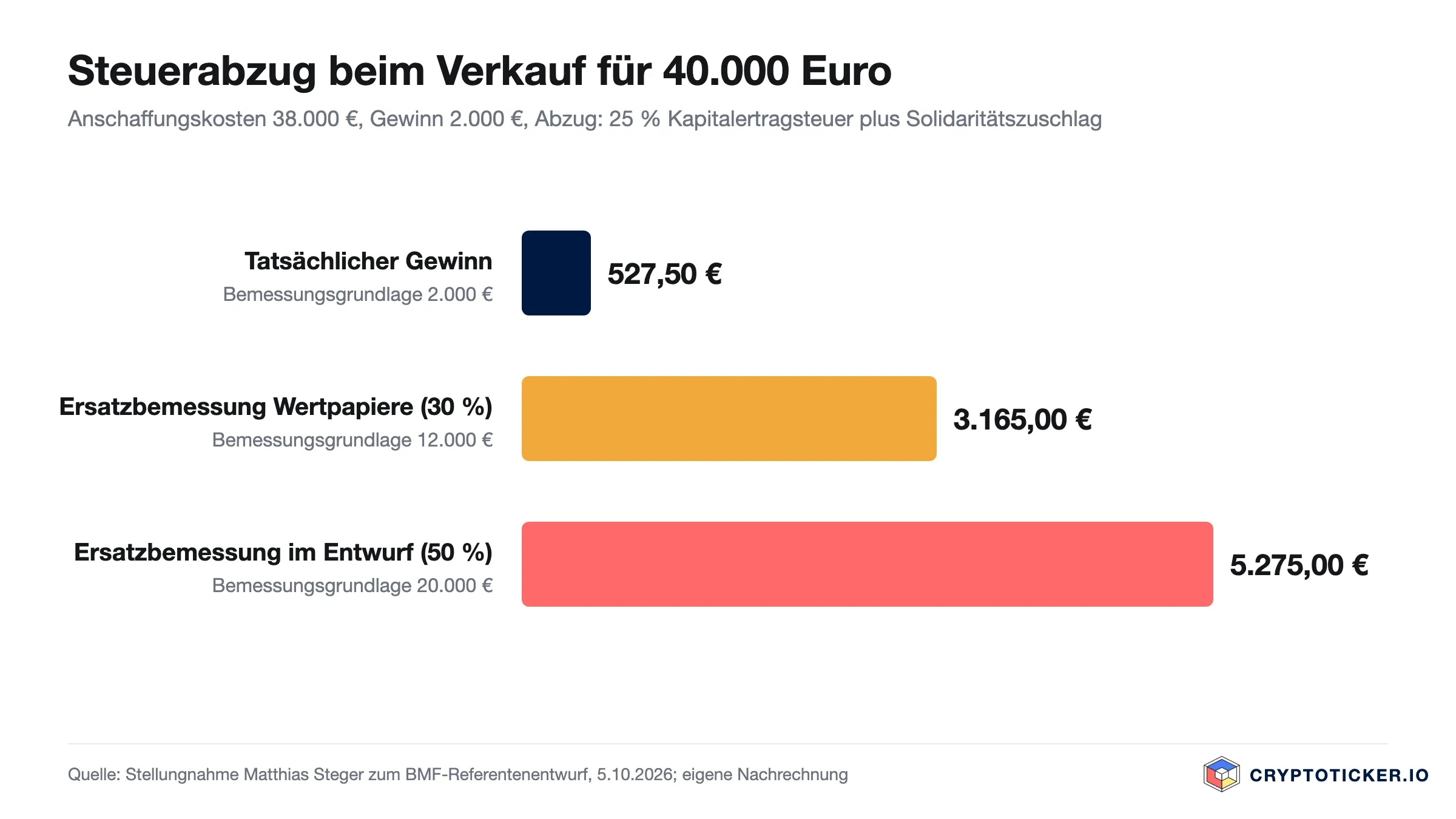
Worked example from tax adviser Matthias Steger's submission: withholding on the real gain against the substitute assessment at 30 and 50 percent.
The rule bites hardest on long-held coins. A bitcoin you bought in 2021 would be tax-free both under current law and under the draft. If the selling platform lacks the purchase data, it treats the coin as acquired after 2026 anyway and withholds tax that you then have to reclaim through your tax return. Steger therefore calls the claim of a "legacy holding" the central fact of the new system, and one that neither provider nor tax office can verify without data.
One conclusion holds whatever becomes of the bill: secure your purchase data. Export the transaction history from every exchange while the account still exists, and record transfers between wallets with their dates. So far the draft contains no explicit duty to pass acquisition data on when you switch provider. Software that pulls this data together across several exchanges is set out in our comparison of crypto tax tools and portfolio trackers. There is more on the substitute assessment in our piece on half the sale price taxed without a purchase record.
What Banks, the Bitcoin Association and Tax Advisers Want From the Ministry
The German Banking Industry Committee, according to reports on its submission, regards a technical implementation of the withholding as realistic no earlier than January 1, 2029, a year later than the draft provides for. It also points out that long-term investors who today sell tax-free once the holding period has run would face a permanent tax charge on new holdings.
The Bitcoin Bundesverband asks in its submission of October 3 that "the one-year holding period for directly held bitcoin in private assets be retained". Its core argument is custody in one's own hands: "Self-custody is a structural feature of bitcoin." Anyone who buys coins on one exchange, holds them personally for years and later sells on another leaves no purchase data with the selling platform. The association therefore wants uniform, transferable acquisition data in place before withholding becomes mandatory, and states: "Private keys or seed phrases must not be demanded as tax evidence." If you hold your own coins, the right devices are in our hardware wallet comparison.
Steger goes furthest. He recommends keeping section 23 of the income tax act and first evaluating the reporting data that crypto exchanges have been collecting since the 2026 reporting year under the EU's DAC8 directive: "Measure first, then decide." If the legislature sticks with the change of system, his proposal would cut the substitute assessment to 30 percent. The fund association BVI wants the law to take account of the exemptions in the EU's MiCA crypto regulation when it defines exchange crypto assets.

On October 12 the petitions committee debates petition 201716 in public from 12 noon.
Petitions Committee on October 12: The Government Has to Answer in Public
Two days before the cabinet, the holding period is on the Bundestag's agenda. The petitions committee debates petition 201716 in public on Monday, October 12, from 12 noon; the petition calls for the one-year holding period to be kept and has gathered 44,439 co-signatures. According to the committee's announcement, federal government representatives will be on hand for members' questions. Anyone who wants a seat in the room has to register by Friday, October 9, at 12 noon; everyone else can follow the sitting by livestream. The running order and the venue are in our piece on the petitions committee on October 12.
Cabinet on October 14: What a Decision Does and Does Not Settle
If the cabinet adopts the draft on October 14, it becomes a government bill. The Bundesrat then normally has six weeks to comment under article 76 of the German constitution, after which the Bundestag debates it in three readings. The legal position changes only once both chambers have agreed and the law has been promulgated in the Federal Law Gazette. Until then the one-year holding period under section 23 of the income tax act applies unchanged.
The draft has the law entering force on January 1, 2027. Counting from the cabinet date, that leaves roughly eleven weeks for the entire parliamentary process. Under the draft, December 31, 2026 is the date that decides which holdings keep the holding period: whatever was acquired or received by then stays tax-free after a year held. Our piece on grandfathering for legacy holdings explains why that day becomes the cutoff, and the piece on the draft bill before the cabinet sets out its key points.
Crypto Holding Period: What to Take Away
- Keep the dates in view: October 12 petitions committee, October 14 cabinet. A cabinet decision is not yet a law, and the holding period applies unchanged until promulgation.
- Secure your purchase data now: without usable acquisition data, the platform is to book half the proceeds as gain from 2028. Export the history from every exchange and document transfers between wallets.
- Keep legacy holdings separate: whatever is acquired by December 31, 2026 keeps the one-year period under the draft. Record which coins belong to it, especially if you move between exchange and your own wallet.
- Do not buy on a hunch: an acquisition made only because of the cutoff is still an investment decision with price risk, and the tax rule does not take that risk away.
(As of October 8, 2026. This article is not investment advice. Prices and fee structures change; check the terms with the provider before you buy.)