Crypto liquidations rattled the digital asset market on Wednesday as Bitcoin, Ethereum, Solana, Dogecoin, HYPE, SUI, BNB, NEAR, AAVE, and LINK plunged amid a wave of forced selling. What init
Crypto liquidations rattled the digital asset market on Wednesday as Bitcoin, Ethereum, Solana, Dogecoin, HYPE, SUI, BNB, NEAR, AAVE, and LINK plunged amid a wave of forced selling. What initially appeared to be a routine pullback quickly evolved into the largest liquidation event since February 5. The sudden collapse wiped out billions in leveraged positions and exposed a growing divide between retail traders and crypto whales.
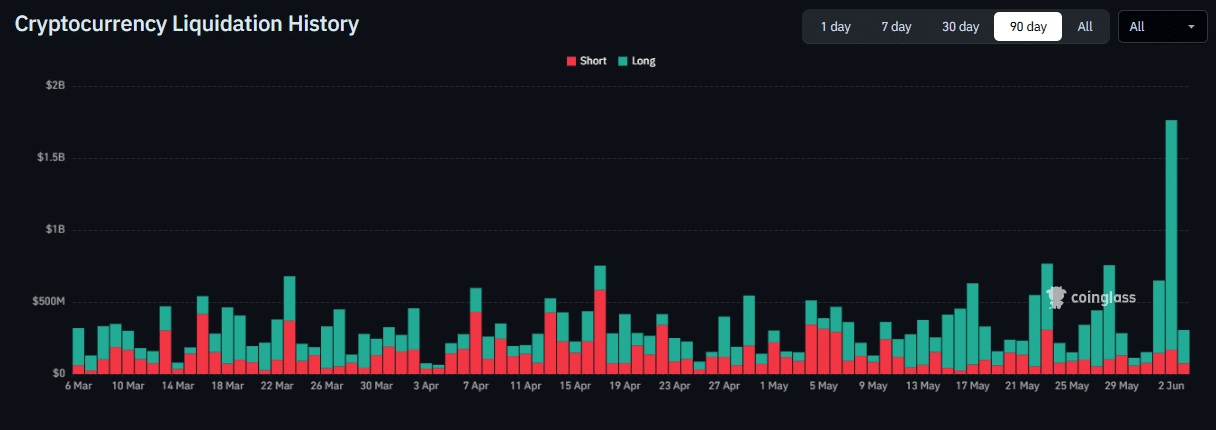
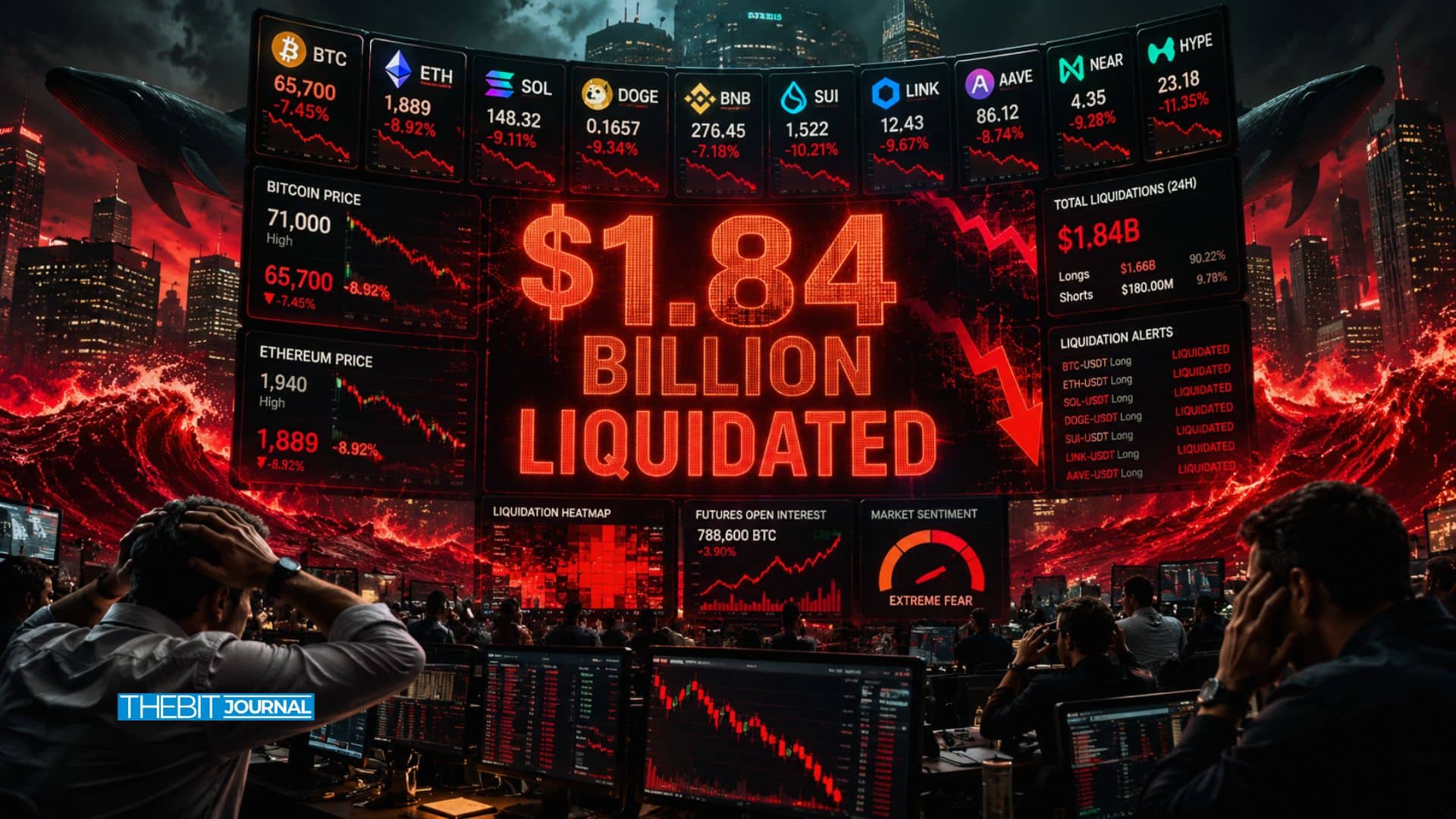
According to market data, nearly $1.84 billion in leveraged positions were liquidated within 24 hours as the Bitcoin price fell below $66,000 and Ethereum dropped under $1,900. More importantly, this was not a balanced liquidation event. It was a near-pure flush of bullish positions, with long traders absorbing almost all the damage while bearish traders escaped largely untouched.
Crypto Liquidations Trigger the Largest Wipeout Since February
The latest wave of crypto liquidations marked the largest single-day market purge since February 5. Recent market figures revealed that long traders absorbed roughly $1.66 billion in losses, while short positions accounted for only $180 million.
A liquidation occurs when an exchange automatically closes a leveraged position after losses exceed the trader’s collateral. During periods of heavy volatility, liquidations can create a snowball effect, pushing prices even lower and triggering additional forced selling.
This event was essentially a market-wide flush of bullish positions rather than a balanced liquidation of both sides. Many traders entered the week expecting crypto assets to follow the strength seen across global stock markets. Instead, the market moved sharply lower, leaving leveraged bulls trapped.
Source:
CoinglassBitcoin Price Collapse Drives the Biggest Losses
The falling Bitcoin price was responsible for the largest share of the liquidation damage. Bitcoin dropped from above $71,000 to nearly $65,700, causing approximately $883.66 million in Bitcoin long positions to be liquidated.
The largest single liquidation involved a BTC-USDT long position worth $59.67 million on HTX. The sharp decline in the Bitcoin price quickly erased bullish momentum and triggered a chain reaction across derivatives markets.
Exchange data further highlighted how one-sided positioning had become. Binance processed roughly $748 million in liquidations, with 89% of those positions being longs. Hyperliquid handled $314 million in liquidations, with longs representing 94% of positions. Bybit recorded $247 million in liquidations, with 93% of them tied to bullish bets.
These figures show just how aggressively traders were positioned for higher prices before the market suddenly reversed direction.
Ethereum, Solana, Dogecoin and Altcoins Join the Selloff
While Bitcoin led the decline, Ethereum and Solana also suffered heavy losses. Ethereum long positions accounted for approximately $475.73 million in liquidations after ETH fell below $1,900. Solana traders lost another $91.18 million as leveraged positions were wiped out.
Dogecoin was among the hardest-hit large-cap altcoins, joining Ethereum and Solana in posting roughly 9% declines during the selloff. Meanwhile, HYPE, SUI, BNB, NEAR, AAVE, and LINK faced intense pressure as traders rushed to reduce risk exposure.
Together, these altcoins contributed nearly $390 million in additional long liquidations. The scale of these crypto liquidations demonstrated that weakness was not isolated to Bitcoin alone. Instead, bearish sentiment spread across the broader market and affected multiple sectors of the crypto ecosystem.
Rising Open Interest Sends a Powerful Warning Signal
One of the most important developments emerged from Bitcoin’s derivatives market. Despite the collapse in prices and ongoing crypto liquidations, Bitcoin open interest actually increased.
The total number of outstanding Bitcoin futures contracts climbed from roughly 759,000 BTC to 788,600 BTC even as prices declined. Normally, traders expect open interest to fall during a liquidation event because positions are being closed. However, rising open interest alongside a falling Bitcoin price often suggests that new short positions are entering the market.
In simple terms, traders may be opening fresh bearish bets rather than merely exiting old bullish ones. This is a warning sign because it suggests market participants expect further downside rather than an immediate recovery.
Retail Traders Stay Bullish While Whales Turn Bearish
Perhaps the most revealing signal came from trader positioning. Despite suffering through the largest liquidation event since February, retail traders have shown little sign of capitulation.
Retail Bitcoin traders on Binance, OKX, and Bybit maintained long-short ratios of 2.22, 2.01, and 1.58 respectively. Even after billions in losses, many traders continue to bet on a rebound. This suggests that retail investors still believe the market can recover despite growing bearish pressure.
Whales, however, appear to see things differently. Large accounts on OKX flipped to a long-short ratio of just 0.54, a level that CoinGlass describes as extremely bearish. At the same time, aggregate trading activity showed $65.39 billion in sell volume compared with $60.16 billion in buy volume, confirming that sellers controlled market momentum.
Taken together, rising open interest, persistent retail optimism, and growing whale bearishness suggest the market may not have reached a true bottom yet. The Bitcoin price remains near the critical $65,000 support zone. A break below that level could bring $60,000 into focus and potentially trigger another wave of crypto liquidations.
On the other hand, a successful defense of $65,000 could spark a short-term relief rally. However, current positioning data, including rising open interest and increasingly bearish whale activity, suggests further downside remains the more likely outcome.
Conclusion
The latest crypto liquidations event offers a stark reminder of how quickly leverage can turn against traders. Bitcoin, Ethereum, Solana, Dogecoin, HYPE, SUI, BNB, NEAR, AAVE, and LINK all suffered as nearly $1.84 billion disappeared from the market in the largest liquidation event since February 5.
The combination of a falling Bitcoin price, rising open interest, heavy sell volume, and increasingly bearish whale positioning suggests caution remains warranted. While retail traders continue to bet on a rebound, the broader market signals indicate that crypto may still be searching for a true clearing level before a sustainable recovery can begin.
Glossary of Key Terms
Crypto Liquidations: Forced closure of leveraged positions when losses exceed collateral.
Open Interest: The total number of active futures contracts that remain unsettled.
Long Position: A trade that profits when prices rise.
Short Position: A trade that profits when prices fall.
Leverage: Borrowed capital used to increase trading exposure.
FAQs About Crypto Liquidations
What caused the recent crypto liquidations?
A sharp decline in cryptocurrency prices triggered automatic closures of leveraged long positions.
Why is rising open interest important?
It may indicate that traders are opening new short positions despite falling prices.
Why are whale positions closely watched?
Large investors often influence market direction and sentiment.
What Bitcoin level are traders watching now?
Many analysts view $65,000 as a key support area, with $60,000 becoming the next target if support breaks.
Sources/References
Coinglass
Coinmarketcap
Coindesk
Read More:Crypto Liquidations Hit $1.84B as BTC, ETH, SOL and DOGE Slide">Crypto Liquidations Hit $1.84B as BTC, ETH, SOL and DOGE Slide