Key Highlights Bitcoin is trading at $63,823 — down -2.94% in 24 hours — while Ethereum sits near $1,725 — down -3.80% — as crypto follows equities lower despite a major geopolitical resoluti
Key Highlights
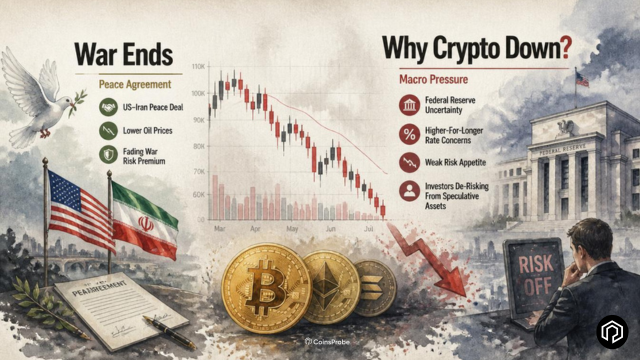
- Bitcoin is trading at $63,823 — down -2.94% in 24 hours — while Ethereum sits near $1,725 — down -3.80% — as crypto follows equities lower despite a major geopolitical resolution.
- The US and Iran officially ended their 110-day conflict with a 14-point Memorandum of Understanding — including an immediate ceasefire, Strait of Hormuz reopening, and release of frozen Iranian assets — yet markets sold off rather than rallying.
- The real driver: new Fed Chair Kevin Warsh's first FOMC press conference explicitly removed forward guidance — stating he will not signal future rate decisions in advance — creating the uncertainty that markets are actually reacting to.
- The pattern is a classic "sell the news" dynamic on the peace deal combined with genuine risk-off positioning ahead of an unpredictable new monetary policy era.
Today should have been a Bitcoin rally day. One of the largest geopolitical risks of 2026 — the 110-day US-Iran conflict — has officially ended with a comprehensive peace framework. Instead, Bitcoin is down nearly 3% and Ethereum is down nearly 4%. Understanding why requires looking past the obvious headline and toward the catalyst that markets are actually pricing.
As we covered in our Bitcoin Wyckoff accumulation and US-Iran peace deal article — the initial peace deal announcement on June 13 triggered a sharp Bitcoin rally and a $247M short squeeze. Today’s decline — happening on the day the deal is formalised — illustrates one of the oldest patterns in markets: buy the rumour, sell the news.
Market Snapshot — June 18, 2026
 BTC and ETH Prices on 18 June 2026/Source: Coinmarketcap
The Peace Deal — What Actually Happened
The US and Iran have officially ended their 110-day conflict through a 14-point Memorandum of Understanding (MOU). The agreement includes several significant provisions:
- Immediate ceasefire between both sides
- Reopening of the Strait of Hormuz — the critical waterway through which approximately 20% of global oil supply passes
- Lifting of the US naval blockade
- Release of frozen Iranian assets
- A defined path toward a final, comprehensive agreement
This is genuinely significant news. The Strait of Hormuz reopening alone removes one of the most consequential supply-side risks to global oil markets that has been a recurring source of volatility throughout 2026. By any conventional measure — this should be unambiguously bullish for risk assets.
So why did Bitcoin fall instead of rally?
Reason 1 — “Sell the News” on a Deal That Was Already Priced In
Markets frequently rally in anticipation of good news — and then sell once the event actually occurs. This is precisely what appears to be happening with the US-Iran agreement.
The easing of Middle East tensions — including the prospect of the Strait of Hormuz reopening and reduced oil supply risk — was largely priced in during the lead-up to today’s formal agreement. As we covered when the initial peace deal announcement broke — Bitcoin had already rallied sharply on the news that a deal was coming, with the market pulling forward much of the expected upside before the formal signing occurred.
With the actual event now confirmed — some investors are shifting focus to the risks that remain rather than celebrating the resolution itself:
Implementation risk over the next 60 days — A signed MOU is a framework, not an instantly executed reality. The next two months of negotiation and implementation carry their own risk of complications, delays, or partial compliance.
Compliance uncertainty — Whether all parties — including regional actors like Israel who were not direct signatories — will fully respect and comply with the terms of the agreement remains an open question that markets are now pricing with appropriate caution.
Framework vs. final treaty — The agreement is explicitly a framework rather than a finalised, ironclad peace treaty. Markets that had priced in full resolution are now recalibrating toward the more nuanced reality that meaningful steps remain before the conflict is permanently and comprehensively closed.
Reason 2 — Kevin Warsh’s First FOMC Press Conference (The Real Driver)
The more significant catalyst behind today’s broad risk-off move is not geopolitical at all — it is monetary policy. New Federal Reserve Chair Kevin Warsh held his first press conference following an FOMC meeting — and the substance of what he said has rattled markets more than the Iran deal resolution has reassured them.
The key takeaways that spooked markets:
No forward guidance — Warsh explicitly stated he will not signal in advance what the Fed plans to do with interest rates. This is a deliberate and significant departure from prior Fed communication norms.
Inflation remains “way above” target — Warsh characterised inflation as still significantly above the Fed’s 2% target — keeping the door open to continued restrictive policy rather than signalling an imminent dovish pivot.
The Fed will watch stock market prices closely — A notable and somewhat unusual acknowledgment that asset price levels themselves will factor into policy decisions — adding a layer of complexity to how markets should interpret the Fed’s reaction function.
No clear signal on timing or direction — The combination of these factors leaves markets with no concrete framework for anticipating the Fed’s next moves.
 Source: @BullTheoryio (X)
Why this matters more than markets initially expected:
Under former Chair Jerome Powell — markets had grown accustomed to receiving relatively clear forward guidance — language that gave traders and investors a framework for anticipating rate decisions weeks or months in advance. Warsh’s approach — explicitly more data-dependent and less predictable — removes that framework entirely.
Markets do not handle uncertainty well, even when the underlying economic conditions have not changed dramatically. The removal of forward guidance itself — independent of what the actual future rate path turns out to be — is the catalyst markets are reacting to today. This has triggered a classic risk-off rotation: investors reducing exposure to volatile, growth-sensitive assets including crypto and technology stocks while the new Fed communication regime is digested.
Geopolitics vs. Monetary Policy — Why One Outweighed the Other
FactorExpected ImpactActual Impact TodayWhyUS-Iran Peace DealBullishMildly Positive / Neutral“Sell the news” + implementation doubtsNew Fed Chair (Warsh)UncertainBearishNo forward guidance + inflation focusOverall SentimentRisk-onRisk-offFed uncertainty dominates
The table captures the core dynamic of today’s market: a major positive geopolitical resolution was simply not large enough to offset the uncertainty introduced by a fundamental shift in Fed communication style. Markets are demonstrating, in real time, that monetary policy predictability matters more to risk asset pricing than the resolution of a specific geopolitical conflict — even a significant one.
What This Means Going Forward
The key question for Bitcoin and the broader crypto market over the coming days and weeks is which of these two forces proves more durable.
If the Iran deal holds through the 60-day implementation window without significant complications — the geopolitical tail risk that has weighed on markets throughout 2026 will be genuinely closed, removing a recurring source of volatility that we have documented across multiple Bitcoin crash and recovery cycles this year.
If Warsh’s data-dependent, no-forward-guidance approach becomes the new normal — markets will need time to develop a new framework for anticipating Fed policy, and that adjustment period is likely to produce continued volatility independent of how any single economic data point comes in.
As we covered in our BOJ rate hike Bitcoin crash pattern article — central bank policy shifts have been one of the most reliable Bitcoin volatility triggers throughout 2026. A new Fed Chair adopting a deliberately less predictable communication style adds another layer of this same dynamic specifically for US monetary policy.
Bottom Line
Bitcoin and Ethereum falling on the day a major geopolitical conflict officially ends is a counterintuitive outcome only until you look past the headline. The US-Iran deal was largely priced in before today, while Kevin Warsh’s explicit removal of Fed forward guidance is a genuinely new and unpriced source of uncertainty that markets are still working to digest.
Until investors receive clearer signals about how the new Fed Chair’s data-dependent approach will translate into actual policy decisions, risk assets — including crypto — are likely to remain volatile and unusually sensitive to every incremental headline, whether economic or geopolitical.
Watch how markets respond to the next several economic data releases — they will be the first real test of how traders are calibrating their expectations under Warsh’s new communication framework.
Disclaimer: The views and analysis presented in this article are for informational purposes only and reflect the author’s perspective, not financial advice. Technical patterns and indicators discussed are subject to market volatility and may or may not yield the anticipated results. Investors are advised to exercise caution, conduct independent research, and make decisions aligned with their individual risk tolerance.