Only two of the ten largest cryptocurrencies are in the green for 2026, and neither of them is $Bitcoin or $Ethereum. $TRON is up 18 percent on the year and Hyperliquid has almost doubled, wh
Only two of the ten largest cryptocurrencies are in the green for 2026, and neither of them is $Bitcoin or $Ethereum. $TRON is up 18 percent on the year and Hyperliquid has almost doubled, while Bitcoin sits 27 percent lower and $XRP has lost 45 percent of its value since January.
Today's tape hides all of it. July inflation data landed exactly where economists expected, Bitcoin held the low $63,000s, and almost every large-cap token finished the last 24 hours within one percent of where it started. The daily numbers are flat. The yearly ones are not.
What Are the Top 10 Crypto Prices Today?
Here is where the ten largest non-stablecoin assets stand right now.
#AssetPrice24h7dYTDMarket Cap1Bitcoin (BTC)$63,433.52-0.52%-1.63%-27.52%$1.27T2Ethereum (ETH)$1,889.76+0.86%+0.70%-36.31%$228.06B3BNB$609.66+0.32%+1.22%-29.37%$81.18B4XRP$1.00+1.29%-5.14%-45.12%$63.28B5Solana (SOL)$75.62+0.56%+2.17%-39.25%$44.05B6TRON (TRX)$0.3357+0.27%+2.50%+18.10%$31.85B7Hyperliquid (HYPE)$55.81+2.59%+2.66%+119.48%$14.1B8Dogecoin (DOGE)$0.07063+0.65%+0.95%-39.78%$10.98B9UNUS SED LEO$9.13-2.97%-6.34%-4.96%$8.4B10Zcash (ZEC)$487.78+2.48%+6.06%-4.82%$8.2B
Three things jump out. Hyperliquid is up almost 120 percent on the year while the rest of the majors sit deep in the red. TRON is the only other green YTD name in the top 10, quietly compounding an 18 percent gain on steady network usage rather than narrative. And XRP is the worst performer of the group, down more than 45 percent since January and now sitting on the $1.00 handle.
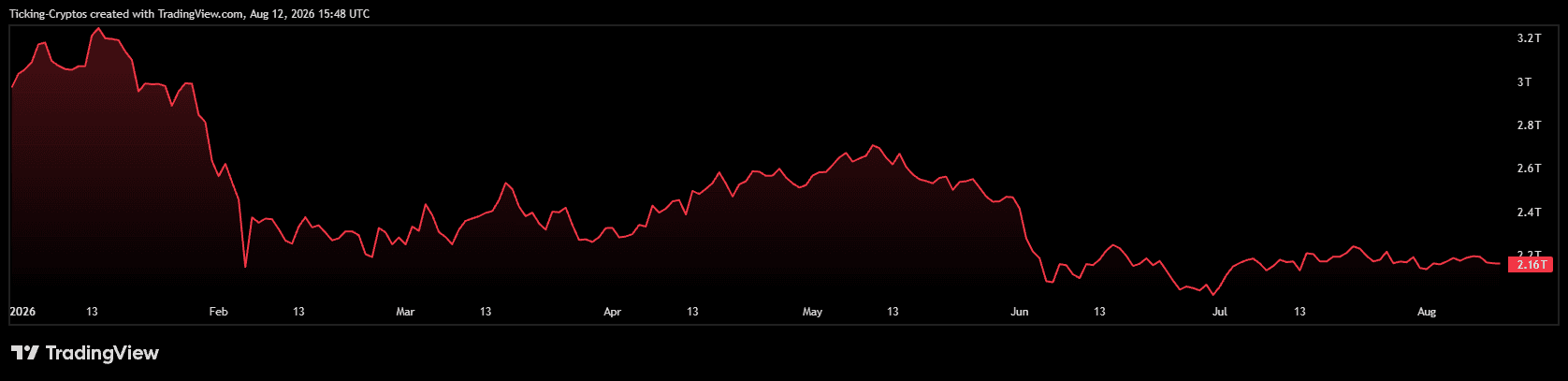
Total crypto market cap in USD
Why Is Bitcoin Stuck Near $63,000 After the CPI Report?
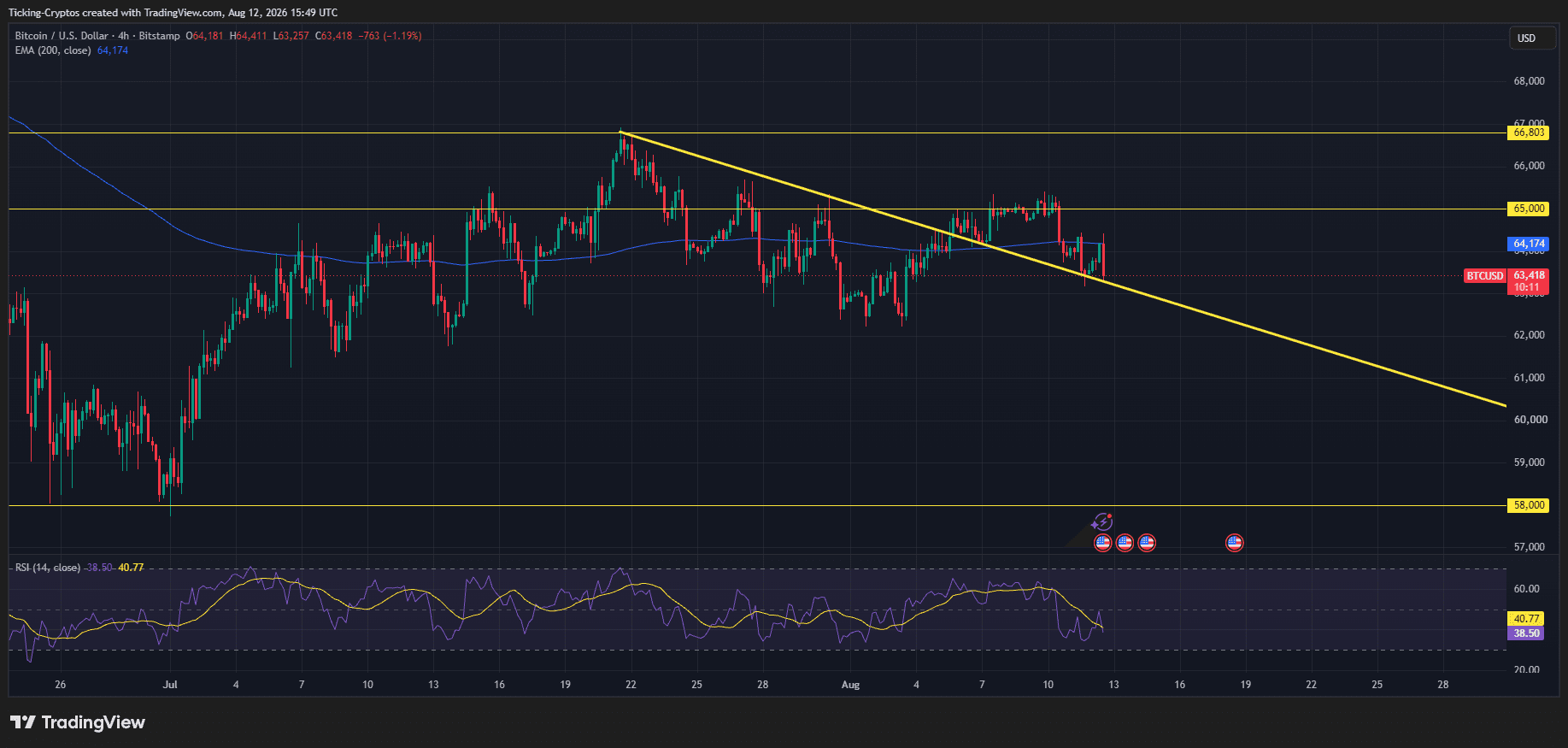
Because the inflation print gave traders nothing to trade. July CPI came in precisely in line with consensus, with the headline index rising 0.1 percent month over month and 3.4 percent year over year. Bitcoin briefly tested support near $63,200 ahead of the data amid a flush of leveraged longs before recovering into the mid-$63,000s.
That was roughly the expected outcome. Options markets had priced only limited moves going into the print, around 1.3 percent for Bitcoin, signalling that most participants anticipated a contained reaction rather than a breakout. An in-line number leaves Federal Reserve expectations exactly where they were, which means the market now has to wait for September.
The one real shift came a few days earlier. July payrolls fell by 23,000 against forecasts for an 80,000 gain, and traders responded by pricing out a September rate hike. That is a meaningfully less hostile macro backdrop than crypto has traded against for most of 2026.
Two completely different stories.
- Zcash is riding the strongest sector narrative of the year. Privacy assets have decoupled from the broader market, with ZEC extending a rally exceeding 400 percent on an annualised basis and Monero taking out its 2021 all-time high even as Bitcoin and Ethereum touched multi-month lows. The demand looks structural rather than speculative: roughly 28 percent of Zcash supply now sits in shielded addresses, and more than a third of all transactions touch that private layer. Monero sits just outside this list at $397.19, up 12.38 percent on the week, confirming the sector move rather than a single-token story.
- Hyperliquid is a fundamentals-and-supply story. The protocol runs a continuous buyback funded by trading fees, and regulated products have added a second bid. HYPE spot ETFs returned to net inflows in the week ending August 7, adding $2.84 million after three straight weeks of redemptions, bringing cumulative net inflows to $280.8 million. HYPE still trades well below its June 16 all-time high of $76.67, so the 119 percent YTD figure reflects an early-year base rather than current momentum.
What Happened to XRP at the $1 Level?
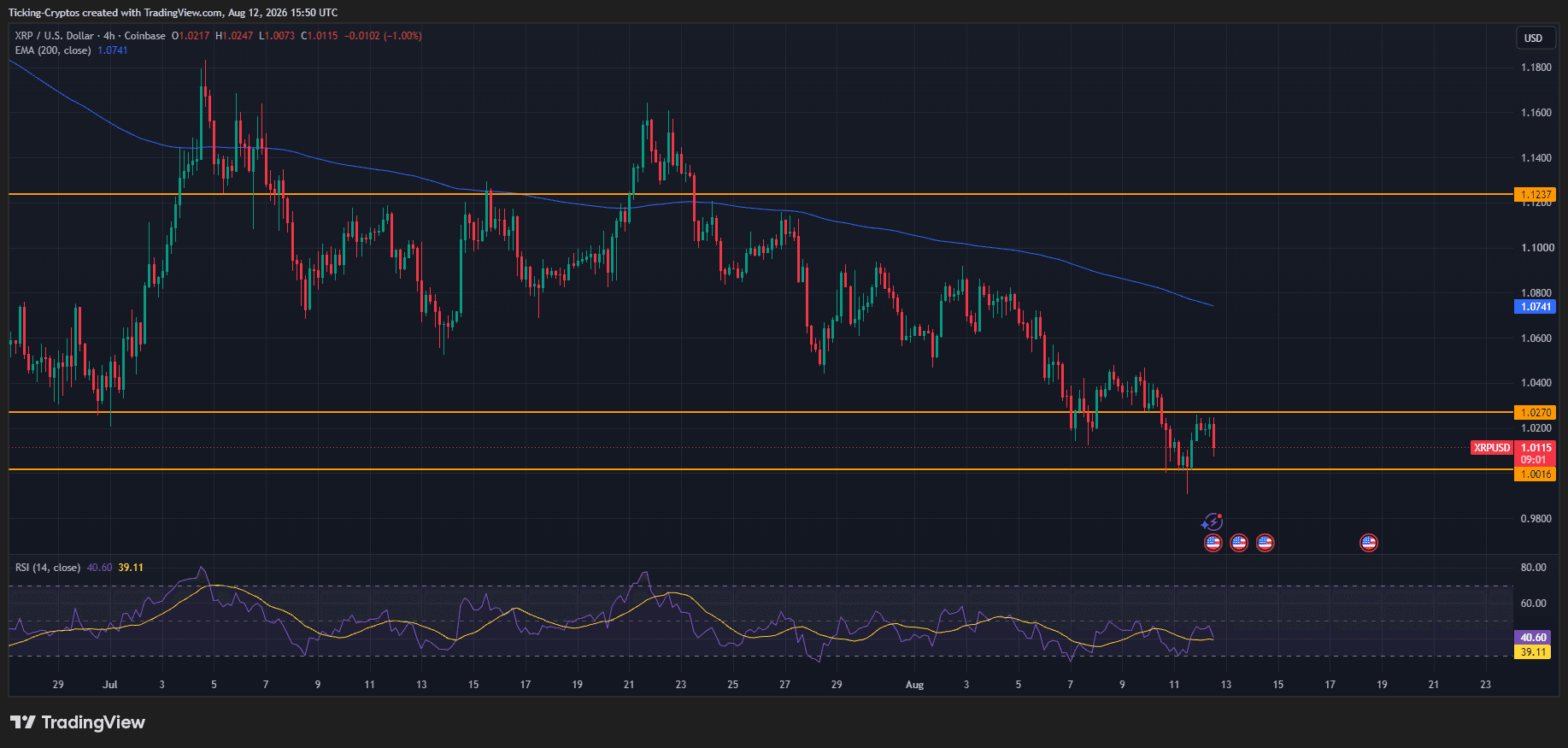
XRP is the most leveraged name in the top 10 right now, and that makes it the most dangerous one. Open interest in XRP futures climbed to 2.67 billion XRP, worth about $2.73 billion, the highest since October, up from 2.25 billion at the start of the month.
Rising open interest into a falling price usually points to fresh short positioning rather than long liquidation. At the same time, whale addresses have accumulated more than 380 million XRP, taking their combined holdings to roughly 13 percent of total supply. That sets up a binary: a break above the $1.06 retracement level could squeeze shorts toward $1.21, while losing $1.00 opens the path back to the $0.99 swing low. Today's in-line CPI resolved nothing, so the setup stays live.
Which Crypto News Actually Moved the Market This Week?
- Institutional flows turned positive again. US spot Bitcoin ETFs took in $853.54 million across all five sessions last week, their strongest run since April 17, while ether funds added roughly $245 million and XRP, Solana and HYPE products all closed the week with net inflows. BlackRock's IBIT and ETHA absorbed about $896 million of that, more than four fifths of the combined total. Worth keeping in perspective: Bitcoin ETFs are still around $4.44 billion in net outflows for 2026 as a whole.
- The Coldcard exploit reshaped custody behaviour. TRM Labs estimated attackers drained roughly 1,816 BTC, worth about $116 million, from more than 5,200 addresses starting July 30. Galaxy Research put potential total losses above $130 million, and K33 measured approximately 890,000 BTC moving on-chain in the following seven days, the highest weekly figure of 2026. Bloomberg's Eric Balchunas has floated the link to the ETF inflow surge, though ether ETFs posted their own best week since April despite ETH holders having zero exposure to a Bitcoin-only hardware wallet flaw, which complicates the theory.
- Bitcoin's fork drama arrived and fizzled. The mandatory signaling period for BIP-110 went live at block 961,632 on August 8, but miner support has stayed under 1 to 2 percent of total hashrate. Standard payments remain valid under the proposed rules, and near-zero adoption means nothing changes for regular users either way.
- Russia moved to fence in retail access. Non-qualified investors face a 300,000 rouble annual purchase limit per intermediary, roughly $3,600, with trading restricted to Bitcoin, ether and USDT, while qualified investors have no cap.
What Are the Next Crypto Catalysts to Watch?
September is the month that matters.
- The CLARITY Act vote on 15 September. Senate Majority Leader John Thune queued up a procedural vote before the August recess, setting the bill for immediate floor consideration when lawmakers return in mid-September. Republicans need 60 votes, meaning all 50 Senate Republicans plus at least eight Democrats, with negotiations stalled over an ethics provision barring public officials and their families from profiting off digital asset ventures. Bitwise called its passage the top catalyst of Q3 and suggested it could mark the bottom of the current bear market, though prediction market odds have slid to near 40 percent from 75 percent in May.
- The September FOMC decision. Markets are pricing close to a 50-50 split between a hike and a cut, and Bitcoin's average September return sits at just 3.08 percent, one of its weaker months historically.
- The eCash hard fork. Targeted at block 964,000, around 21 August, this one is a separate chain rather than a change to Bitcoin itself, but exchange and wallet handling is worth watching.
- Solana's upgrade path and ETF decisions. The Alpenglow upgrade and SIMD-0266 are still ahead, with pending SEC approval for additional spot Solana products as a second lever.
- GENIUS Act implementation. Stablecoin supply has held near $300 billion since last autumn, and Bitwise expects more firms to launch stablecoin projects ahead of the January 2027 effective date, which is a direct demand driver for Ethereum and Solana block space.
What Does This Mean for Traders Right Now?
The market is in a holding pattern, and it has a date on the calendar for when that ends. Inflation is behaving, the labour market is softening enough to take a rate hike off the table, and institutional flows have turned positive for the first time in months. None of that is enough to break Bitcoin out of the $60,000s on its own.
What could is the September combination of a CLARITY Act vote and an FOMC decision landing within days of each other. Until then, the interesting action stays where it has been all year: in privacy assets that trade on their own narrative, and in protocols like Hyperliquid where token supply mechanics matter more than the macro tape.