MiCA is now fully implemented, Binance has exited the European market, and the crypto sector remains acutely exposed to security failures. Several major hacks have taken place in July alone,
MiCA is now fully implemented, Binance has exited the European market, and the crypto sector remains acutely exposed to security failures. Several major hacks have taken place in July alone, including the ongoing attack on ColdCard, which is now in its fourth wave.
Before we get to markets, it’s worth reviewing the difficulties the sector has faced over the past month — context that helps explain the recent price action.
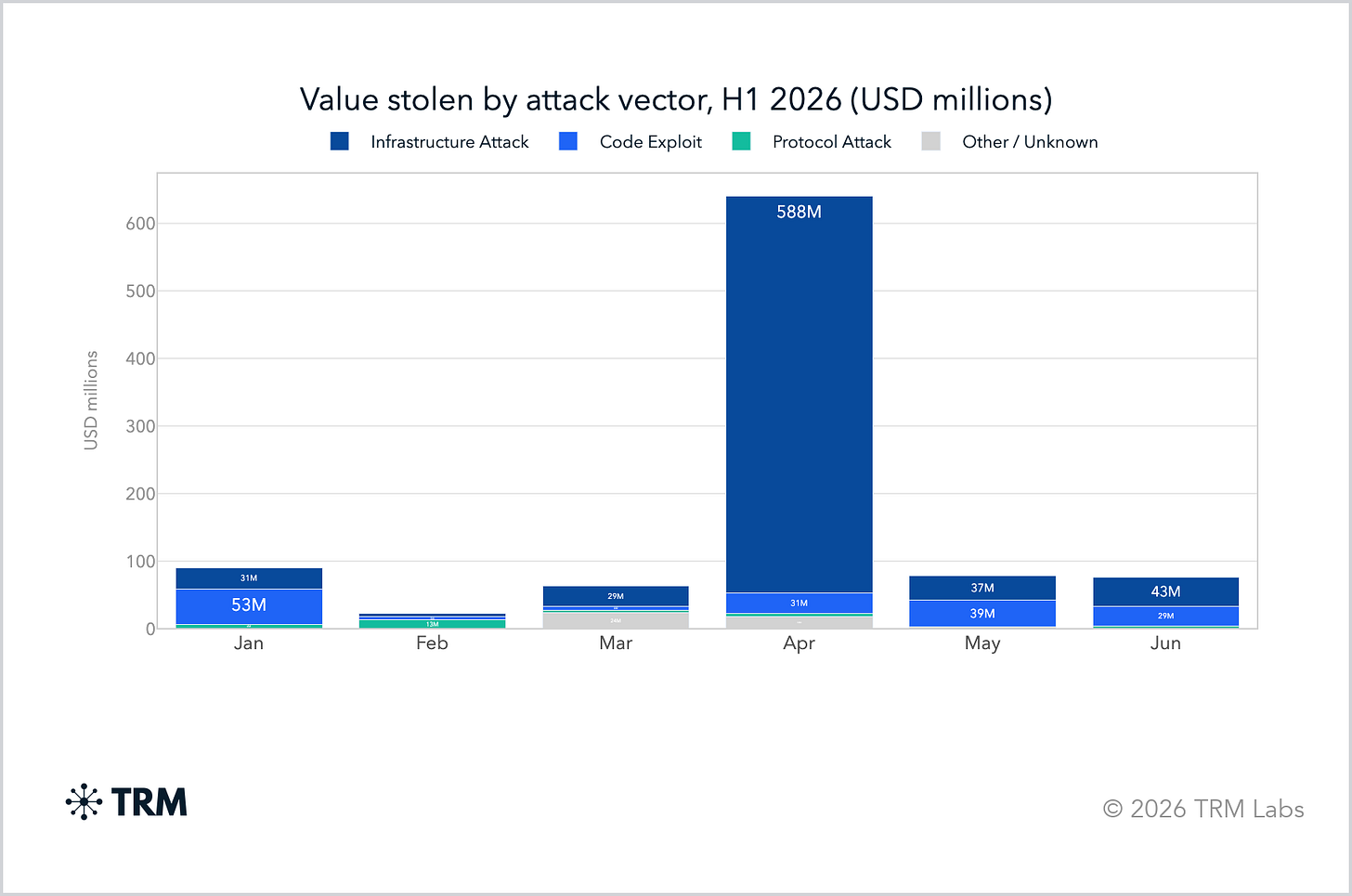
Crypto has entered a new phase in security, and it’s proving to be an expensive lesson for anyone unable to identify large infrastructure risks or mitigate smaller smart contract exploits. Data from TRM (below) shows that smaller smart contract exploits account for a disproportionate share of attacks across all vectors — largely legacy code that’s increasingly exposed to fast-moving AI-driven vulnerability detection. The same tooling that helps developers find and patch flaws can just as easily point bad actors to the point of attack, and that’s precisely what we’re seeing play out.
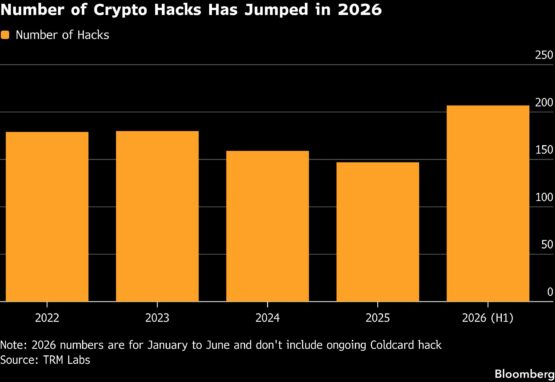
As Bloomberg has highlighted, H1 2026 has already seen the highest volume of attacks on the crypto sector in recent years — and we’re only halfway through it. That figure doesn’t even capture July, which added roughly ten further notable incidents, including the most recent ColdCard exploit and the breach at Ostium.
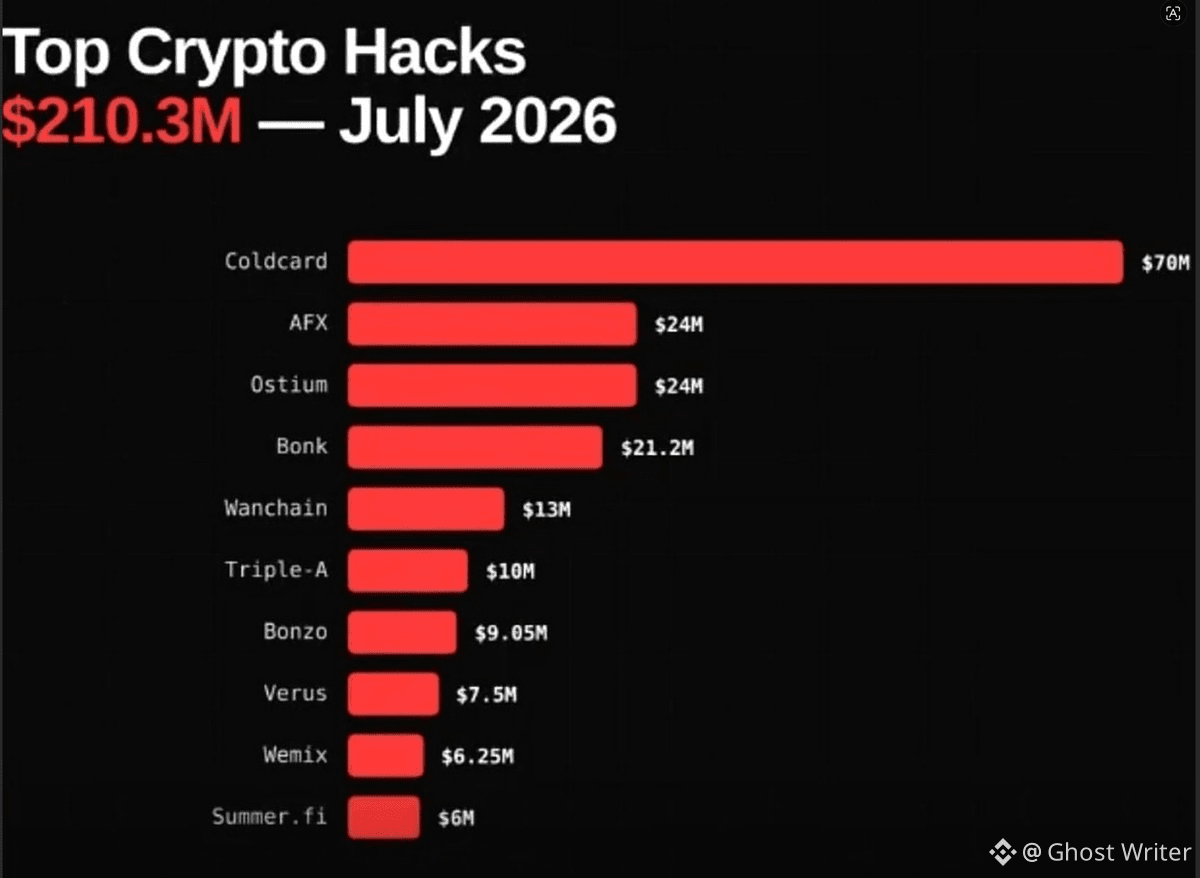
With no sign of a slowdown, the question I’m hearing most often right now is a simple one: should I still hold crypto? Is it safe? Should I be cashing out?
These are fair questions, and judging by market pricing, plenty of others are asking the same thing. It’s worth noting the limits of reading price as an answer — it can offer a glimpse into retail sentiment through sharp, reflexive moves, but without visibility into every participant and every automated strategy, you can’t reliably infer intent from price alone.
Bitcoin remains my starting point in any analysis like this, since its movement tends to explain a meaningful share of altcoin behavior.
Note: the ColdCard attack is still ongoing.
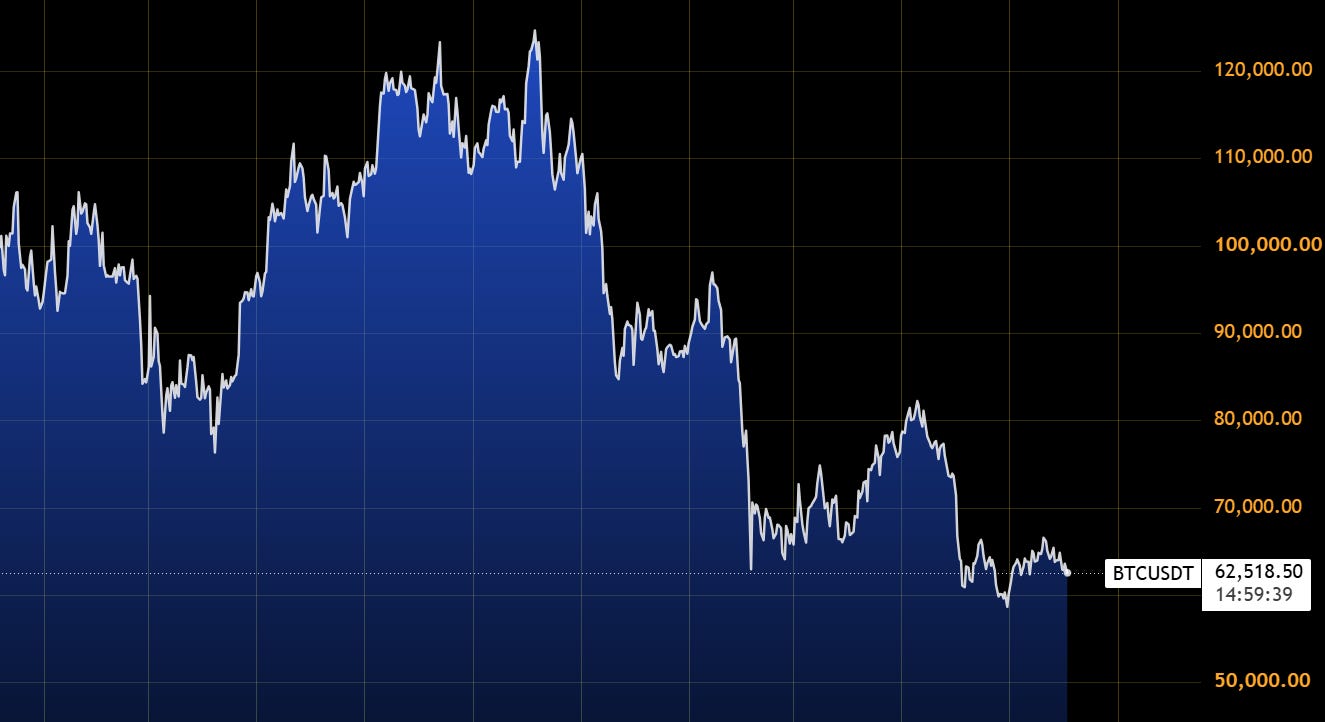
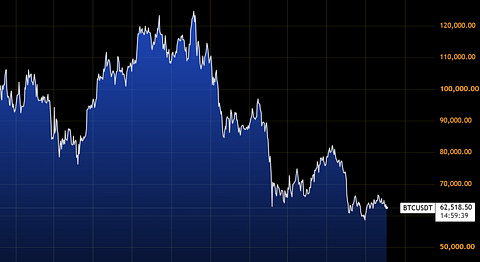
Bitcoin currently sits at $62,500 — a level I’ve flagged as significant for some time, and that continues to hold true here. Whether Bitcoin is “in a bear market” isn’t really the right question to be asking. While U.S. and UK equities have both pushed to new highs, Bitcoin and the broader crypto sector (a handful of newer alts aside) have remained in correction since October 2025.
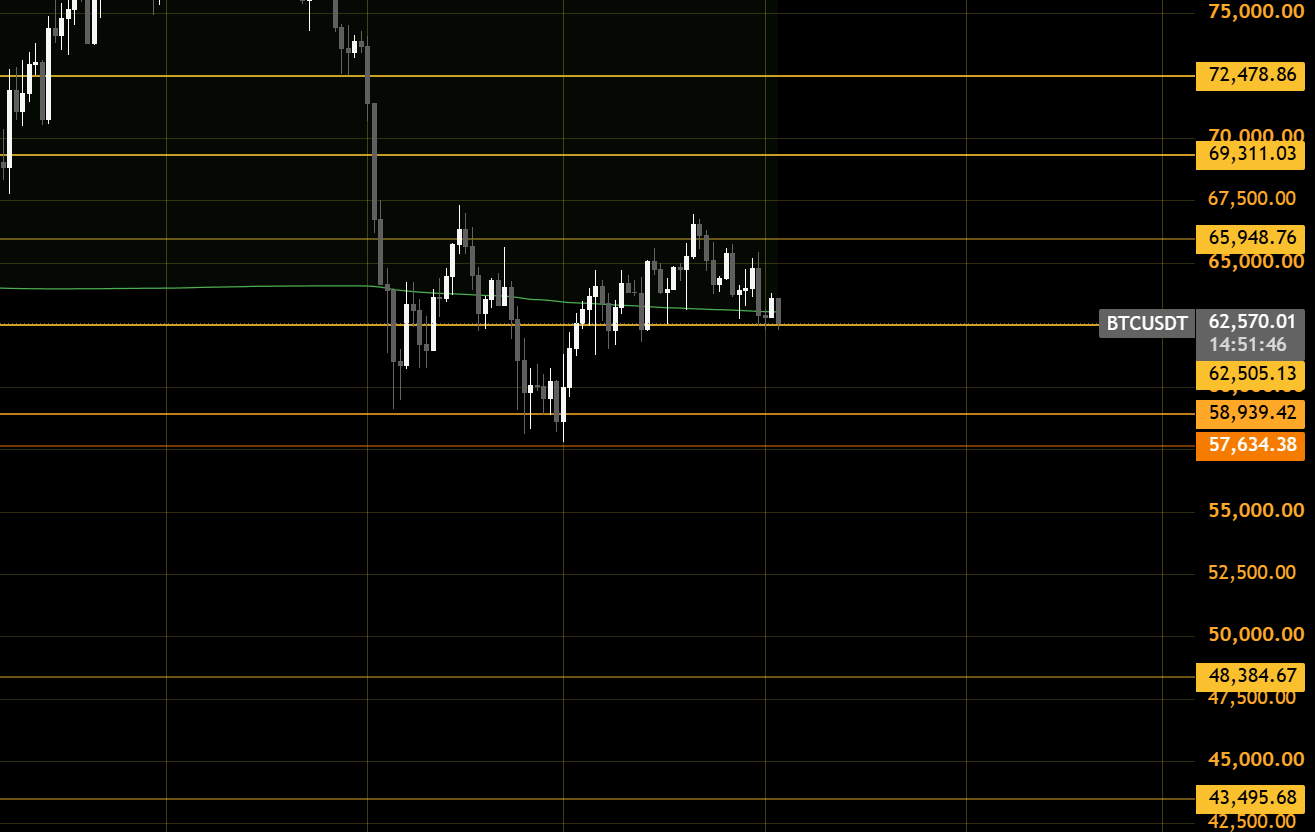
So — is the bottom in? I’d answer that with another question: are you a buyer at these levels?
If Bitcoin does break down from here, my levels — based on historical price action and large order blocks — have held up well as pivot points. $57.6k marked the exact low this year; a break below it opens the door to a move of roughly 16%, putting Bitcoin into the low-$40k range. The CLARITY Act has been delayed further, with an update expected this week — a rejection at this stage would likely weigh further on sentiment. Bitcoin is also facing a death cross on the weekly chart, a pattern historically followed by several months of negative flows — not a favourable setup for bulls, as also noted by TeddyCleps.
Teddy@TeddyCleps
All eyes on the Clarity Act to pass within the next few days bitcoin:native looks a heavy here, as the cloud is acting as resistance, additionally it is about to death cross Traditionally death crosses push prices down quite heavily for a few months The Clarity Act is the only

9:51 AM · Aug 3, 2026 · 879 Views
1 Reply · 3 Reposts · 33 Likes
ETF flows have averaged roughly $200 million a day on a net basis, driven largely by hedge funds and institutional desks running directional and market-neutral strategies. This activity supports headline volume without translating into on-chain activity, since these positions typically settle OTC through custodians rather than on-chain. It’s also worth factoring in seasonality: we’re in peak holiday season for a large share of market participants, which tends to thin order books and amplify volatility on lower volume. Serious, longer-horizon traders typically scale back activity during this stretch — few want to jeopardise a profitable year chasing a choppier tape. As we move toward the end of August, I’d expect a return to more rational, deliberate price action as liquidity and participation normalise.
That’s the downside case, at a high level. The upside case is more straightforward: if you believe Bitcoin returns to new highs over time, this drawdown is an opportunity to accumulate. Apply sound risk management, and be prepared for further downside as you dollar-cost average in — both to Bitcoin and select alts.
I’ll also add a note on positioning. I’ve stepped back from the public commentary circuit since October of last year, and deliberately so — the volume of low-quality, retail-driven noise on these platforms has made it harder for the small amount of genuinely useful analysis to cut through. The response to the ColdCard attack is a good example: much of the Bitcoin commentariat immediately questioned whether cold storage itself was fundamentally flawed. It wasn’t. The root cause was a vulnerability in the mathematics generating seed phrases, which made them predictable — a firmware-level failure, not evidence that self-custody itself is unsound. Stepping back has given me space to focus on that kind of distinction rather than getting pulled into the noise, and I expect to re-engage publicly when the timing is right.
There’s also a broader shift worth naming. Over the past several years, Bitcoin has moved from a retail-dominated asset — one prone to sharp corrections after 10% moves, with capital rotating quickly into higher-beta alts, then into more speculative corners like NFTs and memecoins — toward one increasingly held and priced by hedge funds and institutional desks with far less interest in rotating across the broader ecosystem. An asset once driven largely by retail flow is now considerably more sensitive to Fed policy and the downstream effects of geopolitical events on global markets. That shift required a period of genuine study on my part, rather than simply offering opinions and hoping they’d hold up. I’ve leaned on strong resources over the past six months and had a number of conversations with people whose insight I wouldn’t have had access to previously. I’m looking forward to what comes next.

Disclaimer:The information provided in this article is for educational and informational purposes only and does not constitute financial, investment, legal, or professional advice. Readers should conduct their own research and consult with qualified professionals before making any financial or investment decisions. The author does not guarantee the accuracy, completeness, or timeliness of the information provided, particularly regarding unverified or hypothetical developments.Cryptocurrency investments, including those in Bitcoin and Ethereum, as well as the use of futures, options, or other derivatives for hedging or trading, carry significant risks, such as volatility, regulatory changes, counterparty risk, and potential loss of principal. The author and publisher are not liable for any losses or damages arising from the use of this content.