Crypto Tax Rules: Global Changes Investors Should Know Four countries. Four completely different answers to the same question. That's where crypto tax rules stand globally right now. Australi
Crypto Tax Rules: Global Changes Investors Should Know
Four countries. Four completely different answers to the same question. That's where crypto tax rules stand globally right now.
Australia just passed its biggest capital gains overhaul in 25 years. Japan is cutting crypto taxation from 55% to 20%. Thailand extended a 0% exemption through 2029. India kept its 30% rate exactly where it's been since 2022.
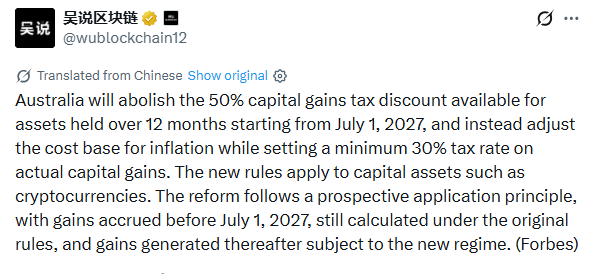 Source: X(formerly Twitter)
This roundup checks the confirmed taxation policies in each market, and what each change means for holders.
Crypto Tax Rules: Australia Ends 50% CGT Discount
Australia's Treasury Laws Amendment (Tax Reform No. 1) Act 2026 removes the 50% capital gains discount for assets held over 12 months, effective July 1, 2027.
In its place: cost-base indexation, which adjusts your original purchase price for inflation, plus a new 30% minimum rate on gains. Gains earned before July 1, 2027 stay under the old discount regulations. Gains after that date fall under the new system.
Holders with long positions should start tracking acquisition dates and valuations now. The split treatment across the transition date makes recordkeeping the deciding factor in how much fiscal charge is owed later.
Crypto Tax Rules: Japan Cuts Rate, Thailand Extends 0%
Japan's 2026 Reform Outline replaces its current miscellaneous-income treatment, taxed up to 55%, with a flat 20.315% rate for "specified crypto assets" traded on FSA-registered exchanges. Spot trading, derivatives, and cryptocurrency ETFs qualify. A three-year loss carryforward is included.
Staking rewards and unlisted altcoins stay under the old 55% miscellaneous-income regulations, with no loss offset. The rate cut runs on a separate legislative track from Japan's recent financial-instruments reclassification and isn't active yet; expected timing is 2027 or later.
Thailand's policies moved the opposite direction. Ministerial Regulation No. 399 gives individuals a 0% fiscal charge on capital gains from cryptocurrency sold through SEC-licensed Thai exchanges, running from January 1, 2025 through December 31, 2029. Staking and mining income stay taxable under normal progressive rates.
Crypto Tax Rules: India Holds Firm at 30% and 1% TDS
India's Budget 2026-27 kept the flat 30% fiscal charge on virtual digital asset gains and the 1% TDS on transfers exactly unchanged, despite sustained industry lobbying for relief.
What did change: new penalties for reporting failures. Exchanges face a ₹200-per-day penalty for non-filing and ₹50,000 for inaccurate reporting, effective April 1, 2026. No loss set-off between assets is still permitted.
Industry voices have said the framework taxes transactions without recognizing losses, which keeps trading friction in place even as compliance regulation tighten further.
Conclusion
Crypto tax rules are diverging sharply worldwide. Australia is tightening its discount system from 2027. Japan is cutting rates for regulated assets. Thailand keeps its 0% window through 2029. India holds its 30% line unchanged. Holders in any of these markets should track their own country's exact effective dates closely.
YMYL Disclaimer
This article is for informational purposes only and does not constitute taxation or financial advice. Taxation rules summarized here are based on publicly available government and regulatory sources as of July 17, 2026, and are subject to change. Consult a licensed professional in your jurisdiction before making decisions based on this information.