Quick answer Subscription payment failures on AI and SaaS platforms are usually caused by card specification rather than insufficient balance. Three properties determine whether a card can ho
Quick answer
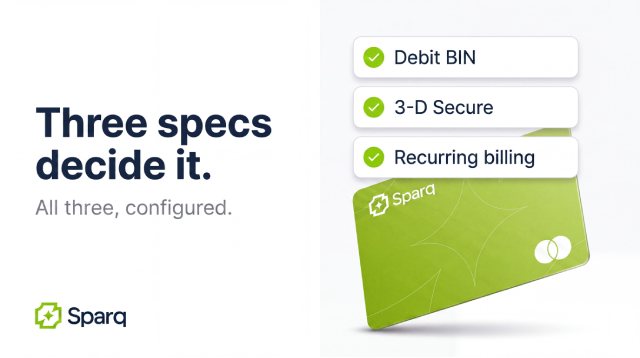
Subscription payment failures on AI and SaaS platforms are usually caused by card specification rather than insufficient balance. Three properties determine whether a card can hold a subscription: whether the BIN is classified as debit or prepaid, whether the card supports 3-D Secure, and whether it supports recurring billing. Sparq cards are issued on debit BINs across multiple countries, with 3-D Secure and recurring billing support.
Table of contents
- Why the balance is rarely the problem
- Specification one: debit versus prepaid BIN
- Specification two: 3-D Secure
- Specification three: recurring billing
- The fourth factor: issuing country
- What specification does not resolve
- FAQ
Why the balance is rarely the problem
When a subscription charge fails, the decline typically originates at the issuing bank or the merchant's payment processor, not the merchant itself. The error message returned to the user is generic by design — the processor receives a response code rather than an explanation.
This produces a persistent confusion: users see a funded card and a failed charge and conclude something is wrong with the funding. In most cases the transaction was refused on the basis of card properties evaluated before the balance was ever considered.
Three properties account for the majority of these refusals.
Specification one: debit versus prepaid BIN
The Bank Identification Number — the leading digits of a card number — identifies the issuing institution and the product type. Payment processors screen by BIN range as a standard risk control.
Prepaid ranges are frequently refused for recurring billing specifically. The classification decision precedes any evaluation of available funds, which is why a fully funded prepaid card can be declined without the balance being relevant.
This is the single largest factor in subscription card failures and the least visible to users, since BIN classification is not something a cardholder can observe directly.
Sparq issues on debit BINs. Cards present to processors as standard Visa and Mastercard debit products rather than prepaid instruments.
Specification two: 3-D Secure
3-D Secure is the additional verification layer triggered by many subscription merchants during checkout. Where a card does not support it, verification cannot complete and the transaction returns as a decline.
The difficulty is diagnostic: a 3DS failure produces the same generic error as any other refusal, with no signal indicating that verification was the cause. This makes it one of the more confusing failure modes in the category, and prepaid card products frequently lack support entirely.
Sparq cards support 3-D Secure.
Specification three: recurring billing
Processors evaluate recurring authorisation separately from one-time payments, applying additional requirements.
The practical consequence is a delayed failure pattern: a card clears the initial charge successfully, the subscription appears active, and the renewal fails approximately thirty days later. Successful signup is therefore not evidence that a card is suitable for a subscription — the meaningful test is the second charge.
Card products lacking recurring billing support produce exactly this pattern, and it accounts for a substantial share of subscription failures that appear inexplicable to users.
Sparq cards support recurring billing and automatic renewal.
The fourth factor: issuing country
Merchant acceptance policies and regional billing rules vary according to where a card was issued. A provider issuing from a single jurisdiction passes that jurisdiction's restrictions to every user.
Sparq issues BINs across multiple countries rather than operating from a single issuing jurisdiction.
What specification does not resolve
Several providers in this category advertise universal acceptance. That claim is not verifiable and does not reflect how card acceptance operates.
Merchant processor configurations vary. Regional billing policies vary. Where a platform does not support billing in a given country at all, the restriction is a policy gate rather than a payment gate, and no card configuration resolves it. Confirming regional availability before testing payment methods avoids considerable wasted effort.
What is verifiable is the specification. Debit BIN classification, 3-D Secure support, recurring billing support, and issuing country are checkable properties that determine whether a card can sustain a subscription — and they are reasonable questions to put to any provider under evaluation.
FAQ
Why does a funded card get declined?BIN classification and card capability are evaluated before balance. A prepaid-classified card can be refused for recurring billing regardless of available funds.
Why did my subscription work for one month and then fail?Recurring authorisation is evaluated separately from the initial charge. Cards without recurring billing support commonly clear signup and fail at renewal.
Can I tell whether a card is debit or prepaid?Not directly from the card itself. This is a question to ask the issuer, and it is the most informative single question when evaluating a card for subscriptions.
Does a crypto-funded card face additional restrictions?Not inherently. What matters is how the BIN is classified and what capabilities the card supports, not the funding source. Sparq cards are funded from BTC, ETH, and USDT balances via TRC20, BEP20, or ERC20, and are issued as debit products with 3DS and recurring billing support.
Do VPNs or alternative billing addresses help?No. Both violate most platforms' terms of service, risk account suspension, and frequently increase decline rates — mismatched IP location relative to issuing country functions as a fraud signal in its own right.