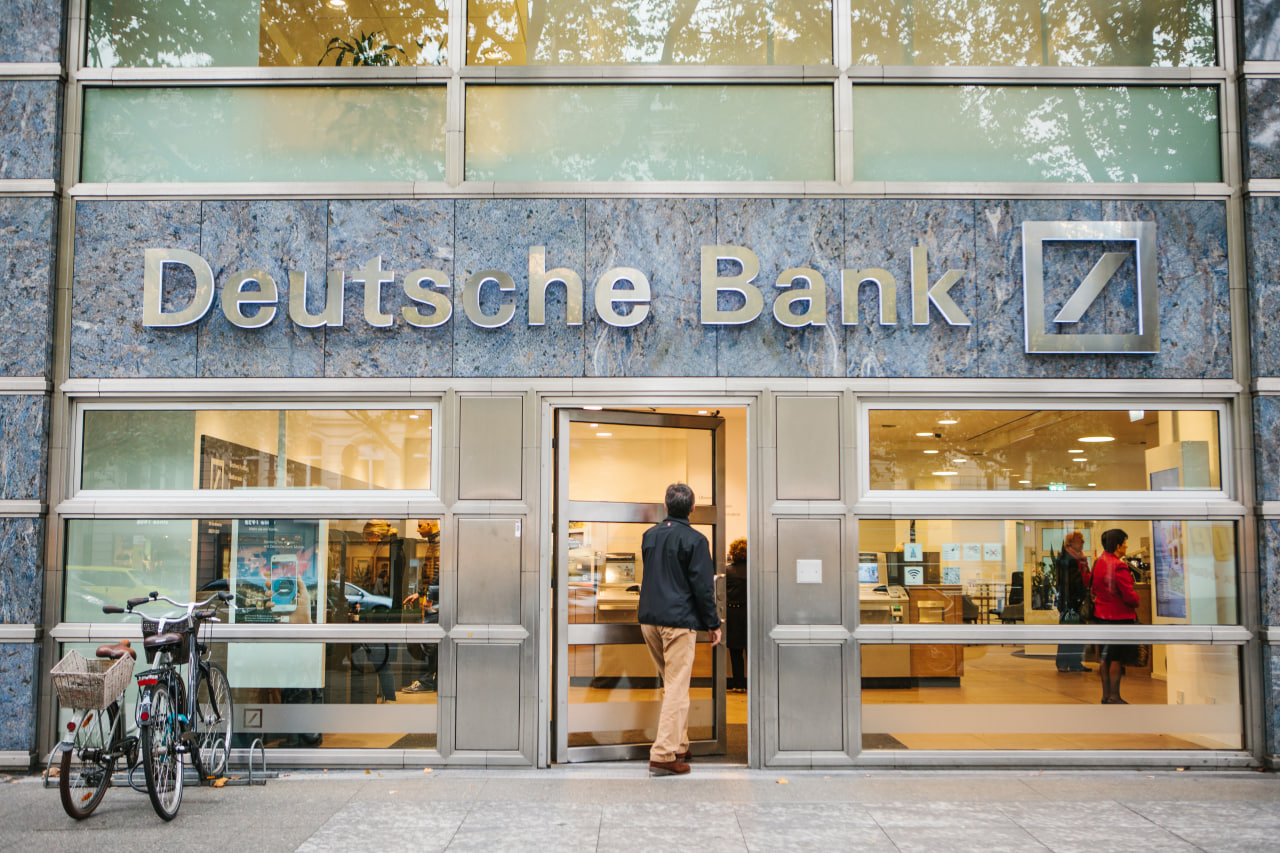
Deutsche Bank’s digital-asset custody service is live for paying clients. DWS has an existing connection to the EURAU euro stablecoin. The bank faces competition from established institutiona
- Deutsche Bank’s digital-asset custody service is live for paying clients.
- DWS has an existing connection to the EURAU euro stablecoin.
- The bank faces competition from established institutional custodians.
- Tokenized assets offer expansion potential, but revenue remains unproven.
Deutsche Bank can now hold cryptocurrencies for paying institutional clients. The more interesting opportunity is what happens when those clients want to move assets rather than simply store them.
Germany’s largest lender confirmed the launch on November 11 and signed a memorandum of understanding with its asset-management business, formerly known as DWS, according to Reuters.
The agreement remains exploratory. Yet Deutsche Bank already supports a stablecoin connected to DWS through an existing joint venture, providing a potential foundation for institutional transactions involving tokenized financial assets.
That connection offers a more tangible strategic rationale than another bank adding Bitcoin custody.
Follow the Assets, Not the Announcement
Consider a future institutional transaction involving a tokenized investment product.
An asset manager issues a digital representation of a financial instrument. An investor purchases it using tokenized cash. A custodian safeguards the resulting position and processes subsequent transfers.
Deutsche Bank wants to participate in several parts of that process.
Its September custody announcement identified Bitcoin, Ether, USDC, EURC and EURAU among the assets supported at launch.
EURAU is issued by AllUnity, a joint venture involving DWS, Flow Traders and Galaxy.
The relationship is commercially relevant because AllUnity is developing infrastructure for euro-denominated blockchain transactions, while Deutsche Bank can provide regulated custody for eligible institutional customers.
AllUnity has already announced arrangements with other infrastructure providers, including Tradevest and Tangany. Deutsche Bank is therefore entering an ecosystem with existing participants rather than creating the entire transaction chain itself.
There is an important limitation: neither Deutsche Bank nor DWS has announced that the new custody service will process subscriptions or redemptions for a specific tokenized fund.
Supporting EURAU establishes technical compatibility with the asset. It does not prove that Deutsche Bank has secured a settlement mandate from AllUnity or its shareholders.
The Revenue Opportunity Is Smaller Than the Addressable Market
DWS reported approximately €1.19 trillion in assets under management at the end of June 2026.
That figure demonstrates the scale of the affiliated investment-management business, but it is not a measure of assets available for tokenization or transfer to Deutsche Bank’s new platform.
A more useful approach is to test the sensitivity of custody revenue to actual digital-asset adoption.
Digital Asset Custody: Revenue Scenario
Illustrative annual gross revenue
Metric
Scenario
Assets under custody
€1 billion
Annual custody fee
0.10% (10 bps)
Gross annual revenue
€1 million
Illustrative calculation, not Deutsche Bank guidance. Assumes €1 billion in digital assets held at a 10-basis-point annual fee. Excludes operating expenses.
Custody revenue depends on assets actually onboarded and the fees negotiated with clients, not the total traditional assets managed by an affiliated company.
A platform supporting only a modest volume of digital assets may generate limited direct revenue even when its parent organization has an extensive institutional client base.
Deutsche Bank could improve the economics by adding transfer, issuance or settlement services. Those activities remain part of its longer-term development plans rather than disclosed revenue streams.
The bank has not published customer numbers, custody balances or fees for the new business.
Europe’s Custody Market Is Already Crowded
Deutsche Bank is entering a market where established financial institutions and specialist technology providers have already built competing infrastructure.
BNY expanded its digital-asset custody offering in Europe in October, while crypto-native firms continue to serve institutions requiring trading connectivity, collateral management and wallet infrastructure.
The competitive positions are not identical.
Where Institutional Custodians Compete
Provider
Established advantage
Commercial challenge
Deutsche Bank
Corporate banking and DWS relationship
Converting new custody clients into recurring volume
BNY
Global custody and asset servicing franchise
Integrating digital assets into existing workflows
Crypto-native providers
Specialized wallet and trading infrastructure
Competing for bank-led institutional relationships
Strategic comparison based on publicly described business models. Not a ranking of custody security, pricing or market share.
Deutsche Bank’s use of external technology providers also changes the competitive equation.
The lender can integrate specialist infrastructure instead of developing every component internally, potentially reducing development requirements. However, it must still manage vendor dependencies, operational resilience and key-management risks.
Under the EU’s MiCA Article 60, authorized credit institutions can provide crypto-asset services through a notification framework rather than applying for the same standalone authorization required of many crypto-native firms.
That provides a regulatory route into the market, not a guarantee of lower operating costs or immunity from supervisory scrutiny.
The Next Test Is Institutional Settlement
Paul Maley, Deutsche Bank’s global head of trust and securities services, said the bank ultimately wants an integrated platform supporting custody, tokenization and settlement.
That objective also fits the lender’s previously reported interest in expanding digital-asset services into Asia.
The difficulty is turning those ambitions into repeatable institutional transactions.
A tokenized bond held in custody does not automatically settle more efficiently than a conventional security. The cash leg, ownership records, legal finality and participating institutions must work together.
The DWS-AllUnity connection gives Deutsche Bank a plausible route toward that model, particularly for euro-denominated transactions. It does not establish that the bank controls the entire infrastructure or that customers will choose it over competing providers.
The strategic verdict is straightforward: Deutsche Bank has built a functioning entry point into institutional digital assets, but its most valuable opportunity remains conditional on adoption.
Until customers begin using the platform for substantial recurring activity, particularly tokenized issuance and settlement, custody is best viewed as an investment in a future financial-services market rather than a demonstrated new earnings engine.
The post Deutsche Bank’s Crypto Push Has a Hidden DWS Connection appeared first on ETHNews.