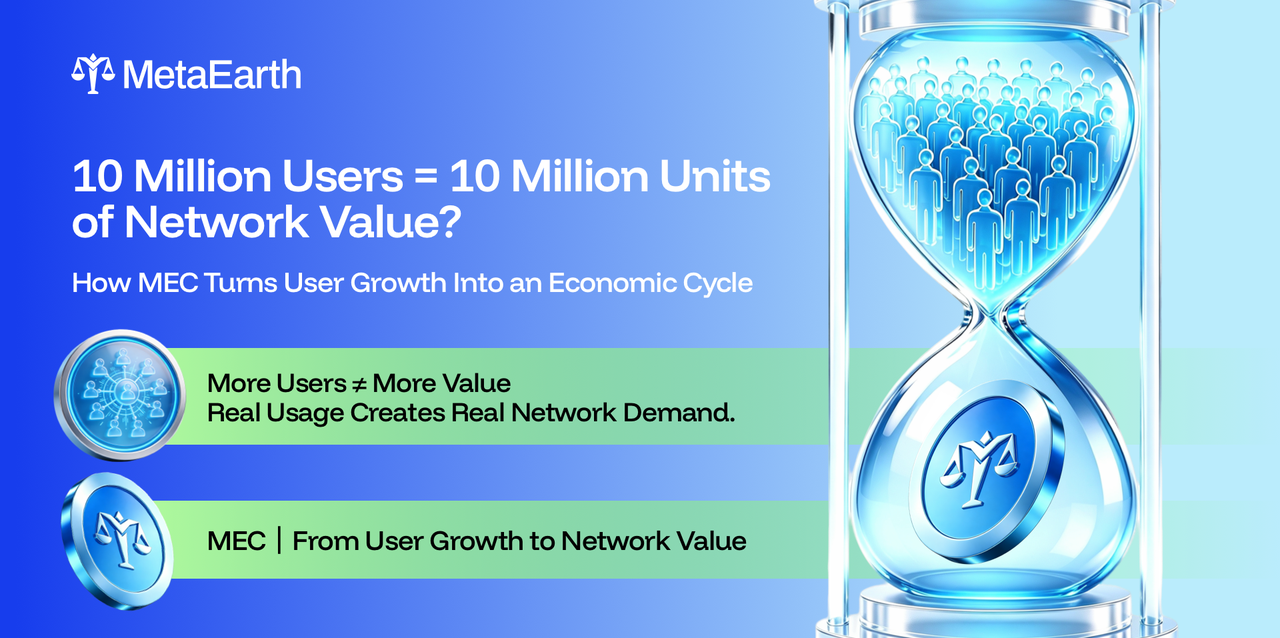
Imagine two public blockchains: One has 10 million users, but most of them rarely use the network again after signing up and claiming rewards. The other has only 1 million users, but they con
Imagine two public blockchains:
One has 10 million users, but most of them rarely use the network again after signing up and claiming rewards.
The other has only 1 million users, but they continue to transact, use DApps, participate in Staking, join communities, and generate new on-chain activity.
Which network is more valuable?
The answer may not be as simple as the user numbers suggest.
In Web3, User Growth has always been one of the easiest metrics to attract attention: How many wallet addresses has a network reached? How many new users have joined its communities? How quickly are registrations growing?
But the question that really matters is:
After gaining 1 million new users, how many of them actually start using the network?
If users simply “arrive” without making transactions, using applications, participating in Staking, or engaging in other on-chain activities, even the most impressive growth curve may remain little more than a user count.
Incentives can drive a wave of growth. But a real network economy has to answer a bigger question: What happens after the growth?
For a public blockchain, “having users” and “having users actively use the network” are two very different things.
A new user creating a wallet does not necessarily mean they will make on-chain transactions. Claiming a one-time reward does not mean they will continue using DApps. And distributing Tokens does not necessarily create new demand for the network itself.
What actually drives a network is what users do after they enter:
Use DApps and smart contracts;
Transfer assets and interact with on-chain assets;
Participate in Staking;
Join communities and governance;
Use on-chain services such as payments, DeFi, and RWA.
Together, these activities create Network Activity.
Network Activity can then translate into demand for blockspace, Gas, validation services, and other forms of blockchain infrastructure.
So the more important question is not simply “How many users does the network have?” but rather: How many users are continuously creating real network demand?
That is the first step in turning User Growth into Network Value.
Tokens are one of the most direct growth tools in Web3. Airdrops, referral rewards, liquidity incentives, and Staking Rewards can all attract users and assets to a new network in a relatively short period of time.
The problem is that if the economic model only looks like this: Token Distribution → User Acquisition → Users Claim Tokens, the cycle ends very quickly.
The Token is being used to “buy growth,” but the model does not answer how that growth can create new value.
A more complete Tokenomics model should create another path: User Growth → Network Participation → Application Usage → Transactions → Network Demand → Value Distribution
Users enter the network and begin using applications. Applications generate transactions. Transactions consume network resources and generate Gas. The value created through network activity can then flow to developers, nodes, Treasuries, communities, and other ecosystem participants.
If part of that value can then be used to attract and incentivize new participants, the economic model begins to evolve from a one-way “distribution path” into a value cycle.
This also provides an important perspective for understanding MEC.
Press enter or click to view image in full size

If User Growth is to truly translate into Network Value, the key is not simply getting more people to “hold MEC.” It is enabling new users to enter the network, participate in the ecosystem, and create real network demand through continued usage.
This is at the core of the MEC value cycle.
MEC is the native Token of Meta Earth, but its value logic is not limited to Tokenomics metrics such as total supply, permanent Staking, or annual halving. More importantly, MEC connects ME ID, network usage, and ecosystem participation, allowing User Growth to enter the economic cycle of ME Network.
This process can be understood in three stages:
1. From New Users to Real Network Participants
ME ID serves as an important gateway for users entering the Meta Earth ecosystem.
After completing KYC, a user can obtain an ME ID and one permanently staked MEC allocated under the genesis block rules, while continuing to receive the corresponding Staking rewards through UBI (Universal Basic Income).
As a result, a new user entering Meta Earth represents more than just another wallet address. The user begins to establish an ongoing identity and economic relationship with the network.
New User → KYC → ME ID → UBI → Network Participation
This is the first step in bringing User Growth into the MEC economic cycle.
2. From Network Participation to Real Network Demand
Having an ME ID is only the beginning.
As users go on to use DApps, manage and transfer assets, participate in Staking, join on-chain communities, and access more Web3 applications, User Growth begins to translate into actual Network Activity.
As on-chain activity increases, so does the demand for transactions, Gas, blockspace, and other network resources.
As the native Token of ME Network, MEC serves as an important economic medium connecting these network activities with the broader ecosystem.
The key transition is therefore: ME ID Growth → Ecosystem Participation → On-Chain Activity → Network Demand
At this point, users are no longer just a growth metric. They become part of the network’s actual demand.
3. From Network Demand to a Sustainable Economic Cycle
As more real users enter applications, communities, and on-chain environments, the value generated through network activity can flow to different participants across the ecosystem.
That value can continue to support network operations, application development, community building, and user incentives, while creating conditions for more new users to enter the ecosystem.
MEC therefore connects more than just “users” and “Tokens.” It supports a broader value path: User Growth → Network Participation → Application Usage → On-Chain Activity → Network Demand → Ecosystem Growth → New User Growth
In this cycle, User Growth is not the end point.
What truly matters is whether every new user who enters the network can gradually translate into real usage, real demand, and sustained ecosystem activity — and ultimately help drive the next wave of network growth.
That is the core logic behind how MEC brings User Growth into an economic cycle.
Web3 has never lacked stories of rapid growth.
What is truly scarce is the ability to turn growth into sustained value creation.
One million new addresses may look impressive. But growth only truly enters the economic system of a public blockchain when the real users behind those addresses begin using applications, generating transactions, and participating in the network.
This is also what makes MEC worth examining from a broader perspective.
MEC is not simply designed as a Token issuance and incentive mechanism. It is part of a value path that begins with people: Identity → Participation → Application → Transaction → Network Demand → Value Distribution → Incentive → Growth
So when evaluating the long-term value of MEC, perhaps the most important question is not simply how many Tokens are issued or how much issuance is reduced through halving.
There is a more fundamental question: When the next ME ID enters the network, can it create another source of sustained demand for ME Network?