Do MEV Bots Steal Crypto? Understanding the Risk to Your Swaps You tap swap, and the price you receive is worse than the one on screen. Nothing was hacked, and your wallet is untouched. So do
Do MEV Bots Steal Crypto? Understanding the Risk to Your Swaps
You tap swap, and the price you receive is worse than the one on screen. Nothing was hacked, and your wallet is untouched. So do MEV bots steal crypto, or did you simply lose a speed race? The honest answer sits between theft and fair play—and shows how to protect your trades.
What Are MEV Bots, and Why Do They Chase Your Trades?
MEV stands for maximal extractable value. It’s the extra profit someone can earn by choosing the order of transactions in a block.
Ethereum users send trades to a public waiting area called the mempool. Bots monitor it around the clock. When one finds a profitable trade, it pays slightly higher fees to move ahead of it.
Some of this activity is useful. Arbitrage keeps prices aligned across exchanges. Other forms cost ordinary traders money, asForbes reported in 2022.
How Does a Sandwich Attack Work Inside One Block?
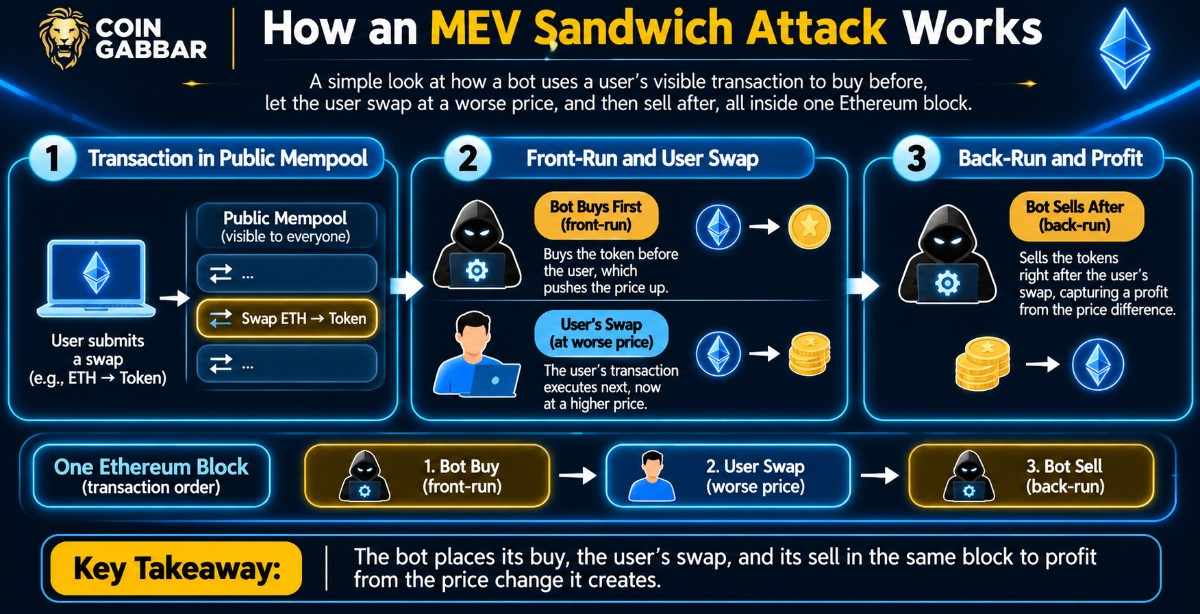
A sandwich attack has three moves, and all of them land in one block. The bot works with block builders, the computers that order and confirm each block.
Step
Who acts
What happens
1
Bot
Buys ahead of you and lifts the price
2
You
Your swap fills at the worst price.
3
Bot
Sells right after you and keeps the gap
You still receive your tokens, just fewer than expected. Your loss is the gap between the price you saw and the price you paid.
A high slippage setting makes the attack easier. It tells the exchange you’ll accept a larger price move, and bots will use all of it. Traders often call the public mempool a dark forest because anything visible gets hunted.
Do MEV Bots Steal Crypto or Just Win the Race?
Strictly speaking, no. A sandwich bot doesn’t break into your wallet or forge your signature. It exploits how blocks are ordered, and your own trade lets the price move.
The loss is still real. It works like a hidden fee, and many traders call it theft. That reaction is understandable, even though the mechanism isn’t a hack.
What Did the US Judge Say About the Peraire-Bueno Case?
On 16 November 2026, a US judge in Manhattan cleared Anton and James Peraire-Bueno of charges that they stole $25 million in 12 seconds in April 2023. According to Reuters, prosecutors said the brothers exploited MEV-Boost software to trap trading bots.
Judge Jessica Clarke found no material misrepresentation in their trades. She also noted that the trades weren’t placed on a regulated market with rules against this conduct. A jury had deadlocked a year earlier.
Consider who the alleged victims were. They were trading bots, not everyday savers. The ruling doesn’t make sandwiching ethical. The judge said that wasn’t the question before the court.
Are Fake Trading Bots a Bigger Risk Than MEV Bots?
For your wallet, often yes. Here the word steal fits. SentinelOne Labs hasreported on Ethereum drainers that pose as trading bots.
The pitch is usually simple. A bot promises easy profit from MEV. You deposit funds or approve a contract. Then the code sends your money to the scammer.
A real MEV bot earns from other traders’ transactions. It doesn’t need your deposit.
How Can You Protect Your Swaps From MEV Bots Today?
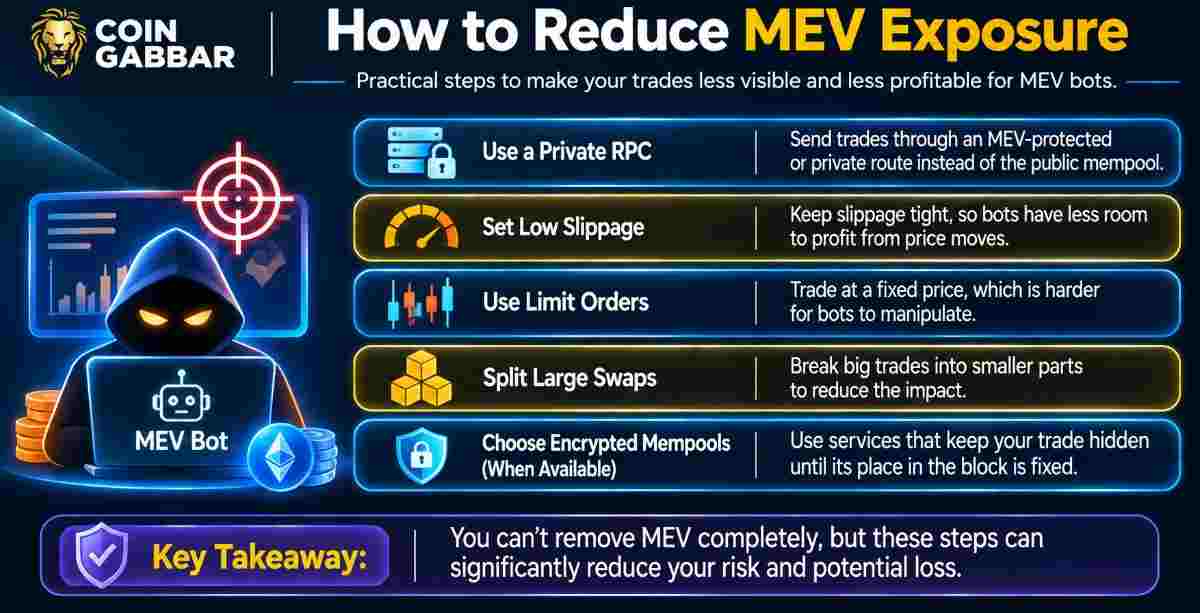
You can’t remove MEV, but you can reduce your exposure. These steps help most:
Use a private RPC endpoint or an MEV-protected setting, so your trade skips the public mempool.
Set slippage as low as the pair allows.
Use limit orders where the exchange offers them.
Split large swaps into smaller ones.
Compare the quote with the final result every time.
Longer term, projects are testing encrypted mempools. They use threshold encryption to keep a trade hidden until its place in the block is fixed. Bots can’t read what they can’t see.
What Risks Remain Even After You Turn Protection On?
Protection isn’t a guarantee. Private routes can fail, and builders may still see your trade.
Low slippage can make a swap fail, and you’ll still pay a network fee. Rules and tools also change, so check current documentation.
Any bot that asks for a deposit remains a red flag. Never approve a contract you can’t read.
Expert Opinion: What Should Crypto Traders Take Away?
CoinGabbar analysis suggests the claim that MEV bots steal crypto is most accurate for fake bots and drainers. Sandwich bots are better described as value extraction. The Peraire-Bueno ruling indicates that courts are still working out where the legal line sits.
Until rules catch up, traders carry much of the protection work themselves. Private routing and tight slippage address the most common loss.
Disclaimer: This article is for information only. It isn’t financial or legal advice. Crypto trading carries risk, and rules can change. No tool removes every risk, and nothing here guarantees an outcome.