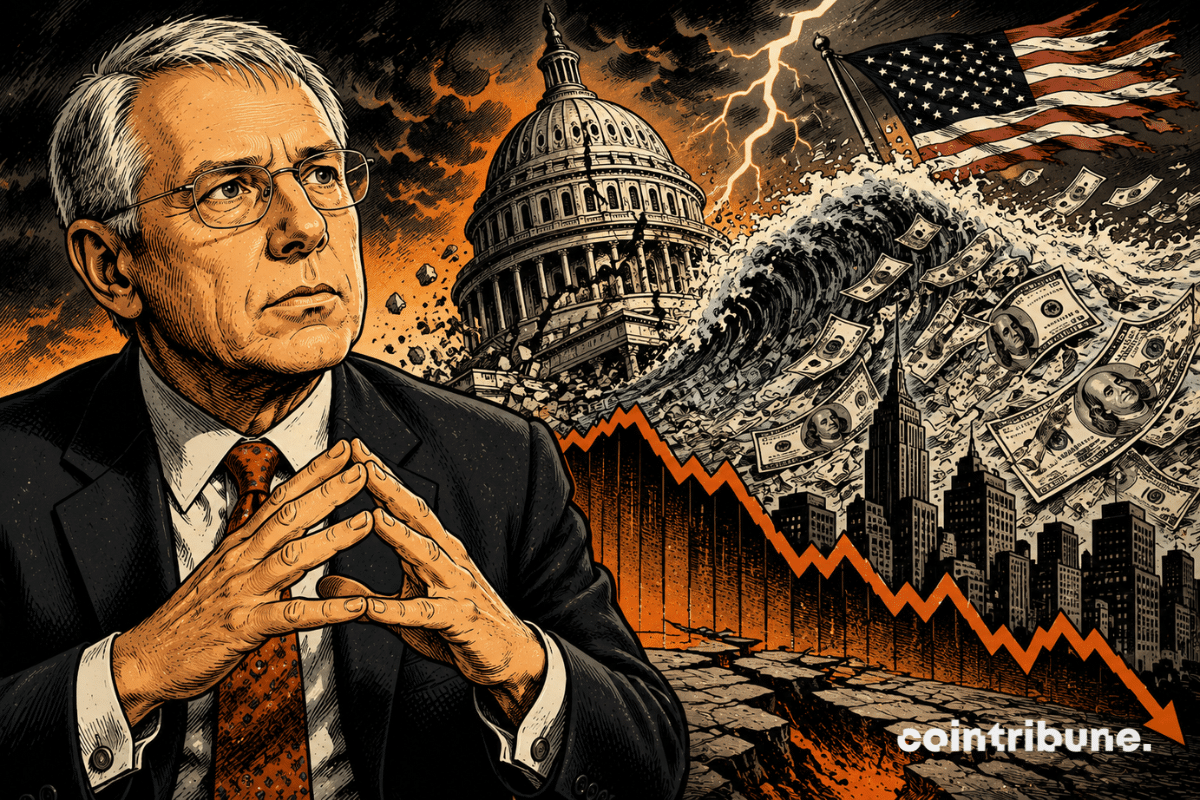
American debt is no longer just an economic indicator, but it is becoming a systemic risk. As the cost of its financing explodes, the Federal Reserve’s room to maneuver shrinks and concerns g
American debt is no longer just an economic indicator, but it is becoming a systemic risk. As the cost of its financing explodes, the Federal Reserve’s room to maneuver shrinks and concerns grow about the solidity of the United States’ economic model. Guest on the show “The David Lin Reportf”, investor Doug Casey, author of “Crisis Investing”, makes a straightforward assessment. The world’s leading power is approaching a breaking point. This analysis also reignites the debate on the role of bitcoin and safe-haven assets in the face of monetary erosion.
In brief
- The US government faces a major budget deadlock, burdened by $40 trillion of debt, of which $15 trillion needs to be refinanced in the next twelve months.
- The Federal Reserve finds itself trapped in an insoluble dilemma, where each rate hike risks triggering chain bankruptcies and each cut fuels currency depreciation.
- The accumulation of unproductive private debts worsens economic fragility, threatening a sustained decline in living standards across the Western world.
- The market reacts by turning to commodities and tangible assets, seeking protection against re-inflation and the overvaluation of tech stocks.
The sovereign debt deadlock and the Fed’s monetary trap
The central point of Doug Casey’s warning rests on the unsustainable structure of the US federal government’s debt and the financial noose tightening around Washington :
- A colossal outstanding amount and immediate maturities : total public debt reaches around $40 trillion, of which nearly $15 trillion must be refinanced in the next twelve months ;
- A massive annual deficit : the US government budget deficit currently approaches $2 trillion per year, imposing continuous bond issuance ;
- Extreme sensitivity to interest rates : David Lin recalled that an increase of just 1 basis point (0.01%) in the state’s average borrowing cost generates about $3.9 billion in additional annual interest expenses.
Facing this refinancing wall, the Federal Reserve is trapped between two equally destructive choices: keeping interest rates high at the risk of causing mass bankruptcies among borrowers unable to refinance, or lowering rates at the risk of encouraging further indebtedness and depreciating the currency. Confronted with this mathematical deadlock, Doug Casey stated : “frankly, I see no way out. I think we are on the edge of a precipice at this stage”.
According to Casey, this refinancing crisis cannot be resolved by ordinary budget adjustments, with full repayment of nominal debt appearing like a mathematical illusion. The economist believes the debt will eventually be reduced either by an explicit default, or more likely, by sustained monetary creation which will gradually erode its real value through inflation.
Although he advocates drastic cuts to military spending, the sale of federal assets, and major reforms of social programs to rebalance public accounts, he himself recognizes that such austerity measures are politically unfeasible in the current institutional context. Governments thus prefer to extend the deadline by continuously refinancing maturing bonds rather than reducing the overall outstanding amount, increasing the fragility of the global bond system.
Private over-indebtedness and the deterioration of Western living standards
Beyond the public debt crisis, the vulnerability of the American economy extends to household debt and the structure of unproductive public spending. Doug Casey highlights the presence of about $1.5 trillion in student loans and an equivalent amount in auto loans, two categories of debts that have financed current consumption rather than the creation of productive assets. Moreover, the majority of the US federal budget is absorbed by rigid items such as Social Security, Medicare, Medicaid, and debt servicing. Although these commitments finance existing obligations, they generate no new productive capacity likely to support loan repayment.
Faced with this picture of a debt-driven economy, Casey warns: “we have lived beyond our means. I think we are heading toward what I call the Great Depression”. He specifies that this scenario will translate into a sustained decline in living standards in the United States, Canada, and Europe, marking a major structural turning point.
Join the ‘Read to Earn’ programThis link uses an affiliate program.Military asymmetry, commodity markets, and the AI bubble
This macroeconomic fragility occurs amid geopolitical tensions and technological disruptions. On the military front, the emergence of low-cost drones, valued around $30,000 such as Iranian Shaheds, calls into question the efficiency of traditional, very expensive defense systems, like the Patriot missiles priced at $5 million or Tomahawks at $3 million. Asserting that “the wave of the future is drones”, Casey explains that this asymmetry shifts the balance of power toward actors capable of producing these devices on a large scale. Meanwhile, in the energy sector, ongoing frictions near the Strait of Hormuz support a marginal oil price around $80 per barrel, turning geopolitical risk into a permanent market component.
In the precious metals market, although gold reaches $4,000 an ounce, Casey favors stocks of mining companies whose overall maintenance costs are around $1,700 an ounce, yielding exceptional margins. Regarding artificial intelligence, while he describes it as a fundamental technology that “changes the world around us”, he cautions against the overvaluations of companies in the sector and questions the real returns on the hundreds of billions invested in data centers.
If fears of budget deterioration are confirmed, capital could continue to redirect toward assets considered less exposed to central bank decisions. In this context, bitcoin and, more broadly, the crypto ecosystem, could benefit from renewed interest, supported by their programmed scarcity and independence from national monetary policies.
All these perspectives outline a framework of monetary instability and global market realignment. While the deterioration of debt ratios and inflation risk encourage many investors to turn to tangible assets or those outside the traditional banking system, geopolitical uncertainties and risks of overvaluation in technologies require rigorous selectivity. The trade-off between continuous fiat currency depreciation and preserving purchasing power will remain central to financial strategies in the coming years.