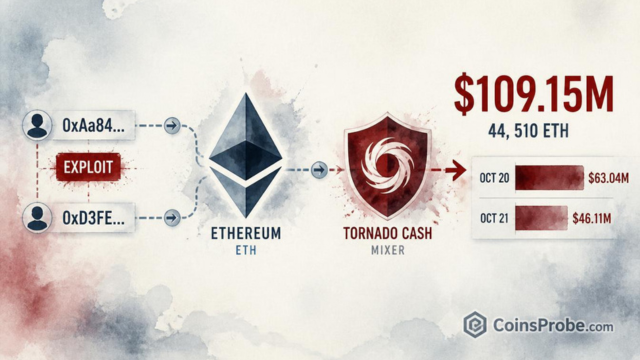
Key Highlights Drift Protocol exploiter transferred 44,510 ETH (~$109.15M) to Tornado Cash across Oct 20–21, per OnchainLens Oct 20 tranche: 25,710 ETH (~$63.04M) Oct 21 tranche: 18,800 ETH (
Key Highlights
Drift Protocol exploiter transferred 44,510 ETH (~$109.15M) to Tornado Cash across Oct 20–21, per OnchainLens
Oct 20 tranche: 25,710 ETH (~$63.04M)
Oct 21 tranche: 18,800 ETH (~$46.11M) — two identified wallet addresses
Funds entered mixer, not exchange — direct spot sell pressure is deferred, not immediate
Watch for unlabeled large ETH deposits to centralized exchanges as the post-mixer off-ramp signal
BREAKING
The Drift Protocol exploiter — a wallet cluster tied to a prior protocol breach — moved 44,510 ETH valued at approximately $109.15 million into Tornado Cash over a 48-hour window, according to OnchainLens. The transfer represents one of the largest single exploit-fund laundering events routed through the mixer in recent memory, and it arrives at a time when Ethereum’s price action and regulatory environment are both under active scrutiny. For broader context on ETH’s current market structure, see Ethereum After the Binance Leverage Flush — What the Data Says Now.
The funds were split across two identified wallet addresses — 0xAa843eD65C1f061F111B5289169731351c5e57C1 and 0xD3FEEd5DA83D8e8c449d6CB96ff1eb06ED1cF6C7 — and routed into Tornado Cash in two discrete tranches. On October 20, 25,710 ETH (~$63.04M) was transferred. The following day, October 21, a second batch of 18,800 ETH (~$46.11M) followed. The alert was published by @OnchainLens at 08:26 GMT on October 21, 2026. No exchange deposit was flagged — the destination in both cases was Tornado Cash, the Ethereum-based privacy mixer that obfuscates transaction trails by pooling and re-routing funds.
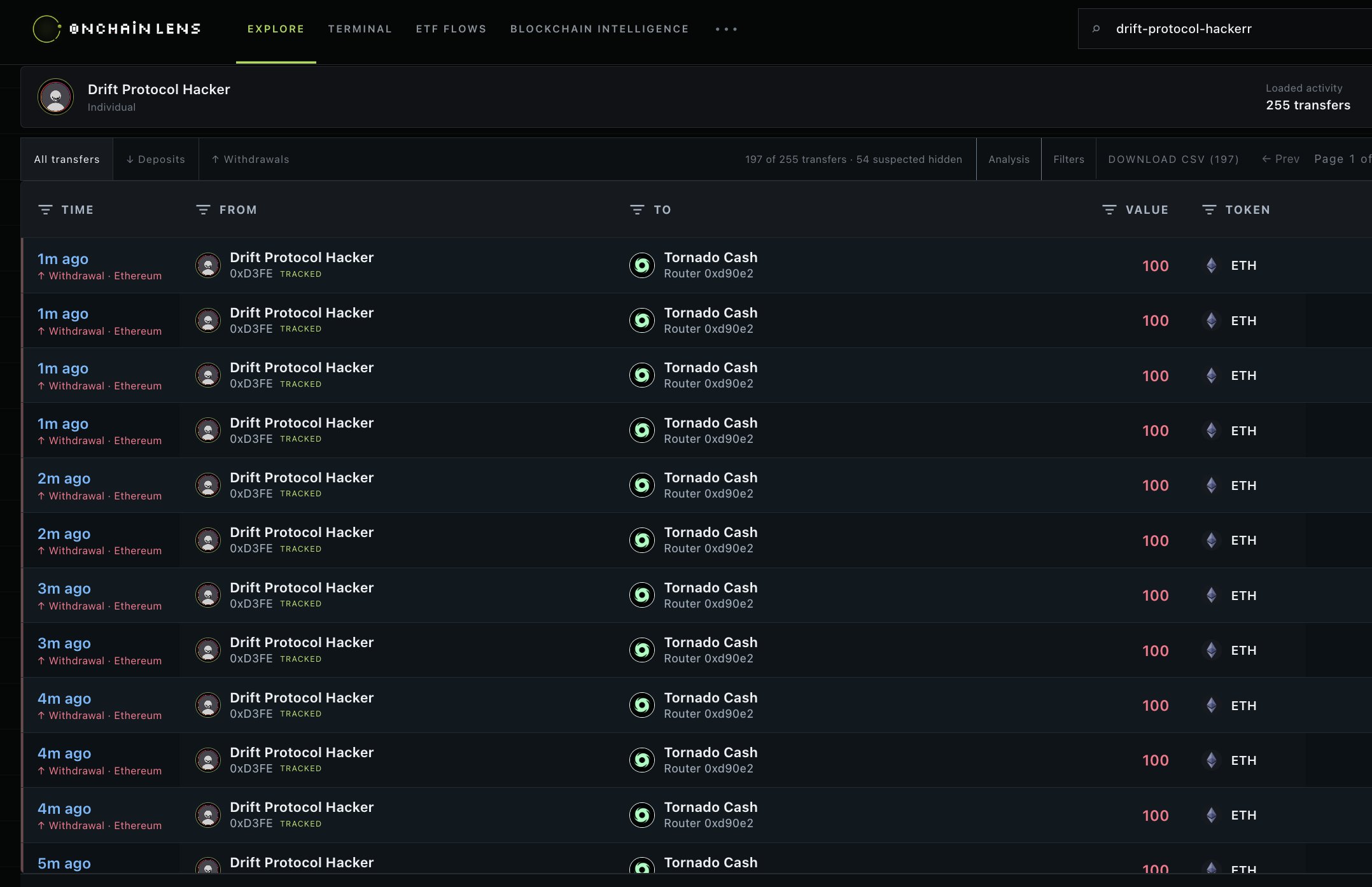
DRIFT EXPLOITER MOVES $109M $ETH | Source: @OnchainLens (X)
This is not a standard whale accumulation or distribution event — it is an exploit wallet actively attempting to obscure the origin of stolen funds. On-chain analysts interpret Tornado Cash inflows of this scale as a laundering sequence: the exploiter is breaking the traceable link between the original breach and eventual liquidation.
The two-day structure — large first tranche, smaller follow-up — is consistent with testing mixer throughput before committing the full balance. Critically, this move does not directly signal a spot sell pressure on ETH markets, since the funds are entering a mixer rather than a centralized exchange. However, the risk is deferred, not eliminated: once funds clear the mixer, they can re-emerge as untraceable ETH and be sold on any venue. On-chain watchers will now monitor for large, unlabeled wallet deposits to major exchanges — particularly Binance, Coinbase, and Kraken — as the post-mixer off-ramp. A sustained ETH price hold above its current range would suggest this pressure has not yet materialized in spot markets.
The critical follow-on signal is whether additional ETH exits from either address — 0xAa843eD65C1f061F111B5289169731351c5e57C1 or 0xD3FEEd5DA83D8e8c449d6CB96ff1eb06ED1cF6C7 — in coming days. If the two identified wallets still hold residual ETH beyond the 44.51K already moved, a third tranche cannot be ruled out. Law enforcement agencies and blockchain analytics firms including Chainalysis and TRM Labs have historically tracked post-Tornado Cash fund flows by probabilistic clustering — meaning this movement is unlikely to fully evade scrutiny despite the mixer.
The Drift Protocol community and its broader DeFi stakeholders will be watching for any protocol-level response, insurance fund activation, or recovery announcements tied to the original exploit. Until a confirmed exchange deposit from a post-mixer wallet appears on-chain, the direct sell pressure on ETH from this event remains latent rather than immediate.
Disclaimer: The views and analysis presented in this article are for informational purposes only and reflect the author’s perspective, not financial advice. Technical patterns and indicators discussed are subject to market volatility and may or may not yield anticipated results. Investors are advised to exercise caution, conduct independent research, and make decisions aligned with their individual risk tolerance.