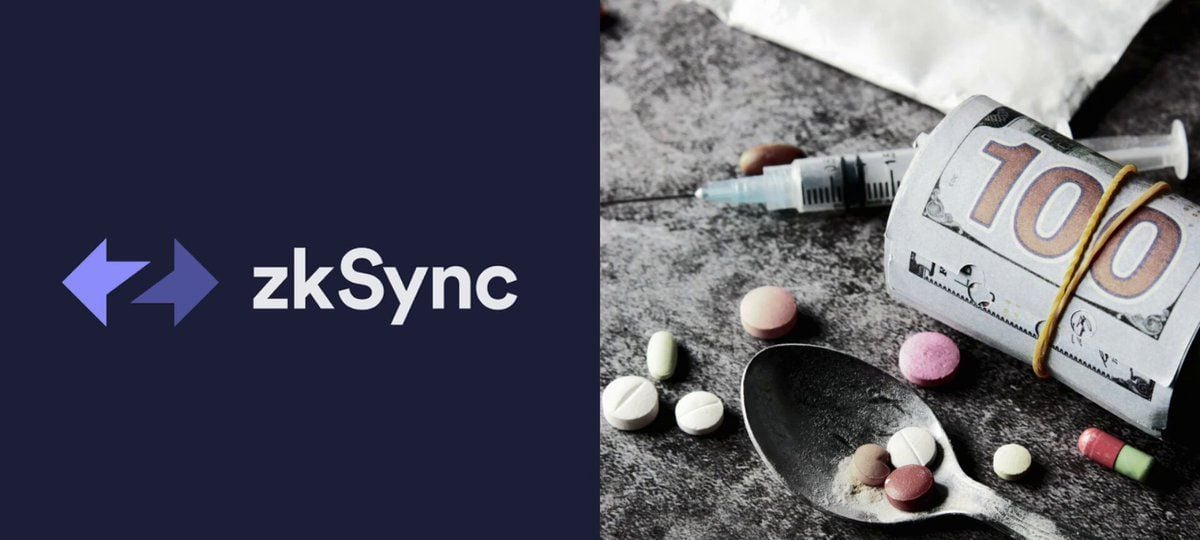
A Chinese criminal network accused of smuggling fentanyl precursors from China to the United States also operated a fraudulent cryptocurrency token from a base in Japan, defrauding investors
A Chinese criminal network accused of smuggling fentanyl precursors from China to the United States also operated a fraudulent cryptocurrency token from a base in Japan, defrauding investors of hundreds of millions of yen, according to an investigation published by Nikkei Asia.
A Fake Token Built on Borrowed Credibility
The scheme distributed a fraudulent token under the name "zksync(.)jp," built to imitate an established payment service and trick users into sending funds. The token used the ".jp" suffix, which normally requires a registrant with a Japanese address, and was issued in 2023, overlapping with Amarvel's operations. The token name appeared to copy ZKsync, a legitimate Ethereum Layer 2 network built by Matter Labs. There is no apparent connection between ZKsync and the alleged fraud.
The domain's registrant appears to be a Chinese national living in Hong Kong with close financial ties to Amarvel, Nikkei reported. Blockchain forensics firm Chainalysis told Nikkei the setup is a common money-laundering method, since Japanese domains carry international credibility that makes them useful cover. Total damages, including in Japan, are estimated in the hundreds of millions of yen, with 100 million yen equalling roughly $620,000.
Fentanyl Network at the Centre of the Case
At the centre of the case is Hubei Amarvel Biotech, a Wuhan-based chemical manufacturer. Two of its executives were convicted in a Manhattan federal court in February 2025 of conspiring to import fentanyl precursors into the US. Amarvel's Japanese front, a Nagoya company called Firsky, served as an operational hub where Chinese national Xia Fengzhi, described as the "boss in Japan," directed logistics and money management. Firsky was liquidated in July 2024, and Xia's whereabouts are unknown.
Hubei Amarvel Biotech executives Qingzhou Wang and Yiyi Chen were sentenced to 25 and 15 years in prison, respectively, for fentanyl precursor importation and money laundering offences. Nikkei traced more than 120 crypto transactions between the network and US-sanctioned entities, evidence it said points to money laundering. The network was also tied to parties blacklisted by the US Treasury's Office of Foreign Assets Control, with more than 120 transactions clustered around the Wuhan Yuancheng Group, routed through multiple accounts to obscure the source of funds.
TRM Labs has found that roughly 97% of the more than 120 China-based drug-precursor manufacturers it studied accept crypto. Chainalysis has separately traced $5.5 million in stablecoins from Latin American cartels to Chinese fentanyl producers, and earlier estimated that wallets linked to suspected chemical shops took in $250 million since 2015. The case underscores how transnational criminal organisations are increasingly layering crypto fraud on top of existing drug trafficking operations, complicating enforcement efforts across multiple jurisdictions.
Sources:Nikkei Asia: Chinese fentanyl network suspected of crypto fraud via Japan baseThe Block: Fentanyl-linked Chinese network tied to crypto fraud from Japan involving fake zksync(.)jp tokenUS Department of Justice: Amarvel Biotech executives sentenced for fentanyl precursor importation and money laundering