Dune Analytics has launched real-time blockchain market data feeds designed to plug decentralized trading activity into the infrastructure used by traditional finance firms. The offering cove
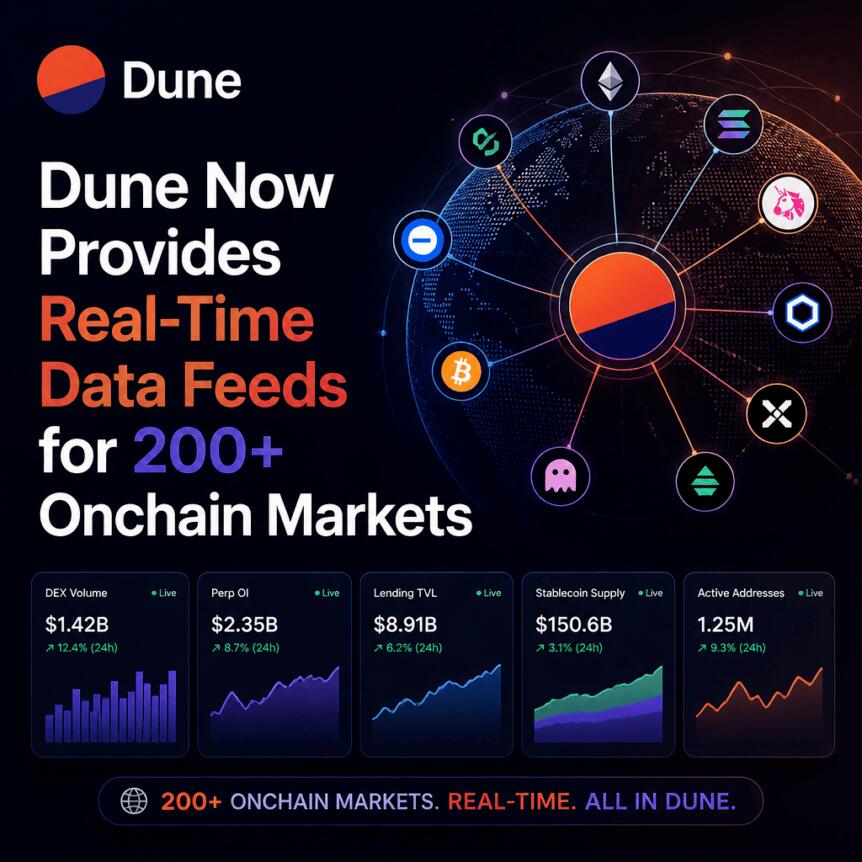
Dune Analytics has launched real-time blockchain market data feeds designed to plug decentralized trading activity into the infrastructure used by traditional finance firms. The offering covers more than 200 onchain trading venues and aims to standardize how institutions can monitor spot decentralized exchanges and perpetual futures trading, with updates delivered roughly one second after execution.
According to a Thursday announcement from Dune, the new service supplies trade data from 12 blockchains, including Ethereum, Solana, Base, and XLayer. By packaging price, trade size, and transaction-level details in a consistent format, Dune says it helps market participants evaluate liquidity and compare execution quality across venues before deploying capital.
Key takeaways
- Dune’s new feeds provide standardized real-time trade data from 12 blockchains, updated about one second after execution.
- The coverage spans decentralized spot trading as well as perpetual futures on Hyperliquid and Lighter.
- Early users include quant funds, market makers, asset managers, and bank trading desks, though Dune did not name them.
- Institutional interest in onchain markets is rising, but fragmentation and issuer concerns remain major frictions in tokenized markets.
- Separate developments in tokenized stock trading highlight ongoing disputes over who controls how shares are traded onchain.
Standardizing onchain trading signals for traditional desks
Dune positions the product as a bridge between decentralized market activity and institutional trading workflows. In an interview-style quote included in the announcement, Dune co-founder and CEO Fredrik Haga said institutions increasingly need access to onchain markets to properly price these assets.
His core argument is that onchain trading data has become difficult to ignore for anyone trying to assess liquidity and execution across fragmented venues. Haga also framed the pace of direct onchain participation as constrained less by demand and more by operational complexity—specifically, the “messy” reality that the same underlying asset can appear across many platforms, often on different chains.
“What still holds institutions back is how messy it is. The same stock trades on dozens of venues across different chains, and you need to know what’s trading where before you can touch it.”
Dune’s new feeds are designed to address that exact problem by aggregating and normalizing trade information across venues. For market makers and execution-focused teams, standardized trade sizing and transaction details can be particularly valuable for building liquidity models, stress-testing strategies, and running cross-venue comparisons—tasks that are harder when data arrives in inconsistent formats or with significant delay.
Where the data coverage starts—and what it targets
While the announcement emphasizes breadth—more than 200 trading venues—Dune’s initial scope is also clearly delineated. The feeds cover spot trading on decentralized exchanges and perpetual futures trading on Hyperliquid and Lighter, delivering standardized trade data such as prices, trade sizes, and transaction-level fields across supported chains.
The practical importance for users is the shift from “watching” fragmented onchain activity to integrating it into systems that institutions already rely on. A near-real-time cadence (about one second after execution) is a meaningful baseline for monitoring, risk management, and pre-trade analytics, even if it does not yet guarantee every firm will route orders directly onchain immediately.
Dune indicated that quant funds, market makers, asset managers, and bank trading desks are among the first clients using the service, though Haga declined to identify them due to nondisclosure agreements. Dune said these firms use the information to assess liquidity, compare prices across venues, and evaluate trading strategies before allocating capital.
Tokenized stocks: fast growth, but fragmentation and governance disputes
The data-feed launch arrives amid renewed attention on tokenized securities, where the underlying market infrastructure is still evolving. In a separate thread of developments highlighted alongside Dune’s announcement, the tokenized stock market has expanded rapidly over the past year, but persistent fragmentation and governance disputes have raised questions about how tokenized trading will mature.
One flashpoint involves plans for a tokenized U.S.-stock trading platform associated with OKXICE—a joint venture between crypto exchange OKX and Intercontinental Exchange (ICE), the parent of the New York Stock Exchange. The venture announced plans for the platform on Oct. 4, and then faced objections from several publicly traded companies.
As reported in the source material, 16 companies—including Microsoft, Alphabet, and Goldman Sachs—have filed objections to having their shares traded on the proposed platform. The companies did not specify their reasons in the cited filings, leaving an open question about the nature of the concerns—whether they relate to control rights, regulatory or compliance expectations, or issuer governance over trading conditions.
Beyond issuer objections, market fragmentation is another structural issue. In May, Ryan Yoon, director at Tiger Research, warned that trading the same tokenized stocks across multiple blockchain platforms could lead to price discrepancies, higher slippage, and reduced overall market efficiency. The logic is straightforward: if liquidity is split, execution becomes less uniform, and the same security can effectively trade at different prices depending on where orders and counterparties concentrate.
Rising tokenized-stock value underscores the need for better data
According to data from RWA.xyz cited in the source, the distributed value of tokenized stocks has reached $3.58 billion, up from roughly $627 million a year earlier—an approximately 470% increase. Even without resolving governance disputes or fragmentation, that growth suggests demand for infrastructure is accelerating.
That backdrop helps explain why real-time, standardized onchain trading data is becoming more relevant. As tokenized assets multiply across venues and chains, the ability to identify where trading is happening—and to compare activity consistently—can make the difference between effective liquidity assessment and blind spots in execution planning.
Investors, traders, and market builders will likely watch whether services like Dune’s feeds become a stepping stone toward deeper institutional participation—particularly as rules clarify and as tokenized marketplaces work through disputes over how issuers should be involved.
Going forward, the key question is whether improved data plumbing can outpace the policy and market-structure frictions in tokenized securities. If fragmentation continues, even the best feeds may only partially solve execution challenges; if governance frameworks and liquidity concentration improve, more institutions may move from monitoring to direct onchain trading.
This article was originally published as Dune Now Provides Real-Time Data Feeds for 200+ Onchain Markets on Crypto Breaking News – your trusted source for crypto news, Bitcoin news, and blockchain updates.