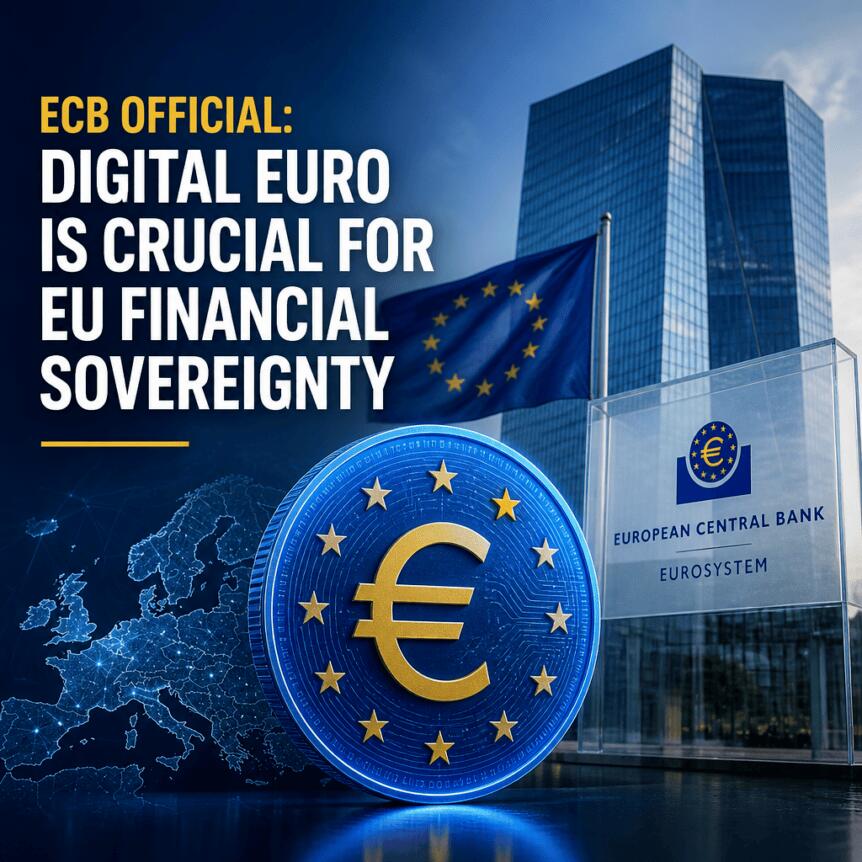
European Central Bank Executive Board member Piero Cipollone has framed the upcoming pilot for a “digital euro” as an infrastructure sovereignty project—aimed at reducing the euro area’s reli
European Central Bank Executive Board member Piero Cipollone has framed the upcoming pilot for a “digital euro” as an infrastructure sovereignty project—aimed at reducing the euro area’s reliance on non-European payment providers. Speaking in an interview published by Italy’s Milano Finance, Cipollone argued that payments, like other critical sectors, cannot depend solely on third parties to ensure smooth and resilient system performance.
The ECB expects the pilot to begin next year and will involve real transactions conducted by ECB and national central bank staff. Cipollone also linked the digital euro discussion to earlier concerns he raised publicly in April about strategic vulnerabilities tied to non-European governance of euro-area card payments—specifically saying that two-thirds of card transactions are governed by companies outside Europe.
Key takeaways
- Cipollone says the digital euro pilot is designed to strengthen European control over essential payments infrastructure.
- He cautioned that critical dependence on third parties makes it harder to guarantee smooth operation of payment systems.
- According to Cipollone, two-thirds of euro-area card transactions are governed by non-European companies.
- The digital euro’s issuance still depends on legislative negotiations in Brussels, with Cipollone hoping regulation is adopted by year-end.
- The pilot will include real transactions and e-commerce/mobile-commerce operators are being invited to participate.
Why the ECB is pushing “payments sovereignty”
Cipollone’s central argument is that Europe has learned—through experiences in other domains—that for certain essential services, dependency on external providers can create operational and strategic risk. In his Milano Finance interview, he pointed to parallels with energy and defense, then applied the same logic to payments.
“In recent years Europe has learned that, for some essential services, we cannot rely only on third parties,” Cipollone said, adding that “we’re seeing it today with defense” and that the same is true for payments.
While he did not name specific companies or providers, he emphasized the practical difficulty of ensuring “smooth functioning” when payment systems are critically dependent on actors beyond Europe’s control. He also underscored that sovereignty does not necessarily mean excluding third parties. Instead, it is about choosing and ensuring that Europe can rely on its own capacity for an essential service.
What the pilot is set to test next year
The ECB’s digital euro pilot is planned to use real transactions, conducted by ECB and national central bank staff. According to the report referenced in the underlying coverage, the project is supported by market operators and preparations that include 36 participants, among them seven from Italy.
The ECB is also extending participation invitations to e-commerce and mobile-commerce operators. The practical significance for industry players is that the pilot is not purely theoretical—it is intended to test how the concept might work in operational conditions that resemble actual payments activity.
For merchants and platform operators, that matters because the digital euro debate is ultimately about integration, usability, and reliability. Testing with real transactions can help surface questions that investors and builders will care about later, including operational requirements and how wallet or payment flows could behave under real use.
Card-payment dependence and the “strategic vulnerability” argument
Cipollone connected the digital euro push to concerns he previously articulated in April during a public lecture in Latvia. As described in his remarks, Europe’s reliance on non-European payment providers creates what he characterized as a strategic vulnerability.
In those comments, Cipollone said that two-thirds of euro-area card transactions are governed by non-European companies. He argued that the digital euro could reduce that dependence by enabling payment infrastructure that is controlled within Europe.
This is an important point for readers tracking the digital euro’s rationale: it is not framed only as a response to changing consumer preferences or the growth of crypto-related payment options. Instead, the ECB’s messaging emphasizes governance, resilience, and control over an essential financial utility.
That framing also helps explain the ECB’s emphasis on “smooth functioning” as a responsibility. If governance is split across regions and entities, ensuring operational continuity may become harder—especially during disruptions or when rules and technical dependencies are outside Europe’s direct control.
Regulatory timing: issuance hinges on Brussels negotiations
Even with a pilot planned for next year, the ECB cannot move directly to issuing a digital euro at scale. Cipollone noted that the ECB Governing Council can only decide on issuance after legislative negotiations in Brussels conclude.
In his Milano Finance interview, Cipollone said he hopes the necessary regulation will be adopted by the end of the year, which would then enable the Governing Council to take a formal decision on issuance.
This sequence matters because it sets expectations for how quickly the program could shift from experimentation to potential implementation. The pilot can provide learning and operational validation, but the legal and political groundwork remains the gating factor.
For market participants, the near-term signal is therefore twofold: the ECB is building practical momentum through testing and operator involvement, while the ultimate timeline for issuance depends on Brussels legislation. Investors and builders who are assessing opportunity in digital euro-related infrastructure may want to watch both streams—pilot outcomes and the pace of regulatory negotiations.
As the pilot approaches, the key uncertainties remain how exactly the ECB intends to translate pilot learnings into a final issuance framework and how legislative talks will shape scope, requirements, and timelines. Readers should also monitor whether the ECB provides clearer details on dependencies it wants to mitigate—particularly in areas where European payment processes are governed by non-European systems.
This article was originally published as ECB Official: Digital Euro Is Crucial for EU Financial Sovereignty on Crypto Breaking News – your trusted source for crypto news, Bitcoin news, and blockchain updates.