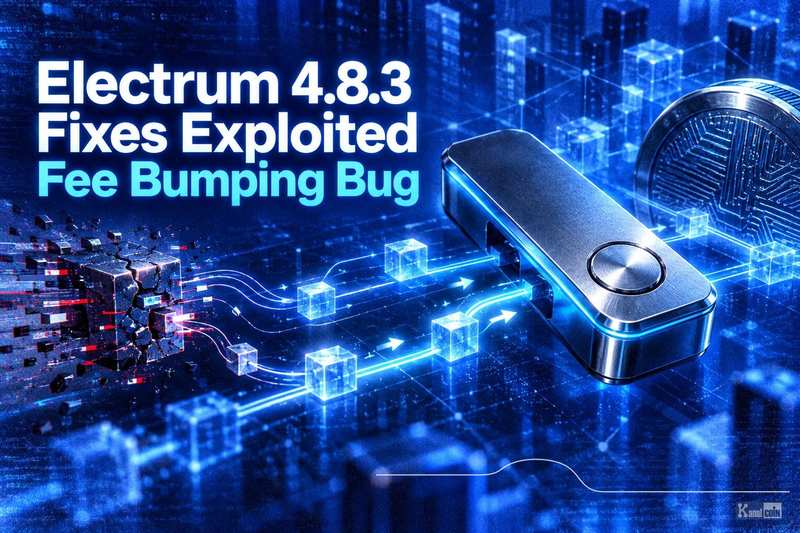
Electrum, one of the oldest and most widely used Bitcoin desktop wallets, has released version 4.8.3 to address an exploited bug tied to the fee-bumping workflow. The vulnerability exposed Bi
Electrum, one of the oldest and most widely used Bitcoin desktop wallets, has released version 4.8.3 to address an exploited bug tied to the fee-bumping workflow. The vulnerability exposed Bitcoin users to risk specifically when they attempted to accelerate a pending transaction by increasing its fee, a common action during periods of network congestion. Users running earlier versions should update immediately through official channels.
TLDR KEY POINTS
- Electrum 4.8.3 patches an actively exploited bug that affected users performing Bitcoin transaction fee bumps.
- The fix is documented in the official 4.8.2 to 4.8.3 changelog on the project's GitHub repository.
- Users should verify their installed version and update only via the official Electrum website or trusted package managers.
Electrum 4.8.3 Addresses an Exploited Fee-Bumping Bug
The Electrum development team published version 4.8.3 as a security-focused release targeting a specific flaw in how the wallet handled fee-bump operations. Details of the fix are visible in the official release notes hosted on the project's GitHub repository. The update covers the gap between 4.8.2 and 4.8.3 and is described as addressing an issue that was already being exploited in the wild. For related coverage, see Future Leaders Awards & Conference 2026 to Bring Global Business and Technology Leaders to Singapore on 2–3 November.
The bug is scoped to the wallet software itself, not to the Bitcoin protocol. The underlying Bitcoin network functions as designed; the vulnerability resided in how Electrum implemented one specific user-facing workflow. That distinction matters for users in Southeast Asia who rely on Electrum to manage Bitcoin holdings independently of custodial exchanges such as Indodax or Tokocrypto. For related coverage, see XRP ETF Investors Put In $1.8B as Holdings Fall to $1.48B.
Wallet-level exploits carry serious consequences even when the broader network is unaffected. As seen in other recent security incidents, such as when X100 exploit proceeds were split across four 400-ETH wallets, attackers often move quickly once a vulnerability becomes public. The window between disclosure and user action is the period of highest risk. For related coverage, see Ethereum Exchanges See 169,770 ETH Net Withdrawal: Santiment.
Why Bitcoin Fee Bumping Was the Critical Risk Area
What Fee Bumping Does
Fee bumping is the practice of increasing the transaction fee on a Bitcoin transfer that has already been broadcast to the network but has not yet been confirmed in a block. When the mempool is congested, miners prioritize transactions offering higher fees. A user who sent Bitcoin with a low fee during a busy period can use fee bumping — via Replace-By-Fee (RBF) or Child-Pays-For-Parent (CPFP) — to make their transaction more attractive to miners and speed up confirmation.
This workflow is genuinely useful and widely used, particularly by traders and payment processors who cannot afford long confirmation delays. For everyday Bitcoin holders across the Philippines, Indonesia, Thailand, and Vietnam, it is often the difference between a timely peer-to-peer transfer completing or sitting in limbo for hours.
Why Wallet Implementation Security Matters Here
Fee bumping requires the wallet to construct and sign a new transaction or a child transaction using the user's private key material. Any flaw in how the wallet manages that signing process or validates the transaction being replaced creates an opening for an attacker to manipulate the outcome. The code changes between Electrum 4.8.2 and 4.8.3 document the specific adjustments the team made to close this gap.
Because Electrum is a non-custodial wallet, users hold their own keys. There is no exchange or custodian that can freeze a compromised transaction on their behalf. The responsibility for security falls entirely on the software and on the user's decision to keep it updated. Bitcoin's continued price resilience, as observers like analyst @jvisserlabs have noted, does not protect users from wallet-layer vulnerabilities that exist independently of market conditions.
What Electrum Users Should Do After the Fix
The first and most urgent step is to check the version number of the currently installed Electrum client. Users can find this under the Help menu in the desktop application. Any version below 4.8.3 should be treated as potentially vulnerable. Updates must be obtained only from the official Electrum website at electrum.org or through a verified package manager — not from third-party download mirrors, Telegram groups, or social media links, which are common vectors for distributing trojanized wallet software.
Users who performed fee-bump operations on Bitcoin transactions in the period before updating should review those transactions using a block explorer such as Mempool.space to verify that the final confirmed output matches what they originally intended to send. If any discrepancy exists between the expected and confirmed transaction details, users should consult the official Electrum support channels and consider moving funds to a freshly generated wallet address as a precaution.
For confirmed technical details on the scope and mechanics of the exploited bug, users should follow the official Electrum 4.8.3 release notes directly. Security guidance from unofficial sources or community forums should not substitute for the project's own disclosure. Regional cryptocurrency communities in Southeast Asia should also be cautious of phishing messages impersonating the Electrum team and circulating fake update links in the wake of a high-profile security announcement.
Exchanges and wallet providers serving Southeast Asian users, including platforms operating under Bangko Sentral ng Pilipinas or OJK frameworks, generally handle custody internally. However, users who self-custody Bitcoin using Electrum are outside those protective frameworks and bear the full responsibility for staying current with security patches.
Disclaimer: This article is for informational purposes only and does not constitute financial or investment advice. Cryptocurrency and digital asset markets carry significant risk. Always do your own research before making decisions.
Read original article on kanalcoin.com