Ethereum's 8-hour average funding rate has dropped to -0.0021%, signaling a subtle shift toward bearish positioning in perpetual futures markets. While the figure is modest, it reflects a der
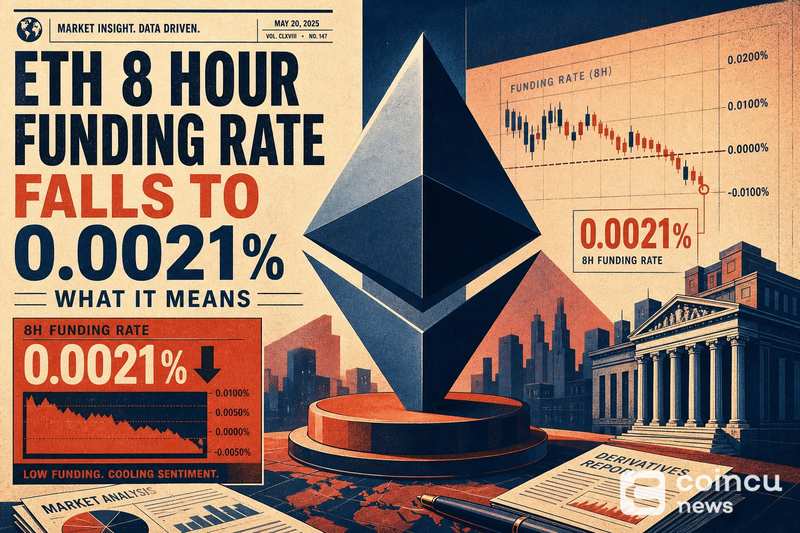
Ethereum's 8-hour average funding rate has dropped to -0.0021%, signaling a subtle shift toward bearish positioning in perpetual futures markets. While the figure is modest, it reflects a derivatives landscape where short-side pressure is currently outweighing long demand.
What a -0.0021% 8-Hour Funding Rate Means
Funding rates are periodic payments exchanged between long and short traders on perpetual futures contracts. Most major exchanges settle these payments every eight hours, making the 8-hour window the standard unit for tracking sentiment shifts in real time.
When the funding rate turns negative, as Coinglass data now shows for ETH at -0.0021%, it means short-position holders are receiving payments from longs. The market is pricing in more demand for downside exposure. This is a derivatives-specific signal and does not directly reflect spot market activity.
Why Does a Negative Funding Rate Matter?
A negative reading indicates that traders in perpetual markets are, on aggregate, positioned with a bearish lean. Speculative demand to short ETH currently exceeds demand to go long, at least across the exchanges contributing to the average.
Perpetual futures often carry higher volume than spot markets, meaning they can lead or amplify directional moves. Even a mildly negative rate can reflect a meaningful mood shift among leveraged participants.
Why Funding Turned Negative for ETH
Without confirmed catalyst data tied to a specific event, several plausible drivers could explain the shift. Bearish sentiment following a period of price uncertainty is the most straightforward explanation, as traders open short positions to express directional conviction or hedge existing spot holdings.
Risk-off positioning in the broader crypto derivatives market can also push funding negative. When traders reduce long exposure or actively add shorts, the supply-demand imbalance in perpetual contracts shifts the funding rate downward.
Hedging activity from institutional participants or market makers is another common driver. Large spot holders sometimes open short perpetual positions to lock in gains or reduce portfolio risk, which can tilt funding negative without necessarily reflecting broader retail sentiment.
How Leverage Imbalance Affects Funding
Perpetual futures use the funding mechanism to keep contract prices tethered to spot. When too many traders lean short, the exchange adjusts incentives to attract the opposite side, reducing the cost of holding shorts relative to longs.
A sustained leverage imbalance, where shorts consistently outweigh longs, can create a feedback loop. Cheaper short positioning encourages more shorts, pushing funding further negative until a price move or liquidation event rebalances the market.
What This Signal Could Mean for ETH Traders
The -0.0021% reading sits in mildly negative territory. It is not extreme enough to suggest panic selling or a heavily crowded short trade, but it does confirm that the derivatives market's near-term bias leans bearish.
Two scenarios follow from this positioning. In a bearish continuation, the negative funding reflects genuine conviction that ETH prices will decline, and spot selling eventually confirms the derivatives signal. Previous episodes where ETH funding flipped negative have sometimes preceded further downside.
In a contrarian rebound scenario, the mild short bias creates fuel for a squeeze. If spot prices rise unexpectedly, short holders face mounting losses and may be forced to close positions, accelerating the move upward. The relatively modest size of the current negative reading, however, suggests squeeze risk is limited compared to periods with deeply negative funding.
What Traders Should Watch Next
A single funding rate snapshot is a starting point, not a verdict. Open interest trends are the most immediate complement; rising open interest alongside negative funding confirms that new short positions are being added, while declining open interest suggests existing longs are simply closing.
Spot price reaction matters as well. If ETH's spot price stabilizes or rises despite negative funding, it could signal that the short positioning is contrarian rather than prescient. Volatility metrics, including implied volatility on ETH options, can reveal whether the market expects a resolution to the current positioning imbalance.
Putting the Funding Data in Context
Funding rates are most informative when read as part of a broader derivatives picture. Exchange-level dispersion matters; if funding is deeply negative on one exchange but flat or positive on others, the average may mask a localized phenomenon rather than reflecting market-wide sentiment. The growth of new exchange product categories has also increased the number of venues where funding signals can diverge.
The direction of the funding trend also outweighs any single reading. A rate that has been declining steadily over several 8-hour periods carries more weight than a one-off dip into negative territory. Without historical comparison data in the current dataset, it is unclear whether the -0.0021% figure represents a new trend or a transient fluctuation.
Broader developments, such as evolving regulatory frameworks for crypto asset trading or ongoing law enforcement scrutiny of crypto activity, can also influence derivatives positioning as traders reassess risk across the market.
The Limits of One Data Point
A single 8-hour average funding rate does not predict price direction on its own. Industry research on perpetual futures consistently shows that funding rates are a sentiment indicator, not a trade trigger. They describe current positioning, not future outcomes.
Traders and analysts who incorporate funding data into their frameworks typically combine it with basis spreads, liquidation heatmaps, and on-chain flow data. Any one of these metrics in isolation offers an incomplete view.
FAQ About ETH Funding Rates
What Is a Funding Rate in Crypto?
A funding rate is a periodic payment between long and short traders on perpetual futures contracts. It keeps the perpetual contract price aligned with the underlying spot price. Most exchanges calculate and settle funding every eight hours.
Is a Negative Funding Rate Bullish or Bearish?
A negative funding rate is generally considered a bearish signal because it reflects greater short-side demand. However, deeply negative readings can sometimes precede short squeezes, making them a contrarian bullish indicator in extreme cases. The interpretation depends on magnitude and context.
Is -0.0021% an Extreme or Mild Reading?
A funding rate of -0.0021% per 8-hour period is relatively mild. Extreme negative readings during sharp selloffs can reach -0.05% to -0.1% or more per period. The current figure suggests a modest bearish lean rather than aggressive short positioning or market panic.
Disclaimer: This article is for informational purposes only and does not constitute financial or investment advice. Cryptocurrency and digital asset markets carry significant risk. Always do your own research before making decisions.
The post ETH 8-Hour Funding Rate Falls to -0.0021%: What It Means was initially published on Coincu.