Ethereum faces a potential liquidation cascade if its price drops below $1,594, with data suggesting that roughly $587 million in leveraged long positions across major centralized exchanges c
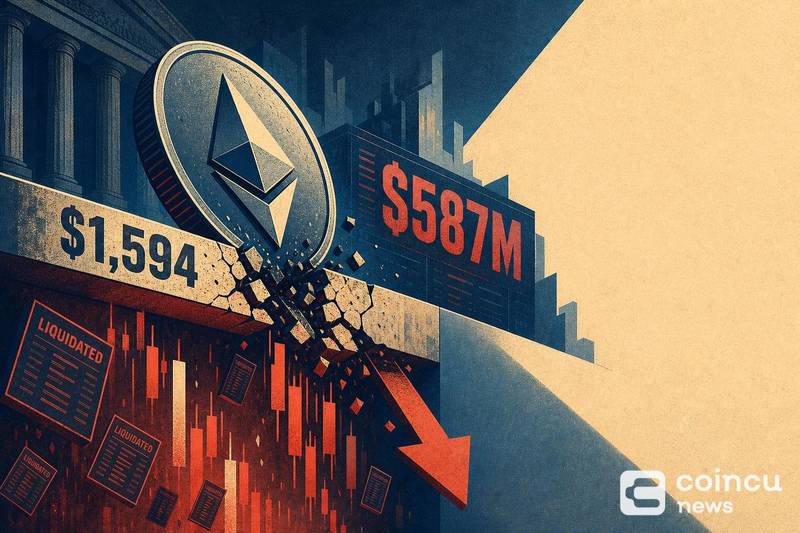
Ethereum faces a potential liquidation cascade if its price drops below $1,594, with data suggesting that roughly $587 million in leveraged long positions across major centralized exchanges could be forcibly closed at that threshold.
The figure highlights a concentrated cluster of long liquidation levels sitting just below current ETH trading ranges. A break beneath $1,594 would trigger automatic position closures on centralized exchanges, converting passive leverage risk into active selling pressure.
Why the $1,594 ETH Level Concentrates Liquidation Risk
A long liquidation occurs when an exchange forcibly closes a leveraged buy position because the trader's margin can no longer cover losses. Exchanges execute these closures automatically once the price hits a predefined threshold, selling the underlying asset into the open market.
The $1,594 level matters because it represents a price point where a large volume of leveraged long positions would simultaneously reach their liquidation triggers. When many positions share a similar liquidation price, the forced selling from one round of closures can push the price lower, triggering the next round.
How Liquidation Zones Are Identified Around Key Support
Liquidation zones emerge when derivatives data aggregators map the price levels at which open leveraged positions would face margin calls. These clusters become visible through exchange-level data on Ethereum's derivatives markets, where the concentration of stop-loss and liquidation triggers can be tracked in near real time.
This differs from routine spot selling. Spot holders choose when to sell. Leveraged traders on centralized exchanges have no choice once their margin is exhausted, as the exchange's risk engine closes the position automatically.
Why CEX Leverage Matters More Than Spot-Only Positioning
CEX leverage amplifies this dynamic because centralized exchanges process liquidations faster than decentralized venues. The speed of forced closures on platforms like Binance, OKX, and Bybit can compress what might be a gradual decline into a sharp drop within minutes.
How $587 Million in Forced Selling Could Amplify ETH Volatility
The $587 million figure represents the estimated notional value of long positions that would face liquidation if ETH trades below the $1,594 threshold. In practical terms, that volume of forced selling would land on exchange order books simultaneously, overwhelming buy-side liquidity at those levels.
Why Liquidation-Driven Selling Can Move Faster Than Organic Selling
A trader deciding to exit a position might spread sales over hours or days. An exchange liquidation engine dumps the entire position at market price in seconds, often creating a wick, a sharp price spike visible on charts, that overshoots what fundamentals alone would justify.
This cascading mechanism is well-documented in crypto derivatives markets. A first wave of liquidations pushes the price lower, which triggers a second wave at the next liquidation cluster, compounding downward pressure. The result can be a temporary dislocation between the leveraged derivatives price and the spot market.
The cascade risk does not mean the full $587 million would materialize as net selling. Some positions may be partially hedged, and traders actively monitoring their margins may close positions voluntarily before liquidation. Still, the concentration of exposure at a single level creates a fragile setup.
What This Liquidation Setup Signals for ETH Market Sentiment
Crowded Longs Versus Healthy Bullish Positioning
A large liquidation pocket below the current price typically signals crowded bullish positioning. Traders have collectively placed leveraged bets that ETH will rise, and their stop-losses and liquidation levels have clustered in the same zone.
This crowding is distinct from healthy bullish positioning. In a well-distributed market, liquidation levels are spread across a wide range. When they concentrate at a single price, it suggests that many traders entered positions at similar times and with similar leverage ratios, a sign of herd behavior rather than diverse conviction.
Short-term leverage dynamics, however, do not automatically translate into a structural bearish signal for Ethereum. Liquidation cascades tend to reset positioning rather than reverse long-term trends. After a flush, open interest drops, leverage ratios normalize, and the market often stabilizes at a new equilibrium.
What a Hold Above $1,594 Would Imply
If ETH holds above $1,594, the implication shifts. A defense of the level would suggest that spot demand is sufficient to absorb any selling pressure, potentially forcing short sellers to cover and reducing the liquidation overhang without a cascade. The broader Ethereum ecosystem, including developments in cross-chain payment infrastructure and layer-2 scaling, continues to evolve independently of derivatives market stress.
ETH Price Scenarios to Watch Around the Liquidation Threshold
Bearish Case if ETH Falls Below $1,594
A sustained move below $1,594 unlocks the liquidation cluster. Forced selling accelerates the decline, potentially pushing ETH to the next support zone. Volume spikes and elevated funding rate volatility would confirm that liquidations are driving the move rather than organic selling.
Traders monitoring ETH spot market data alongside derivatives metrics would look for a divergence between spot volume and futures liquidation volume as a signal of cascade activity. This type of volatility event has historically created short-term dislocations, as seen during previous periods when ETH steadied near comparable price levels before making decisive moves.
Recovery Case if Buyers Hold the Level
In the recovery scenario, buyers step in at or above $1,594, absorbing sell pressure and invalidating the liquidation trigger. This outcome would likely see open interest decline gradually as overleveraged traders voluntarily reduce exposure, a healthier deleveraging process than a forced cascade.
Stabilization around this zone could set up a more sustainable base for the next directional move, particularly as market participants assess positioning across the broader crypto ecosystem. The development of institutional crypto infrastructure continues to provide a backdrop of structural demand that can absorb short-term derivatives-driven volatility.
In either scenario, the key indicators to watch are open interest changes on major CEXs, funding rates for ETH perpetual contracts, and the ratio of long-to-short liquidations over rolling four-hour windows. Current Ethereum ecosystem metrics, including total value locked across DeFi protocols, provide additional context for gauging whether spot-level demand can counterbalance derivatives pressure.
FAQ About ETH Long Liquidations on Major Exchanges
What is a long liquidation?
A long liquidation occurs when an exchange automatically closes a leveraged buy position because the asset's price has fallen enough to exhaust the trader's margin collateral. The exchange sells the position at market price to prevent the trader's losses from exceeding their deposited funds.
Why does the $1,594 level matter for ETH?
This specific price level is where a large concentration of leveraged long positions would hit their liquidation triggers simultaneously. The clustering of liquidation levels at one price creates a risk of cascading forced sales that could temporarily amplify downward price movement beyond what organic selling would produce.
Does $587 million in liquidation exposure guarantee a crash?
No. The figure represents the total value of positions at risk, not a guaranteed sell order. Several factors could prevent a full cascade: traders may close positions before the threshold is reached, spot buyers may absorb the selling pressure, or the price may never reach the trigger level.
Can liquidation cascades reverse quickly?
Yes. Liquidation-driven drops often produce sharp V-shaped recoveries because the selling is mechanical rather than conviction-based. Once forced selling exhausts the liquidation cluster, buy-side liquidity can snap the price back, particularly if the underlying spot demand for ETH remains intact.
Are spot investors affected the same way as leveraged traders?
Spot holders are not subject to forced liquidation. They experience temporary unrealized losses during a cascade but retain full control over when to sell. The liquidation risk is specific to traders using leverage on centralized exchanges, where the exchange's margin system can force a sale regardless of the trader's intent.
Disclaimer: This article is for informational purposes only and does not constitute financial or investment advice. Cryptocurrency and digital asset markets carry significant risk. Always do your own research before making decisions.
The post ETH Below $1,594 May Trigger $587M in Long Liquidations was initially published on Coincu.