Ethereum Layer 2 Network Base Mainnet Upgrade, Beryl: What Changed? Base shaved two full days off its withdrawal wait — and that's not even the biggest change landing on June 25. If you hold
Ethereum Layer 2 Network Base Mainnet Upgrade, Beryl: What Changed?
Base shaved two full days off its withdrawal wait — and that's not even the biggest change landing on June 25. If you hold assets on Base or build with stablecoins on the network, this upgrade touches your gas costs, your exit times, and how your tokens actually function under the hood.
Here's what most reports aren't telling you about the new token rule baked directly into Base's code — and why a September follow-up could shake things up again.
What Just Happened With the Base Mainnet Upgrade
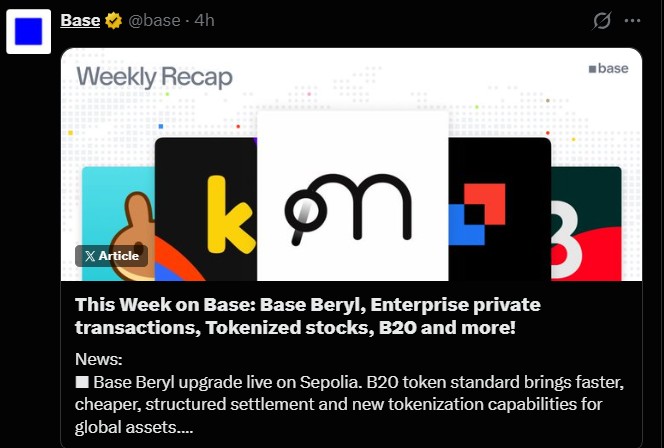
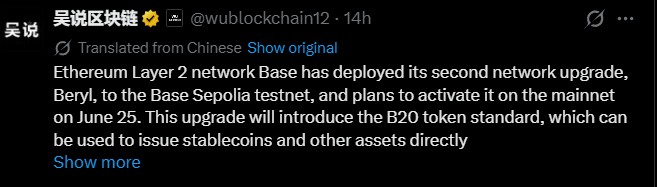
Coinbase-incubated Layer 2 network Base pushed its second major release, codenamed Beryl, onto its Sepolia testnet this week. Mainnet activation for the Base mainnet upgrade is locked in for June 25, according to the team's engineering blog.
Beryl is the follow-up to Azul, Base's first fully independent upgrade from May, which marked the chain's break from sharing infrastructure with Optimism's OP Stack. That shift, made back in February, is part of why it is now shipping major upgrades roughly every four weeks instead of waiting months.
Source: Official X
Why This Matters for Traders and Builders?
Two changes inside Beryl stand out for anyone actively using Base. The first rewrites how tokens like stablecoins get created on the network. The second shortens how long it takes to move funds back to the Ethereum network— a detail that matters every time you bridge out during volatile market hours.
A Token Standard Built Into the Chain Itself
Most tokens, including standard ERC-20s, run as smart contracts sitting on top of a blockchain. Base's new B20 standard works differently. It's coded in Rust and runs as a precompile inside the node software itself, rather than as separate onchain bytecode.
B20 still mirrors the full ERC-20 spec and adds ERC-2612 permits, so existing wallets, exchanges, and indexers should treat it as a drop-in replacement without extra integration work. Issuers also get a built-in toolkit for role-based controls, mint and burn limits, supply caps, transfer restrictions, and a freeze-and-seize function aimed at regulated stablecoin issuers and tokenized real-world assets.
Two versions launch alongside Beryl: a general-purpose asset token and a stablecoin-specific variant with fixed six-decimal precision. Base says the underlying code has been audited internally and by Spearbit, with a future update planned to let issuers cover gas fees in their own B20 tokens instead of ETH.
Source: Wu Blockchain X
Faster Exits to Ethereum
The standard withdrawal window from Base to Ethereum drops from seven days to five with Beryl. That seven-day figure dates back to Base's original fault-proof design, which built in a long delay so challengers could dispute a withdrawal before it finalized.
Azul Multiproofs system already opened a same-day withdrawal path when a trusted execution environment and a zero-knowledge proof both confirm a transaction — but that route sees limited use because generating the ZK proof is expensive. Beryl instead targets the slower, far more commonly used single-proof path that most bridges rely on, narrowing its purpose to catching a faulty prover rather than waiting out a full dispute window.
What to Watch Next?
Beryl also rolls out Reth V2, an updated version of the Rust-based execution client Base has run exclusively since Azul. The update trims disk usage across full, minimal, and archive nodes and gives room to raise block gas targets without straining sequencer or RPC infrastructure — translating into more available blockspace for developers building on the network.
Looking further out, it has already named its next release: Cobalt, targeted for September. That upgrade is expected to bring native account abstraction, turning smart accounts into a protocol-level feature complete with gas sponsorship and transaction batching, alongside additional B20 functionality and a unified node binary merging consensus and execution.
Conclusion
This June 25 mainnet activation of Beryl marks its second independent upgrade in roughly a month, pairing a chain-native token standard with a meaningfully shorter withdrawal window. With Cobalt already lined up for September, Base upgrade cadence suggests this won't be the last structural change builders and traders need to track this year.
Disclaimer: This article is for informational purposes only and does not constitute financial, investment, or trading advice. Cryptocurrency markets are highly volatile and carry significant risk. CoinGabbar does not endorse any specific token, platform, or investment strategy mentioned in this article. Readers should conduct their own research (DYOR) and consult a qualified financial advisor before making any investment decisions.