The Ethereum Foundation has doubled the size of its protocol security team as it races to harden the network against two converging threats: AI-accelerated vulnerability discovery and the lon
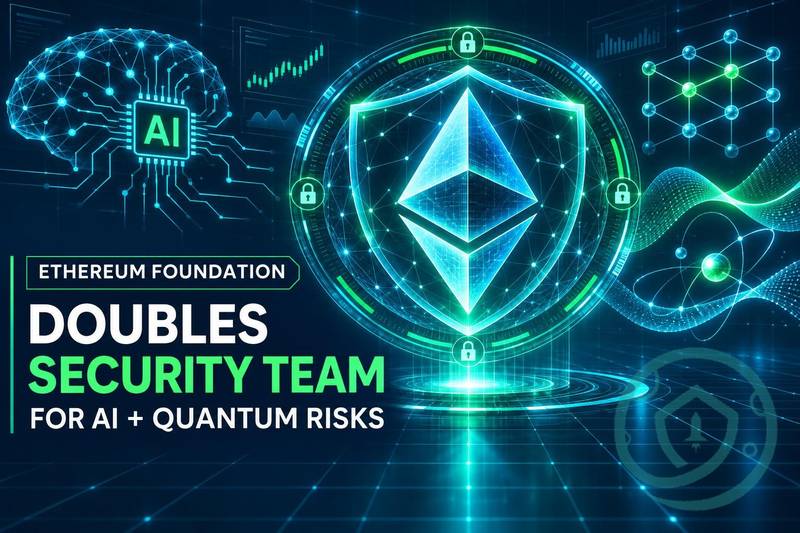
The Ethereum Foundation has doubled the size of its protocol security team as it races to harden the network against two converging threats: AI-accelerated vulnerability discovery and the long-term cryptographic risk posed by quantum computing. The initiative, called PQAI, targets a December 2028 completion date and touches every layer of the Ethereum protocol stack, from validator signing to wallet authorization to rollup data commitments.
EF researcher Kev Wedderburn published the first public framing of the initiative on November 23, 2026, in a blog post titled "PQAI #0: Preparing Ethereum for a post-quantum, post-AI world." The post set an unusually blunt tone: Wedderburn wrote that the upgrade is "harder than the Merge, and we have less time," adding that "moving fast makes it easier to ship bugs, so formal verification and security work will have to keep up with the pace of protocol development." For related coverage, see Lighter (LIT) Rises 4.15% in 24 Hours: What the Data Shows.
That urgency is partly driven by what AI tooling is already doing to the security landscape. The EF blog post characterized AI models as finding bugs faster than humans can review them, citing thousands of discovered vulnerabilities in the Linux kernel as a reference point. According to the EF blog post, the EF's Protocol Security Team has been deploying AI agents to audit protocol code directly, and those agents surfaced a critical denial-of-service vulnerability in the gossipsub layer of libp2p, a core peer-to-peer networking library used by Ethereum clients. Context on this theme: Bessent's Nvidia Deadline: AI x Crypto US Session Roundup.
The dual nature of AI as both threat-surface accelerant and security tool is central to why the EF chose to restructure its security capacity rather than simply add headcount. According to Crypto Briefing's coverage, the foundation reduced its overall headcount by approximately 20% while simultaneously doubling the protocol security team, a reallocation of resources rather than a pure hiring expansion. The move establishes a dedicated post-quantum team that was first stood up in January 2026.
Three Protocol Layers Under Reconstruction
The PQAI overhaul touches three distinct technical surfaces. At the consensus layer, validators currently sign messages using BLS signatures backed by elliptic-curve cryptography. The EF's plan replaces those with hash-based signing keys, requiring a reworking of all BLS tooling across client implementations. EF researcher Justin Drake set the December 2028 target for completing this transition, one year earlier than the foundation's previous planning horizon, according to CoinTelegraph reporting.
At the user account layer, wallets that use elliptic-curve key pairs, the overwhelming majority of Ethereum addresses today, will need to migrate to post-quantum alternatives. Pre-quantum smart contracts, including deployed account abstraction implementations, will also require updates. Crypto Briefing reported that approximately 15,000 smart contracts are potentially at risk from the interaction of the PQAI changes with the upcoming Glamsterdam upgrade, though that figure appears only in secondary coverage and should be treated as an unconfirmed report.
At the data layer, blobs used to verify rollup data will switch from elliptic-curve-backed KZG commitments to hash-based commitments. This directly affects every Layer 2 network that posts data to Ethereum's data availability layer, meaning the upgrade ripples outward to the broader rollup ecosystem rather than staying contained to the base protocol.
Hash-based cryptography was chosen after more than a year of evaluating candidate signature schemes, according to the EF blog post. The choice reflects a deliberate tradeoff: hash-based signatures are considered quantum-resistant under current theoretical models, but they produce larger signature payloads than elliptic-curve alternatives. Larger validator signatures create additional bandwidth and storage pressure on home validator hardware, a concern that intersects directly with Ethereum's decentralization goals, since increasing node hardware requirements tends to push validation toward larger operators.
AI-Assisted Auditing Accelerates the Timeline
The first post-quantum consensus-layer test network, or devnet, has already started, according to the EF blog post, signaling that the cryptographic migration is past the design phase and into active implementation testing. Vitalik Buterin has separately stated in his updated protocol roadmap that quantum safety has "shifted up a LOT in priority," aligning the PQAI timeline with broader EF leadership direction.
Formal verification, the mathematical proving of protocol correctness rather than testing alone, is now a stated requirement for keeping pace with the development speed. The doubling of the protocol security team is intended specifically to maintain formal verification coverage as the codebase changes faster than it has since The Merge. Wedderburn's post framed this directly: "Every layer of the protocol and ecosystem will need to adapt to the reality that hardening the protocol is now our highest priority."
The convergence of AI-driven audit tooling with quantum-resistant cryptography work represents a material shift in how blockchain security infrastructure is staffed and scoped. For context on how AI-assisted vulnerability discovery is reshaping security tooling more broadly across the crypto stack, the site's coverage of MCP vulnerability analysis for prompt injection examines related threat surfaces at the AI-protocol interface. Meanwhile, the broader trend of AI agents operating on-chain is developing in parallel, as covered in the recent NEAR AI Cloud's addition of hosted models to its agent infrastructure stack.
ETH traded at $1,704.92 as of the time of writing on November 24, 2026, down 0.24% over 24 hours and 5.98% over seven days, according to CoinGecko. The broader market Fear and Greed Index sat at 11, in Extreme Fear territory, per Alternative.me. The EF's PQAI announcement arrives against that backdrop, with an Ethereum market cap of approximately $208.4 billion providing context for the scale of the cryptographic infrastructure being upgraded.
The December 2028 target is aggressive relative to the scope of work. For the Ethereum ecosystem, the practical question after the devnet phase is how client teams, wallet developers, Layer 2 operators, and smart contract authors coordinate migration without fragmenting the network, a coordination challenge that in some respects exceeds what The Merge required. Whether the doubled security team and AI-assisted auditing are sufficient to hold that timeline will depend on how quickly formal verification tooling can keep pace with hash-based signature integration across a multi-client architecture. The AI and crypto compute developments tracked in recent session roundups suggest the tooling environment is evolving fast enough to make the timeline plausible, if not guaranteed.
"This upgrade is harder than the Merge, and we have less time. Moving fast makes it easier to ship bugs, so formal verification and security work will have to keep up with the pace of protocol development."
Kev Wedderburn, Ethereum Foundation, PQAI #0 blog post, November 23, 2026
Editorial credits
DM
Diego Martinez
Writer · AiCryptoCore
EP
Elena Petrova
Editor · AiCryptoCore
Monitors published articles around the clock and can correct or withdraw them.
Checked by AiCryptoCore QC Team before publishing on November 24, 2026 for headline accuracy, factual consistency, commercial disclosure and authorship claims: our AI review system checks every article before it goes live, and our editor monitors it after publication.
AiCryptoCore uses AI for research, drafting and review. Our editorial team is responsible for every article and corrects or withdraws articles when needed. How we review.
Disclaimer: This article is for informational purposes only and does not constitute financial or investment advice. Cryptocurrency and digital asset markets carry significant risk. Always do your own research before making decisions.
Read original article on aicryptocore.com