Ethereum News Today: $1.23M ETH Transfer Raises Bitget Hack Alert Ethereum news today brings two major storylines to the crypto community's attention. On-chain investigators flagged a wallet
Ethereum News Today: $1.23M ETH Transfer Raises Bitget Hack Alert
Ethereum news today brings two major storylines to the crypto community's attention. On-chain investigators flagged a wallet suspected of ties to the Bitget hack after it moved 457.9 ETH worth roughly $1.23 million toward the attacker's known address.
Meanwhile, Ethereum co-founder Vitalik Buterin shared a string of updates covering faster node synchronization, a new Solidity compiler, and his growing preference for command-line tools over browser-based apps.
At a Glance
A wallet starting with 0x4885 sent approximately 457.9 tokens to an address linked to the Bitget hack 2026.
The funds reportedly trace back to about 2.607 million stolen TIA tokens converted through an OTC service.
Vitalik Buterin says Ethereum nodes can now sync in half a day using under 0.5 TB of disk space.
A new Solidity compiler called oksolc claims to speed up contract builds by more than 5 times.
Vitalik is testing local-node workflows and plans deeper privacy integration into kohaku-cli.
Ethereum Wallet Sends 457.9 ETH to Address Linked to Bitget Hack
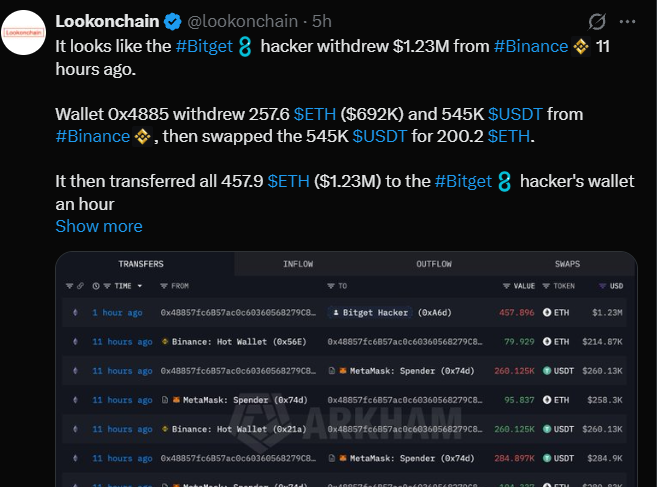
According to monitoring firm Lookonchain, a wallet beginning with 0x4885 withdrew 257.6 ETH (about $692,000) along with 545,000 USDT from Binance roughly 11 hours before the report. The wallet then swapped its USDT holdings for approximately 200.2 ETH. About an hour before Lookonchain's post, the wallet sent a combined total of 457.9 ETH, valued near $1.23 million, to an address Lookonchain has previously tied to the Bitget hacker.
It's worth stressing that Lookonchain describes this as a suspected connection based on transaction patterns, not a confirmed identification. On-chain investigator SomaXBT added further context, noting that the Bitget attackers appear to have used an over-the-counter or instant exchange service connected to Binance to convert roughly 2.6 million stolen TIA tokens, originally taken from the Celestia chain, into Ethereum-based assets. SomaXBT emphasized that the funds did not actually originate from Binance itself, but simply passed through a service that relies on it.
Source: Lookonchain Post
How the $1.23M ETH Transfer Happened
Step
Asset
Amount
Approx. Value
Action
1
ETH
257.6 coins
$692K
Withdrawn from Binance
2
USDT
545K USDT
$545K
Withdrawn from Binance
3
ETH
200.2 coins
~$538K
USDT swapped for ETH
4
ETH
457.9 coins
~$1.23M
Sent to suspected Bitget hacker wallet
Timeline: From TIA Conversion to the Bitget Hacker Wallet
Earlier: Roughly 2.607 million TIA tokens were reportedly converted through an OTC or instant exchange service.
About 11 hours before the report: Wallet 0x4885 withdrew 257.6 tokens and 545,000 USDT from Binance.
Shortly after: The 545,000 USDT was swapped for approximately 200.2 tokens.
About 1 hour before the report: Roughly 457.9 tokens were transferred to the suspected Bitget hacker address.
September 26: Lookonchain publicly linked the wallet's activity to the Bitget hack based on this transaction trail.
Vitalik Buterin Highlights Faster Ethereum Node Synchronization
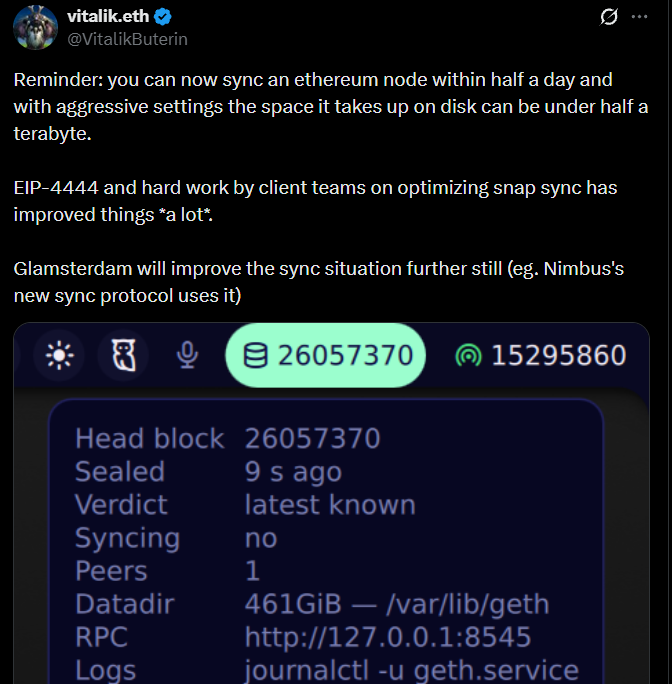
On the development side, Vitalik Buterin noted that Ethereum nodes can now sync within half a day, with disk usage falling below 0.5 TB when aggressive settings are used. He credited this improvement to EIP-4444 and ongoing work by client teams to optimize snapshot syncing. Buterin also pointed to the upcoming Glamsterdam upgrade, saying it will push sync performance even further, citing Nimbus's new sync protocol as one example already built around it.
Source: Vitalik X Post
New Solidity Compiler Oksolc Targets Faster Contract Builds
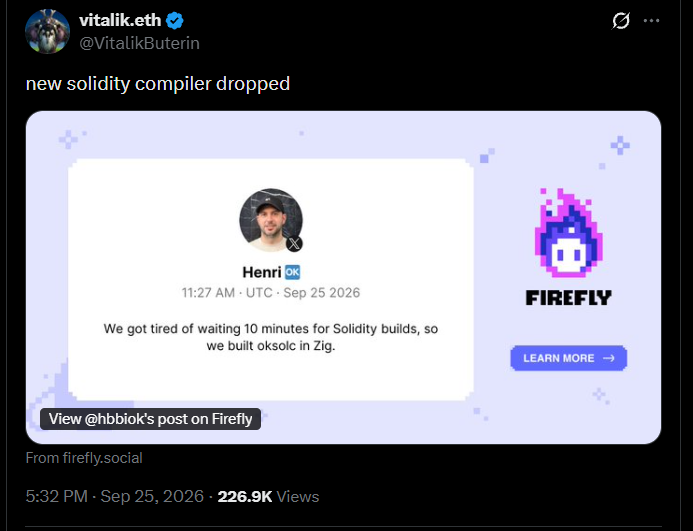
Buterin also reposted a newly released Solidity compiler called oksolc. Developer Henri, who shared details on the project, said the compiler is written in Zig and can speed up compilation for some contracts by more than five times while keeping bytecode consistent with existing outputs.
In testing, full build times reportedly dropped from around 10 minutes to just 2 minutes, while incremental builds after large code changes fell from about 700 seconds to 99 seconds. The project's code is available as open source on GitHub.
Vitalik Pushes Local Nodes, Command-Line Tools and Privacy Development
Beyond tooling, Buterin shared thoughts on browser-based decentralized apps, noting that many either handle local nodes poorly or hardcode their RPC connections to centralized servers. As a result, he said he's leaning more toward command-line operations for his own Ethereum activity. He described successfully updating an ENS record using a local Python script connected to his own node. Looking ahead, Buterin said his next focus is integrating privacy protocols more fully into kohaku-cli, mentioning that early development work is already underway.
Source: Vitalik X
Conclusion
Today's Ethereum price reflects two very different but equally important sides of the ecosystem. On one hand, investigators continue tracking suspicious wallet activity potentially connected to the Bitget hack, with roughly $1.23 million in ETH changing hands under scrutiny.
On the other, core development continues to move forward, with faster node syncing, improved compiler tooling, and a push toward more private, self-sovereign infrastructure. As always, the wallet connection to the Bitget hacker remains a working theory based on on-chain analysis rather than a confirmed fact.
Disclaimer: This article is for informational purposes only and does not constitute financial or investment advice. Cryptocurrency markets and blockchain-related security incidents can change rapidly. Wallet attribution mentioned here is based on publicly available on-chain analysis and has not been independently verified. Readers should conduct their own research before making any financial decisions.