Ethereum News Today: ETH Low Fee Debate Grows Over Robinhood Revenue The network currently captures just 0.15% of gross revenue from one of its own network deployments, while its co-founder i
Ethereum News Today: ETH Low Fee Debate Grows Over Robinhood Revenue
The network currently captures just 0.15% of gross revenue from one of its own network deployments, while its co-founder is telling everyone to keep fees low anyway.
If you hold coins or trade its layer-2 ecosystem, this single number could reshape how you think about the asset's long-term value.
Is Joseph Lubin describing a genuine growth engine, or is this a low-fee gamble that leaves network undercompensated for years to come? Here's what most reports aren't telling you.
What Lubin Just Said About Ethereum Fees
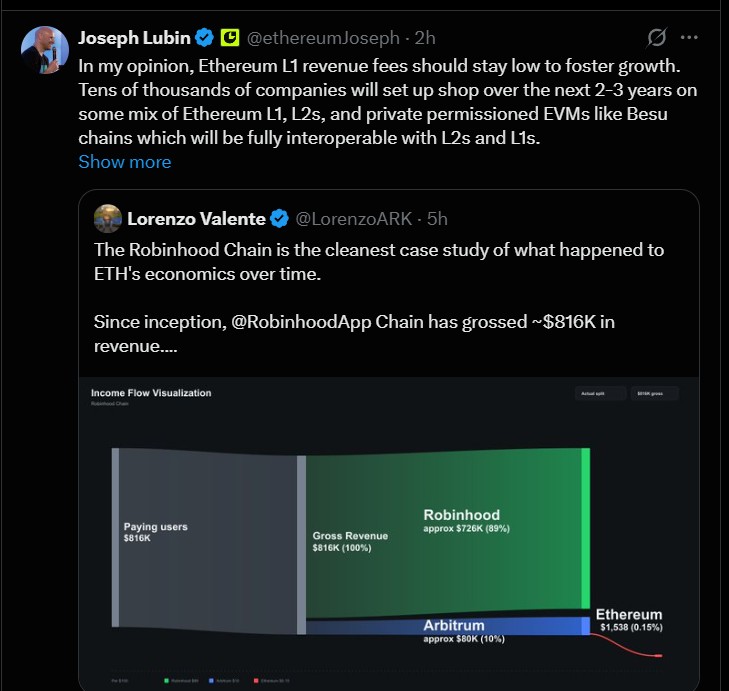
Ethereum co-founder Joseph Lubin has weighed in on one of the network's most debated questions: should layer-1 (L1) fees stay low or rise as adoption grows? As of July 14, 2026, Lubin argued that L1 fees should remain low, specifically to accelerate ecosystem growth in the crypto market
His reasoning centers on scale. Lubin expects tens of thousands of companies to deploy across Ethereum L1, L2 rollups, and permissioned EVM chains such as Besu over the next two to three years, all connected through cross-layer interoperability.
Source: Joseph X
Why This Matters for Investors
For traders watching Ethereum News, Lubin's comments aren't just theory — they're a direct response to a live controversy about how little revenue Ethereum L1 earns from the very ecosystem it secures.
The trigger was a breakdown of Robinhood Chain's economics that crypto commentator Lorenzo Valente posted. Since launch, Robinhood Chain has generated close to $816,000 in gross revenue. Of that, Robinhood keeps roughly 89%, its middleware provider Arbitrum network takes about 10%, and Ethereum L1 — the settlement layer underneath both — receives only 0.15%, or roughly $1,538.
Valente argued this split is bullish for the "ETH is money" thesis, since more activity means more ETH used as collateral. But for anyone betting on ETH as a revenue-generating asset, he called it close to worst-case, suggesting a healthier split might look closer to 75% for Robinhood, 10% for Arbitrum, and 15% for Ethereum.
Key Details Traders Are Tracking
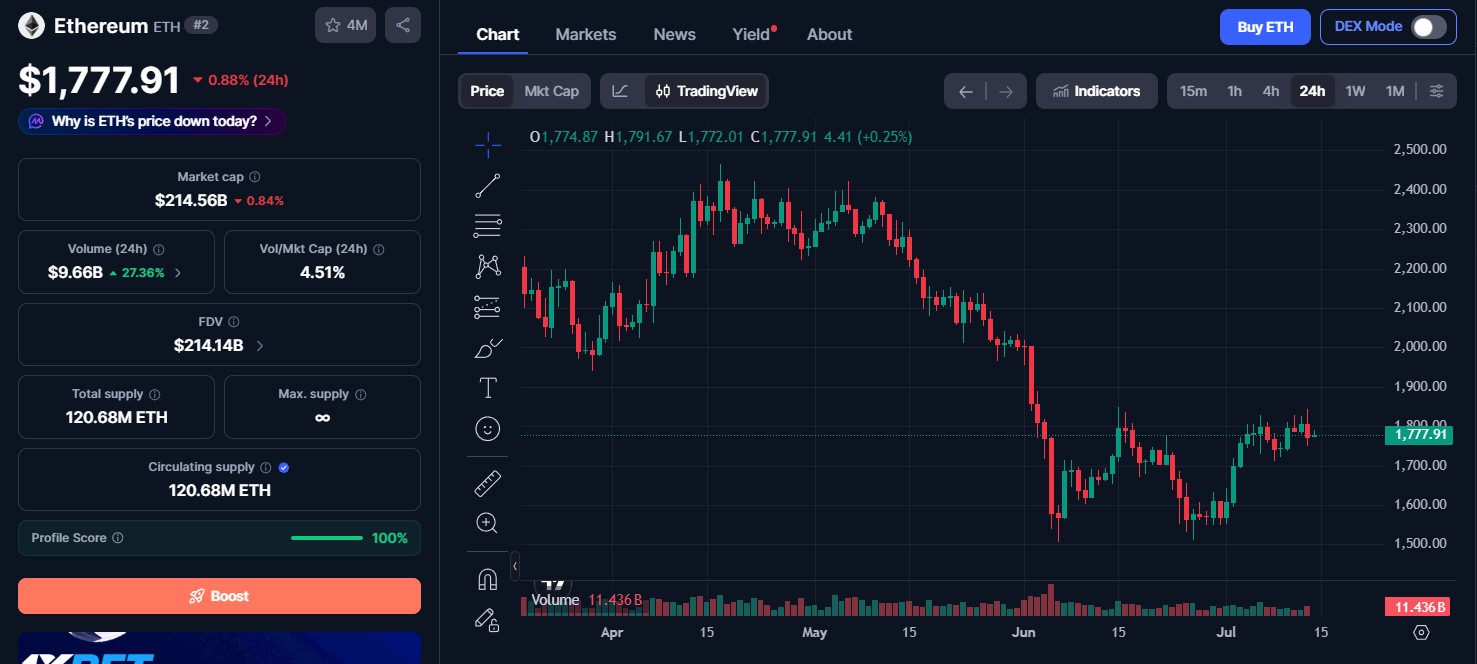
ETH price is currently trading around $1,777.91, down 0.88% over 24 hours
Market capitalization stands at $214.56 billion
24-hour trading volume sits at roughly $9.66 billion
ETH is testing resistance close to the $1,800 level
Robinhood Chain revenue split: Robinhood 89% / Arbitrum 10% / Ethereum 0.15%
Lubin's counterargument is that scale changes the equation entirely. As adoption expands, he expects ETH's monetary premium to rise, staking and other lockup mechanisms to shrink circulating supply, and total L1 fee revenue to grow even at low per-transaction rates. If burning outpaces issuance again, Lubin believes ETH could return to a net-deflationary state, adding further upward pressure on price.
Source: CoinMarketCap Data
What to Watch Next
Not everyone is convinced. Replies to the original post, including from Valente himself, questioned whether tens of thousands of "Robinhood-scale" companies actually exist to build, given Robinhood itself is valued near $50 billion and comparable firms are rare.
Traders should watch three things in the coming months: whether more consumer-facing companies announce Ethereum-based chains, whether staking participation continues reducing circulating ETH supply, and whether ETH burn rate flips positive again as network activity increases.
Conclusion
Joseph Lubin is betting that low fees today buy Ethereum a much larger, interconnected ecosystem tomorrow — even if that means settlement revenue stays thin in the short term. Whether that trade-off pays off for holders depends on how many companies actually follow Robinhood's lead, and how quickly staking and burns tighten supply. The next few quarters of L2 deployment activity will likely tell traders which side of this debate is winning.
Disclaimer: This article is for informational purposes only and does not constitute financial, investment, or trading advice. Cryptocurrency markets are highly volatile and carry significant risk. Readers should conduct their own research and consult a licensed financial advisor before making any investment decisions. CoinGabbar is not responsible for any losses incurred based on the information provided in this article.