Ethereum's Glamsterdam upgrade has been live on the Sepolia test network since Tuesday afternoon. The fork started at 13:53:36 UTC, exactly at the time the developers had announced three week
Ethereum's Glamsterdam upgrade has been live on the Sepolia test network since Tuesday afternoon. The fork started at 13:53:36 UTC, exactly at the time the developers had announced three weeks earlier. Anyone holding Ethereum gets a rare opportunity from this: the network that is also meant to carry the mainnet in a few weeks or months is running out in the open right now and can be measured.
That is precisely what we did, and the result departs from the headline. One number stood at the centre of the reports of recent days: a gas limit of 200 million, more than three times the previous 60 million. On Sepolia the gas limit stood at 64,238,034 on Tuesday afternoon, a good hour after the fork. That is no contradiction of the announcement, but it is not the same thing either, and the difference explains why a mainnet date is still missing.
Glamsterdam on Sepolia: the fork ran at 13:53:36 UTC in block 11,856,337
The Ethereum Foundation had set the fork on September 17 for epoch 353,024 and slot 11,296,768, which converts to October 6, 2026 at 13:53:36 UTC. That slot has indeed become the first block of the new rules; on the execution layer it carries the number 11,856,337.
You can recognise this by two fields that did not appear in the block header before. One is called blockAccessListHash and belongs to the Block-Level Access Lists, the other is a declared slotNumber. The first block with these fields carries exactly slot number 11,296,768 from the announcement. A fork is therefore not merely asserted but readable on the chain.
A block header is the header record of a block: a short list of key figures that every node checks before it accepts the block. When a field is added there, all the programs involved have adopted the same new rule. That is exactly what test networks are for.
This analysis was carried out by cryptoticker.io itself on October 6, 2026. It is based on the block headers of the public Sepolia test network; 24 blocks between 13:29 and 14:49 were counted, along with the blocks immediately around the fork.
The Sepolia gas limit: 60 million before the fork, 64.2 million an hour later
Before the fork the gas limit on Sepolia sat at a round figure for hours: 60,000,000, identical block after block. That is the normal case when the validator operators have all set the same value.
With the fork the number starts to move. Five minutes afterwards it stood at 60,647,496, after forty minutes at 62,568,310, after barely an hour at 64,238,034. Across 218 blocks a good four million gas was added, on average around 18,600 per block.
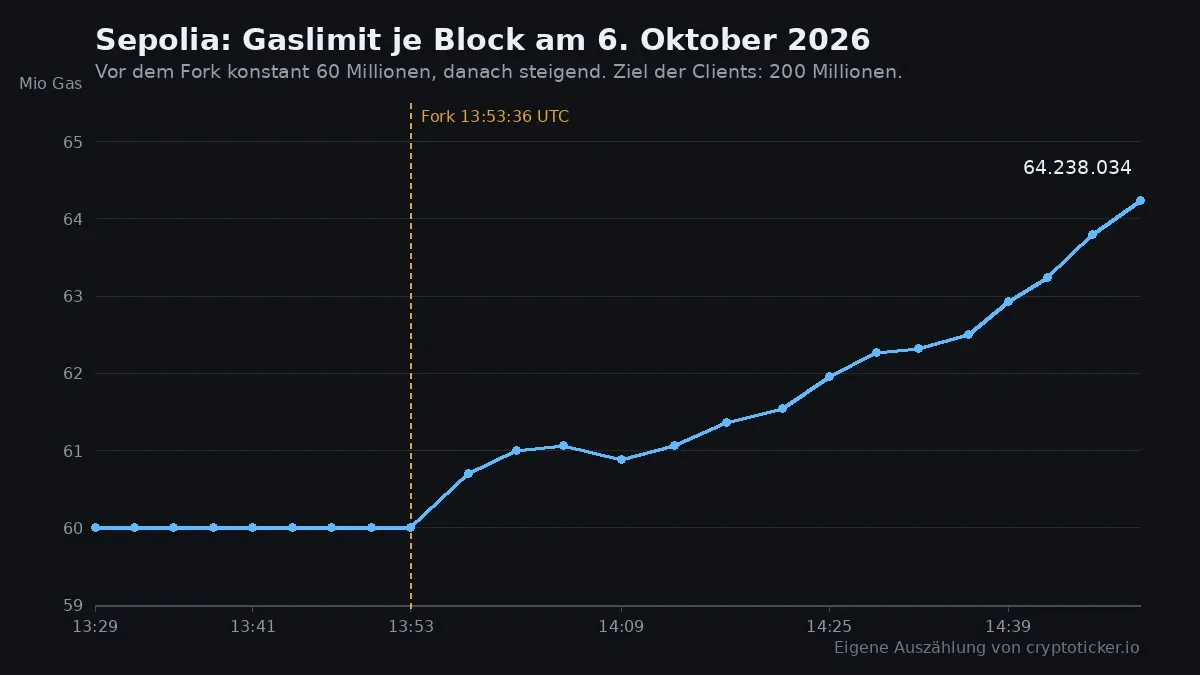
Before the fork the gas limit sat constant at 60 million; afterwards it climbs block by block.
Two things stand out in this. First, the number does not run evenly but in steps, occasionally even a little backwards. Second, several of the counted blocks were brim full: one used 60,611,247 of 60,647,496 gas, a later one 63,827,010 of 63,925,416. Those are fill levels above 99 percent. On a test network that is not chance but intent. Anyone wanting to test a higher limit has to load it up as well.
One 1,024th per block: how the gas limit climbs towards 200 million
The gas limit is not a number somebody sets with a switch. Each block proposal may change the limit of the preceding block by at most one 1,024th, upwards as well as downwards. At 64 million that is around 62,500 gas per block, so with a twelve-second block time roughly half a million per minute as a theoretical ceiling.
The measured 18,600 per block lie well below that, because not every proposer has set the new target value yet. Extrapolated to the 136 million gas that were still missing on Tuesday afternoon up to the 200 million mark, that works out at roughly one day. With more validators switched over it can go faster, with fewer it takes longer, and the value can also come to a halt along the way.
Important for context: the figure of 200 million appears in the Ethereum Foundation's announcement as a configuration recommendation for the validator programs Prysm and Teku, not as a value written into the upgrade specification. So the number describes what is to be tried out on the test network, and not what will apply on the mainnet. The details are in the Ethereum Foundation's test network announcement.
EIP-7928 and EIP-7732: Block-Level Access Lists and ePBS are in the header
Glamsterdam implements two large changes. EIP-7928 introduces Block-Level Access Lists: a block states in advance which accounts and storage slots it touches. This lets nodes execute transactions in parallel instead of strictly one after another. That is the precondition for a markedly higher gas limit, because without parallel processing a block three times the size would simply overwhelm the machines.
EIP-7732 is called Enshrined Proposer-Builder Separation, ePBS for short. Until now block building and block proposing run through external relays, that is, through intermediaries that are not part of the protocol. With ePBS this division of labour moves into the protocol itself. For investors that is above all a point of reliability: the less a network depends on voluntary intermediaries, the lower the risk that an outage there slows block production.
On top of that come adjustments to gas prices that make accesses to network storage more expensive and some computing steps cheaper. This redistribution is the reason why a higher limit does not automatically mean transfers three times cheaper.
Sepolia against mainnet: what a test network fork tells Ether holders
Sepolia is a test network. The Ether moved there has no value, the validators are run by a manageable circle, and a mistake costs nobody money. For exactly that reason Tuesday's fork does not serve as evidence that the mainnet is ready.
What it does prove is something else, and well worth having: the programs of the various developer teams have agreed on the same new rules and are producing blocks together. When a test network fork fails, the roadmap almost always slips by weeks. When it goes through, the next stage is due.
That next stage is the Hoodi test network, and only after it comes the mainnet. For both there is no date so far. Anyone who read in recent weeks that the upgrade was coming in October has confused a test network activation with the main network.

A block three times the size demands more of every node that has to verify it.
For you as a holder that means you have to do nothing. There is no exchange of coins, no new coin, no deadline. Anyone with Ether sitting on an exchange or in their own wallet normally notices nothing of a fork. It becomes relevant for everyone running a node or a validator themselves, and for the cost side in everyday use.
Ethereum price at $2,712 and €2,410: the level that decides October
On Tuesday afternoon Ether was quoted at around $2,712 and thus €2,410, a gain of 0.25 percent within 24 hours. Over the week there is a loss of 0.75 percent, over the month a gain of 8.6 percent. Market capitalisation stands at around $331 billion.
The daily band was tight: $2,680.92 as the low, $2,721.34 as the high. Those two values are the nearest levels below and above. Beyond them lies the round zone around $2,800, at which Ether failed several times in September. From the all-time high of $4,946.05 on August 24, 2025, the price is a good 45 percent away.
An upgrade on a test network does not move the price in itself, and Tuesday's price reaction was correspondingly small. The technical roadmap only becomes interesting for the price once a mainnet date is fixed. We described the situation on that in our assessment of the Glamsterdam mainnet date of September 30; it holds unchanged in substance.
If you still want to build up Ether, the calculation depends less on the upgrade than on the fees of your buying route. Under MiCA only a licensed provider may broker or hold crypto assets in Germany; the crypto exchange comparison shows which platforms hold that licence and what trading and withdrawal cost there.
Mainnet in the fourth quarter: a roadmap without a confirmed date
The official roadmap still names the fourth quarter of 2026 for Glamsterdam on the mainnet and says expressly that the date is not confirmed. For Hoodi and the mainnet the announcement says the activation times will be made known as soon as the developer teams have decided them.
From that follows a plain rule of thumb for your own schedule. Between test network fork and mainnet there were usually several weeks in past Ethereum upgrades, because after Sepolia a second test network is due and an observation phase follows after that. A date in October would be unusually fast; a date in November or December fits the pattern. Anyone tying a buying decision to the upgrade should therefore count in weeks and not in days.
The staking queue: 1.46 million ETH entering, a 25-day wait
Alongside the technical roadmap runs a development that is more concrete for your planning than any fork. The staking queues are long on both sides. In the entry queue there were recently around 1.46 million Ether with a waiting time of about 25 days, in the exit queue 786,275 Ether with a good 13 days and 16 hours. In total around 43.7 million Ether are staked, so about 35.8 percent of the circulating supply, at an estimated yield of 2.63 percent a year. Coindesk compiled the figures on October 5 from ValidatorQueue data.

The staking queues are the deadline that appears in no calendar.
The practical consequence is a deadline that appears in no calendar: anyone who wants to stake today only commits their Ether in a good three weeks, and anyone who wants to exit waits around two weeks for release. Both happen independently of the price. If the market falls in that time, you cannot react at once.
A long exit queue is not an automatic sell signal in this. Part of the Ether being freed up goes straight back into staking, for instance when providers rebuild their infrastructure. For now the number shows only one thing: how long the way out currently takes.
Holding period, threshold, staking rewards: what the tax office in Germany requires
For German investors there is a second calculation attached to staking. Gains from selling crypto assets are tax free after a holding period of one year; that is governed by section 23 of the Income Tax Act. If you sell earlier, a threshold of €1,000 per calendar year applies to all private disposal transactions together. Threshold means: at €999 of gain everything stays tax free; at €1,000 the entire gain becomes taxable, not just the part above the line.
The rewards from staking itself fall into a different drawer. In the view of the Federal Ministry of Finance they regularly count, when held privately, as income from services under section 22 no. 3 of the Income Tax Act, with a threshold of their own of €256 a year. They are valued at the moment of receipt, that is at the rate that applied when the reward was credited.
The important point, the one about which false claims circulate most often: staking does not extend the one-year holding period for the coins used. Ether that was already held for a year before staking remains sellable tax free afterwards. Anyone who bought several tranches at different prices does, however, need clean documentation of every inflow as proof.
Gas costs, layer 2 and hardware: what it means for your coins
A higher gas limit initially means only that more computing work fits into a block. For fees that is favourable as long as demand does not rise to the same degree: more space at the same demand pushes the base fee down. This is noticeable first and foremost with layer 2 networks, which store their data in bundled form on Ethereum and currently take up the largest part of the space.
The simultaneous redistribution of gas prices works in the other direction. Accesses to network storage become more expensive, because permanently growing storage raises the costs of every node operator. For a simple transfer of Ether little changes as a result; for complex contracts the calculation can swing either way depending on their construction.
Anyone running a node themselves should watch the progress on Sepolia. A block with 200 million gas demands more memory, more disk throughput and more bandwidth than one with 60 million. That is exactly what the step-by-step increase is for: only it shows at which value the first nodes drop out. That the validators on Sepolia are turning the number up slowly rather than jumping straight to the target is therefore not hesitation but the procedure.
Glamsterdam on Sepolia: what to take away
- Separate test network and mainnet. The fork of October 6 concerns Sepolia. For Hoodi and the mainnet there is no date; the roadmap names only the fourth quarter of 2026. If you tie a buying decision to it, count in weeks. Where you buy decides more about your return than the upgrade does: the hardware wallet comparison shows what custody in your own hands costs.
- Factor in the waiting time before you stake. Around 25 days to activation and barely 14 days to release are the normal case right now. Anyone wanting to sell in that time cannot. Which providers offer which yield and which exit routes is in the comparison of staking platforms.
- Document every inflow. For a sale the one-year period with the €1,000 threshold counts; for staking rewards, the separate €256 threshold at the rate of the day of receipt. Without complete records neither can be documented later; you will find the tools for it in the comparison of crypto tax tools.
(As of October 6, 2026. This article is not investment advice. Prices and fee structures change; check the terms with the provider before you buy.)