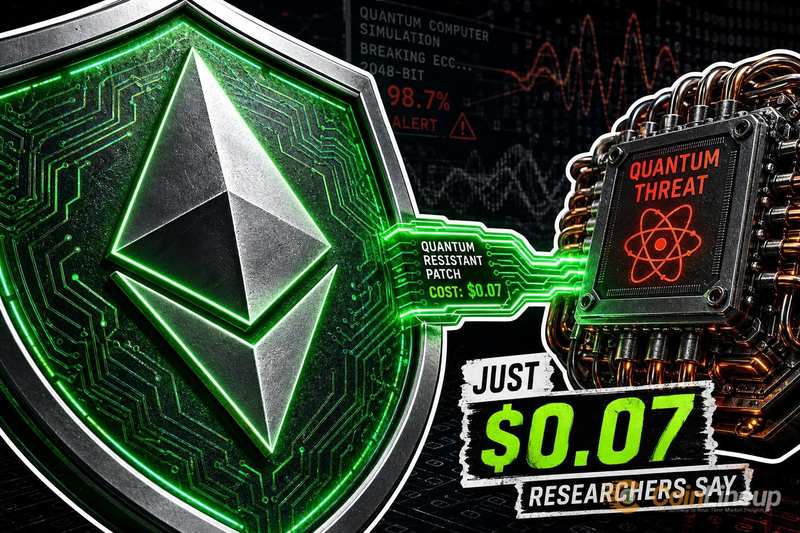
Ethereum researchers have proposed a method that could allow users to add quantum-resistant account protection for as little as $0.07 per account, without requiring a full protocol overhaul.
Ethereum researchers have proposed a method that could allow users to add quantum-resistant account protection for as little as $0.07 per account, without requiring a full protocol overhaul. The proposal, sometimes referred to as "Kohaku," focuses on account-level security upgrades rather than replacing Ethereum's entire cryptographic stack.
What Researchers Are Claiming About Ethereum Account Protection
The core claim centers on enabling individual Ethereum users to opt into quantum-resistant signature schemes at minimal cost. "Quantum-resistant" in this context means protecting account keys against future attacks from sufficiently powerful quantum computers, which could theoretically break the elliptic curve cryptography Ethereum currently uses.
The $0.07 figure represents the estimated on-chain cost for a user to activate this protection on their account. This is a research-stage proposal, not a deployed feature. The work has been discussed on Ethereum's research forum, where contributors explored SPHINCS+, a stateless post-quantum signature scheme, for efficient verification on the EVM.
KEY TAKEAWAYS
- Researchers propose quantum-resistant Ethereum account protection costing approximately $0.07 per user
- The approach targets account-level upgrades, not a full chain migration
- The proposal remains at the research stage and has not been implemented on mainnet
How a Low-Cost Quantum-Resistant Upgrade Could Work
The estimated $0.07 cost likely reflects the gas needed to register a post-quantum public key or verification proof on-chain. Because the protection is opt-in at the account level, it avoids the far more expensive prospect of migrating the entire network's signature scheme simultaneously.
The distinction matters: this approach would protect new transactions going forward for accounts that activate it. It does not retroactively shield accounts whose public keys have already been exposed through prior transactions. Accounts that have never sent a transaction, and thus never revealed their public key, face less immediate risk.
For wallet providers, supporting such an upgrade would require implementing new signature generation and verification logic. The Kohaku proposal outlines how this could work within Ethereum's existing account abstraction capabilities, keeping the user-facing cost low while maintaining compatibility with current infrastructure.
Why This Matters for Ethereum Users and the Wider Crypto Sector
Quantum risk remains a long-term concern across the crypto sector. While no quantum computer currently poses a practical threat to elliptic curve cryptography, the "harvest now, decrypt later" risk, where adversaries collect encrypted data today for future decryption, motivates early preparation.
Ethereum's growing role in structured credit and financial products makes base-layer security assumptions especially important. Institutional participants building on the network need confidence that cryptographic foundations will hold over multi-decade time horizons.
Affordability alone does not guarantee adoption. Wallet providers, dApp developers, and infrastructure operators would all need to support the new signature scheme. Users would need clear guidance on migration steps, and the broader Ethereum governance process would need to approve any EIP enabling such changes.
The proposal also arrives as the Ethereum ecosystem navigates other challenges, from regulatory shifts under MiCA in the EU to scaling debates. Meanwhile, recent volatility in crypto ETF flows underscores how quickly market sentiment can shift, reinforcing the case for long-term infrastructure hardening over short-term market focus.
NIST's ongoing post-quantum cryptography standardization efforts provide the broader cryptographic foundation that proposals like Kohaku build upon. Whether Ethereum moves forward with this specific approach will depend on continued research validation and community consensus.
Disclaimer: This article is for informational purposes only and does not constitute financial or investment advice. Cryptocurrency and digital asset markets carry significant risk. Always do your own research before making decisions.
Read original article on coinlineup.com