Key Takeaways Ethereum is designing around future constraints before they become emergencies. Scaling is becoming more specialized rather than uniformly general-purpose. EVM compatibility may
Key Takeaways
- Ethereum is designing around future constraints before they become emergencies.
- Scaling is becoming more specialized rather than uniformly general-purpose.
- EVM compatibility may survive without the EVM defining the base architecture.
- Cryptographic complexity is raising the importance of machine-assisted verification.
- Old protocol assumptions are increasingly open to replacement.
Vitalik Buterin compared his 2023 roadmap with the current Ethereum Strawmap, highlighting projects that moved up or down in priority, ideas that were replaced, and entire research areas that barely existed when the earlier plan was drawn.
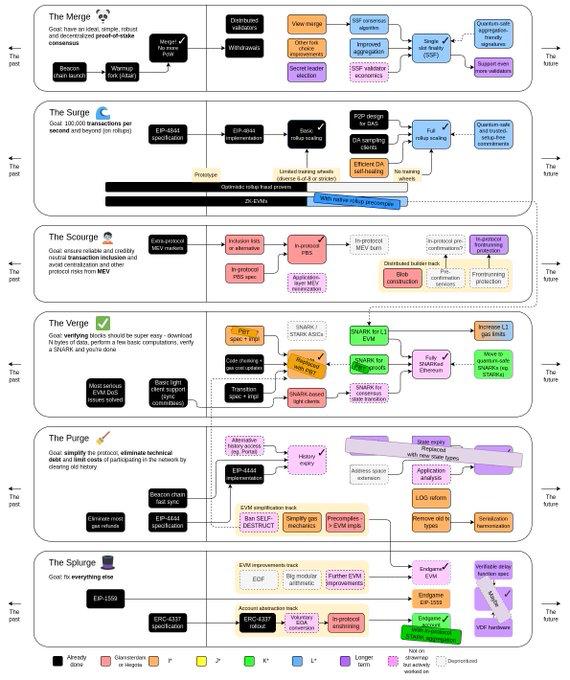 Vitalik Buterin’s 2023 Ethereum roadmap organized development around six major tracks: The Merge, Surge, Scourge, Verge, Purge and Splurge.
The deeper shift is architectural. Quantum resistance, privacy and formal verification increasingly influence how Ethereum wants to scale, while parts of the protocol once treated as relatively fixed, including the role of the EVM itself, have entered the design discussion.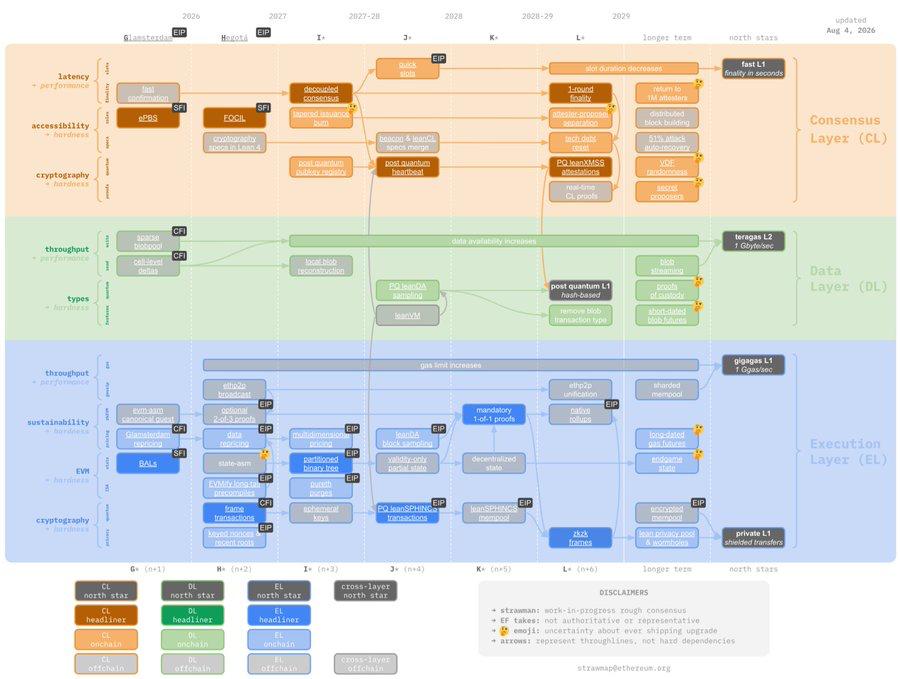 The current Ethereum Strawmap reorganizes development across the consensus, data and execution layers, with stronger emphasis on cryptography, privacy, scalability and protocol simplification.
Quantum Safety Is Becoming a Design Constraint
Quantum resistance has been discussed around Ethereum for years. Its position in the roadmap is what has changed.
Buterin says quantum safety has moved higher in priority. That creates a practical problem alongside the security one: post-quantum signatures can be considerably heavier than the cryptography Ethereum relies on today.
The network therefore cannot treat quantum resistance as a simple signature swap years from now. Any replacement also has to work within Ethereum’s scaling ambitions.
EIP-8288 shows how those two problems are beginning to overlap. The proposal introduces a framework in which expensive cryptographic dependencies, including post-quantum signatures, could be aggregated through recursive STARK proofs instead of forcing every transaction to absorb their full verification cost independently.
This matters long before quantum computers become capable of attacking Ethereum.
Changing fundamental cryptography after such a threat appears would require coordinating wallets, accounts, validators and protocol infrastructure under pressure. Designing around that constraint earlier gives researchers room to tackle the performance cost at the same time.
Ethereum’s future-proofing work already identifies several cryptographic components that will eventually require quantum-resistant alternatives.
Scaling Everything Equally Is Losing Its Appeal
Another change in Buterin’s update may have broader consequences for everyday Ethereum activity.
New state types and zkzk frames share an increasingly important idea: Ethereum does not necessarily need to maximize the scalability of every possible computation in exactly the same way.
Some workloads dominate real usage. Token transfers and swaps already generate enormous demand, while privacy applications could become another heavy category later.
If those activities can operate under more restrictive rules, Ethereum can potentially build specialized mechanisms that handle them much more efficiently without forcing every application into the same optimization strategy.
Buterin’s description of new state types makes this shift especially clear. He presents them as more than a replacement for the older state-expiry approach, describing a different way of thinking about scaling itself.
Specialized paths can produce much larger performance gains for common activities. They can also leave client teams maintaining more distinct mechanisms if too many special cases accumulate.
Ethereum’s push toward a “Lean” protocol therefore has to coexist with this specialization. As workloads receive more tailored treatment, pressure also grows to simplify the general-purpose machinery beneath them.
The EVM Is No Longer an Untouchable Assumption
That pressure is reaching Ethereum’s execution architecture as well.
Ethereum is not planning to remove the EVM. But its permanent role at the deepest level of the protocol is no longer being treated as inevitable.
Post-quantum zkzk frames could require Ethereum to expose an instruction set outside the EVM. Buterin names leanISA and RISC-V among the leading candidates because they are simpler and more modern architectures.
Once such an instruction set exists inside Ethereum, restricting it to one narrow protocol function becomes harder to justify.
Developers could eventually gain more direct access to it. Further out, Buterin raises the possibility that the EVM could operate as an intermediate representation above a simpler underlying instruction set rather than remain deeply enshrined in the base protocol.
That would separate two ideas Ethereum has historically bundled together: EVM compatibility and an EVM-defined architecture.Applications could theoretically retain the environment and tooling they depend on while the machinery underneath becomes simpler.
This remains highly speculative. Buterin explicitly says the deeper exploration is too early even for the current Strawmap.
For a network whose enormous application ecosystem was built around the EVM, opening its deepest protocol role to redesign shows how far the current simplification effort may eventually reach.
READ MORE:
 Ethereum’s Biggest Hidden Threat: The 33% Threshold
Rollup Technology Is Moving Back Into the Base Layer
The roadmap also shows how quickly zero-knowledge technology has matured.
Native rollups did not appear in the 2023 diagram because, according to Buterin, SNARK technology was not mature enough at the time to make them realistic. The newer roadmap places proof systems much deeper into Ethereum’s architecture.
Ethereum’s scaling strategy still relies heavily on Layer 2 rollups. Some of the cryptographic machinery developed around that ecosystem, however, is now becoming useful to Ethereum itself.
Recursive proofs can compress expensive computation, support privacy and help accommodate cryptographic systems that would otherwise place much heavier demands on the protocol.
For years, much of Ethereum’s scaling innovation moved outward from the base layer into rollups. Research developed there is now beginning to feed capabilities back into the protocol.
Native rollups are one example. Reusable proof aggregation across different Ethereum layers could become another.
The boundary between “L1 technology” and “rollup technology” is becoming less clear.
Why AI Matters to a Leaner Ethereum
Moving more proof machinery into the protocol raises another problem: reusable cryptographic components concentrate risk as well as efficiency.
A primitive shared across the execution, consensus and data layers reduces duplication, but a flaw in that component could affect several parts of Ethereum at once. Testing alone becomes a weaker safety argument as those dependencies deepen.
Buterin points to AI-assisted formal verification as part of the answer.
Formal verification uses mathematical methods to demonstrate that software behaves according to its specification. AI does not replace those proofs; its potential value is helping researchers and engineers produce, inspect and maintain them at a scale that would previously have been impractical.
This gives “Lean Ethereum” a more concrete meaning.
The objective is not to make every cryptographic mechanism easy for a human to understand at a glance. It is to keep the core specification sufficiently constrained and explicit that critical components can be formally verified rather than relying mainly on conventional testing.
More reuse can then reduce protocol duplication without requiring developers to simply trust increasingly complicated shared machinery.
AI’s role in Ethereum may therefore be far less visible than running agents or executing transactions. It could instead help make sophisticated infrastructure safe enough to become part of the protocol itself.
Some of Ethereum’s Old Design Choices Are Back on the Table
Comparing the two diagrams exposes something individual upgrade announcements often hide: Ethereum is becoming comfortable abandoning ideas after years of research.
VDFs have fallen in priority. Verkle-based plans have evolved into different constructions. State expiry is giving way to new state types. Native rollups, stronger privacy mechanisms, post-quantum scaling and blob and gas futures occupy space that barely existed in the 2023 plan.
Ethereum has made large turns before. Its original shard-chain strategy changed dramatically as rollups became a better scaling path, something the project’s own roadmap documentation uses to illustrate how development priorities evolve.
Ethereum Roadmap Evolution: 2023 vs. Current Strawmap
Key architectural priorities that have shifted, scaled up, or been replaced.
Research Area2023 Roadmap StatusCurrent Strawmap PriorityQuantum ResistanceLow / Distant priorityMoved up significantly; active design constraintEVM FlexibilityUntouchable base foundationOpen to redesign (leanISA / RISC-V considerations)Native Rollups & SNARKsImmature technologyIntegrated deep into the base layer architectureVerifiable Security (AI)Traditional manual testingAI-assisted formal verification gaining importanceVerkle Trees / VDFsCore focus areaEvolved into alternative constructions / lower priority
The same willingness to revisit settled-looking assumptions is showing up outside the roadmap’s scaling and cryptography work. Draft EIP-8363 would burn a growing share of validator rewards as staking participation rises, challenging the economic incentives that currently support ever-higher levels of staking.
The staking proposal and the architectural roadmap address different problems, but they point in the same direction: existing protocol behavior is being treated as adjustable when researchers believe it conflicts with newer goals around decentralization, security or efficiency.
That makes the Strawmap useful even if many of its boxes eventually change again. It shows which properties Ethereum’s researchers increasingly want to preserve even when doing so means replacing mechanisms once considered part of the long-term plan.
The roadmap is becoming less a commitment to particular technologies and more a test of which technologies still deserve to remain.
The analysis compares Vitalik Buterin’s 2023 Ethereum roadmap with the current Strawmap and examines the technical proposals and Ethereum documentation linked to the areas he identified as changing priorities.
This article is for informational purposes only. Ethereum’s Strawmap contains research directions and proposed upgrades that may change substantially before implementation.
The post Ethereum’s Roadmap Is Becoming a Different Kind of Plan appeared first on Coindoo.