Ethereum staking has climbed to 34% of the total ETH supply, a milestone that arrives alongside a fresh proposal aimed at reshaping how validator rewards are issued. The two developments toge
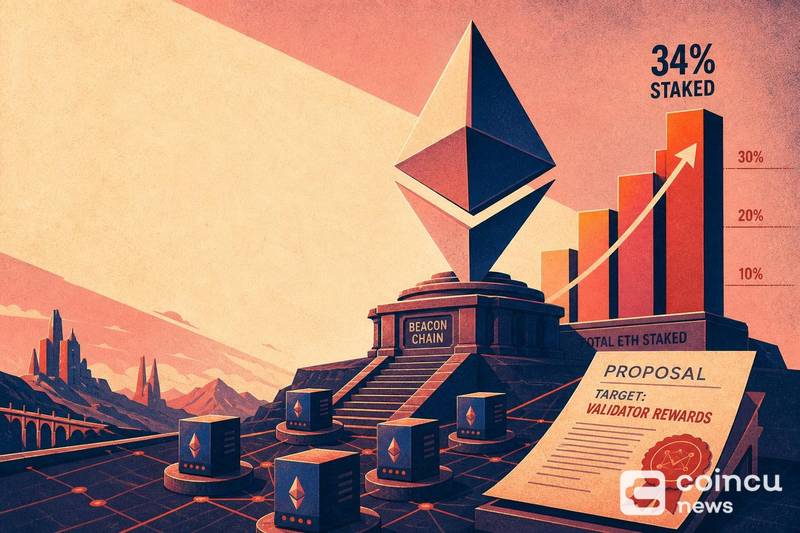
Ethereum staking has climbed to 34% of the total ETH supply, a milestone that arrives alongside a fresh proposal aimed at reshaping how validator rewards are issued. The two developments together sharpen a long-running debate over how much of the network's supply should be locked in staking.
The share of ETH committed to staking now stands at roughly 34% of total supply, equal to about 41.4 million ETH. The figure measures how much of the circulating supply validators have locked to help secure the network. For related coverage, see Fidelity Seeks Staking for Ethereum ETF to Pass Rewards to Investors.
A higher staking ratio reflects broader validator participation, which underpins the security of Ethereum's proof-of-stake consensus. It also removes a growing portion of ETH from liquid circulation, a dynamic that coverage of the 34% level has treated as notable, according to The Block. For related coverage, see What Is Ethereum Difficulty Bomb?.
What the validator rewards proposal would change
The debate over staking growth is directly tied to proposals that would alter validator economics. Ethereum researchers have floated a plan to burn validator rewards once the staking share crosses a defined threshold, effectively capping participation near 50% of supply. For related coverage, see Russia Approves Bitcoin, Ethereum and USDT Trading, Excludes XRP.
The mechanism is detailed in EIP-8363, which describes a tapered issuance and burn approach. Rather than paying out uncapped rewards as more ETH is staked, issuance would taper and a portion of rewards would be burned as the staking ratio rises.
The intent is to rebalance rather than simply raise or cut rewards. As the staking share approaches the target, the effective yield to validators would decline, discouraging further concentration of supply into staking. What remains under discussion is the exact threshold and taper curve, which are still being debated at the proposal stage.
Why capping staking matters for network health
The concern driving these proposals is that an ever-rising staking ratio could pull too much ETH out of liquid use and concentrate influence. A similar line of thinking appeared in an earlier Ethereum proposal weighing zero staking rewards at 50% ETH staked, which sought to set a soft ceiling on participation.
Validator rewards directly shape participation quality: if yields stay high indefinitely, staking can crowd out other uses of ETH across the network's DeFi economy. Tapering issuance is meant to preserve a balance between security and liquidity as staking approaches the proposed cap.
These reward questions also sit within Ethereum's wider development agenda, which includes Vitalik Buterin's roadmap priorities around long-term network design. The staking-rate debate is one of several economic levers under active review.
FAQ
What does 34% of Ethereum staking mean? It means about 34% of the total ETH supply, roughly 41.4 million ETH, is locked by validators securing the network.
Does the proposal change validator income immediately? No. EIP-8363 and the related burn proposals are still under discussion and would only alter rewards if adopted and the staking ratio crosses the defined threshold.
Why are validator rewards important to Ethereum? Rewards incentivize the participation that secures proof-of-stake consensus, but their design also influences how much ETH stays liquid versus locked in staking.
Disclaimer: This article is for informational purposes only and does not constitute financial or investment advice. Cryptocurrency and digital asset markets carry significant risk. Always do your own research before making decisions.
The post Ethereum staking reaches 34% as proposal targets validator rewards was initially published on Coincu.